
Investing in Space with ORBX: How the New Space Economy Is Evolving
Last Updated:

More than 50 years after the last Apollo mission, humans have returned to the Moon. On April 1, 2026, NASA’s Artemis II mission sent a crew into lunar orbit on a 10-day flyby, marking the first crewed mission beyond low Earth orbit since Apollo.
The mission clears a major hurdle for legacy contractors. Boeing built the Space Launch System, and Lockheed Martin built the Orion capsule. The program reflects a multibillion-dollar effort that has now moved from planning into execution, with direct involvement from listed aerospace companies. But demand is exceeding supply.
Launch capacity remains a constraint. Notably, Amazon requested a 24-month extension, pushing its Kuiper deployment deadline to July 2028. The company cited a shortage of available rockets as the reason it could not meet its original timeline of placing more than 1,600 satellites in orbit by mid-2026.
However, beyond the large prime contractors, a new group of innovative companies is emerging with the ability to design, launch, and operate systems in orbit. That layer of the market is still developing, but recent events suggest it is moving closer to scale.
That brings up two questions. Why is space moving back into focus as an area of investment? And how can investors gain exposure to it?
Part of the answer is that the tools to access the theme are starting to catch up with the narrative. Global X Canada recently launched the Global X Space Tech Index ETF (ORBX), which tracks companies involved in the commercialization of the global space economy.
It reflects how the opportunity set is broadening beyond a handful of contractors into a more layered ecosystem. Here’s my take on the space industry’s catalysts, with an ETF twist at the end for investors.
The next generation of orbital players
That backdrop is relevant for companies attempting to build independent launch capability, and Rocket Lab is one of the few publicly traded names working toward that goal.
The company delayed its Neutron rocket into 2026, but also indicated that the vehicle is expected to reach its launch site in the first quarter of 2026, with an inaugural mission to follow.
At the same time, Rocket Lab is generating revenue through defence-related work. The company secured a $190 million contract to conduct 20 hypersonic test flights over four years under the U.S. Department of War’s MACH-TB 2.0 program. That provides a source of contracted revenue while the Neutron program continues to develop.
AST SpaceMobile represents a different part of the ecosystem, focused on satellite-based connectivity. The company was awarded a prime contract position under the U.S. Missile Defence Agency’s SHIELD program. That adds a defence dimension to what had previously been positioned as a commercial telecom platform.
AST SpaceMobile also plans to deploy as many as 60 next-generation satellites in 2026. That scale of planned deployment suggests a transition from early-stage concept toward a more operational network.
These developments point to a growing group of companies operating below the traditional prime contractor layer. They are not yet at the same scale, but they are beginning to participate in launch, defence, and communications markets that were historically concentrated among incumbents.
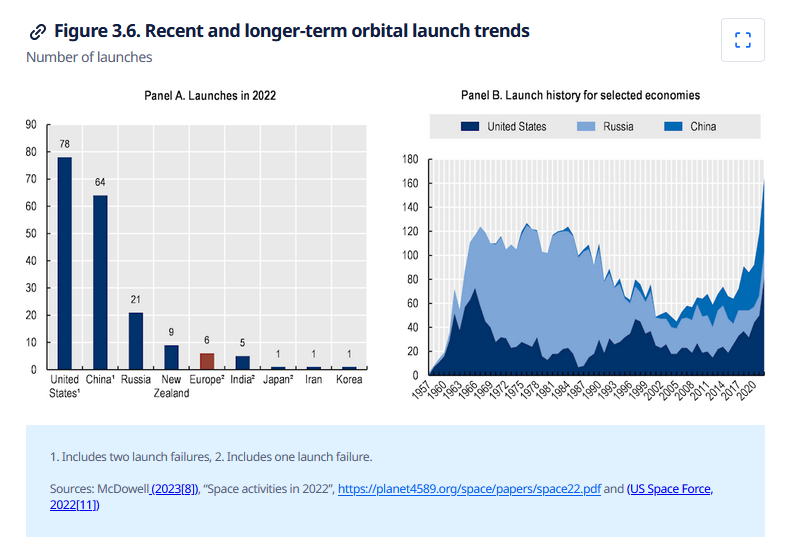
Source: OECD (2023), The Space Economy in Figures, Figure 3.6
The new breed of trillion-dollar IPOs
Attention in the space sector is increasingly centered on one company. SpaceX confidentially filed for an IPO and could be on track for a June listing, with an implied valuation that could exceed $1.75 trillion.
If it proceeds, that will place SpaceX among the largest public companies globally. Even while still private, a filing of that size begins to influence how investors think about valuation across the broader space sector. It introduces a new reference point for companies involved in the launch and satellites.
Part of that valuation discussion is tied to Starlink. SpaceX is expected to generate roughly $22 billion to $24 billion in revenue in 2026, with Starlink accounting for a significant portion. Starlink Mobile had already surpassed 10 million monthly users and was targeting 25 million by the end of the year.
Those figures point to a shift in how space businesses are being evaluated. Satellite networks are moving toward subscription-based models, with recurring revenue tied to connectivity rather than one-time contracts. That changes the revenue profile for investors who may be interested in the sector.
The potential IPO and the scale of Starlink’s user base suggest that space is being viewed less as a speculative concept and more as an operating industry with measurable revenue and growth.
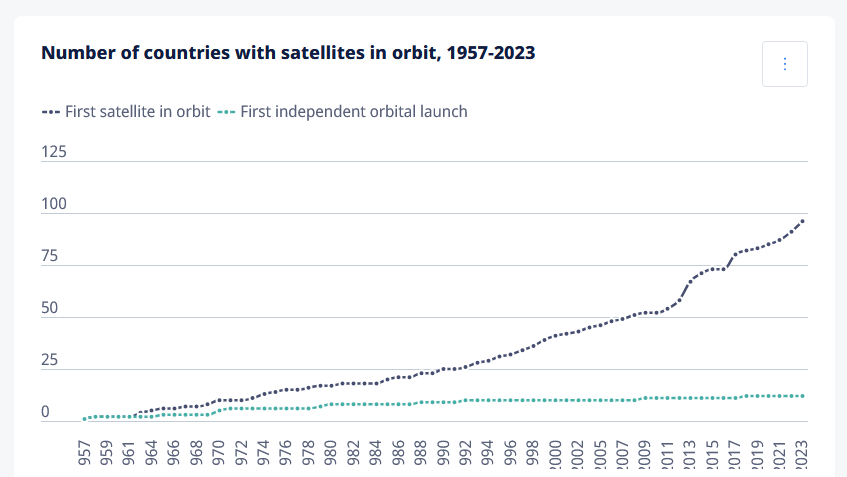
Source: OECD (2023), The Space Economy in Figures, Figure 3.1
The space story at home in Canada
There is also a Canadian angle to all of this, both visible and less visible. On the visible side, Artemis II includes a Canadian astronaut. Jeremy Hansen, selected by the Canadian Space Agency in 2009 and a former CF-18 fighter pilot, served as a mission specialist on the mission.
He is the first Canadian, and the first non-American, to travel beyond low Earth orbit (LEO) and around the Moon. That is a clear point of national pride and reflects Canada’s long-standing role in spaceflight.
At the same time, there is a quieter development happening at a larger scale. Canada is building toward sovereign launch capability as part of a broader modernization of its defence and space infrastructure. Space is increasingly being treated as part of national security, and launch access is a key component.
One recent development occurred when Canada signed a 10-year, C$200 million agreement to use a private east coast spaceport. The goal is to reduce reliance on the United States for launch services.
That has implications beyond a single project. It supports a broader domestic ecosystem that includes satellite manufacturing, launch services, payload integration, and defence communications.
Within that ecosystem, MDA Space is the most established public company. Many will recognize it for the Canadarm, first deployed on the Space Shuttle in 1981 and later used extensively on the International Space Station. The company is now involved in planning the next-generation lunar Gateway station.
There has also been activity in capital markets. In March 2026, MDA sought to raise $300 million through a U.S. listing, with a market capitalization of approximately C$5.6 billion at the time. The offering was seven times oversubscribed and that proceeds would be used for debt repayment and acquisitions.
Operationally, the company is also expanding capacity. MDA’s new Montreal facility is expected to increase production from roughly one satellite per week to as many as ten, with the company embarking on a bid to attract global talent.
Canada’s role in space is extending beyond participation in international missions. It includes domestic infrastructure buildout, capital markets activity, and an expanding industrial base tied to both commercial and defence applications.
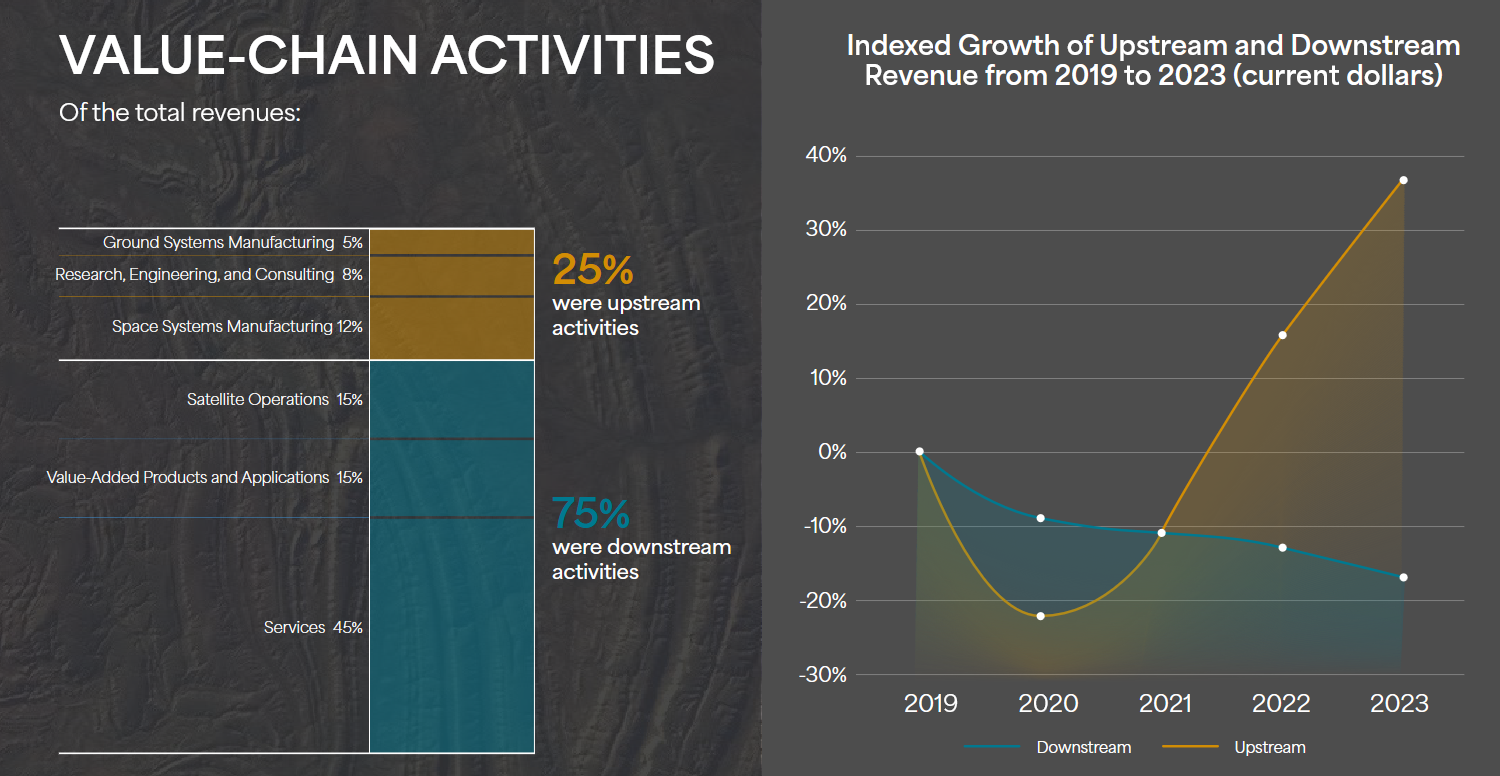
Source: Canadian Space Agency (2024), Canada’s Space Sector Industry Snapshot 2024.
Accessing the space theme through ETFs
For most investors, the question is not whether space is investable. It is how to access it without taking single-company risk in a sector that is still developing. That is where ETFs are starting to take shape.
ORBX is built to track companies involved in the growth and commercialization of the global space economy. The index is structured around four core segments:
- Space technologies and components
- Launch and orbital services
- Space exploration and tourism
- Satellite-enabled communication and data services
These categories reflect how the industry is evolving. It is not just about rockets anymore. It includes the supply chain, data layer, and downstream applications tied to satellites.
The index also defines what qualifies as a “pure play.” Specifically, new entrants must generate at least 50% of their revenue from one or more of these segments, while existing constituents must maintain at least 40%. That helps keep the portfolio focused on companies where space is central, not incidental.
Eligibility is also screened at the country level. Companies must be listed or domiciled in developed or emerging markets, but certain countries are excluded, including China, Russia, Saudi Arabia, and India. This helps reduce exposure to jurisdictions where geopolitical risks may be higher.
There are also practical filters. Companies must meet minimum thresholds for market capitalization and trading liquidity. That ensures the index remains investable and can be tracked efficiently.
Weighting is handled through a modified market capitalization approach. Individual holdings are capped at 20% to limit concentration. The combined weight of positions above 5% cannot exceed 40% of the portfolio, and remaining positions above that threshold are capped at 4.5%.
One feature that stands out is the index’s IPO fast-track inclusion. Newly listed companies can be added more quickly than in traditional benchmarks. In a sector where much of the innovation is happening in private markets (like SpaceX), that matters.
Space isn’t a vanity project
There is always a version of this argument: “Why spend money on space when there are problems on Earth?” It sounds reasonable on the surface, but it tends to ignore how much of modern life already depends on space-based infrastructure.
Technologies such as GPS, satellite communications, weather forecasting, and disaster monitoring all rely on systems in orbit. NASA’s spinoff program has documented hundreds of technologies that moved from space research into everyday use, including water purification, medical imaging improvements, and advanced materials. The Canadian Space Agency has pointed to similar spillover effects in healthcare.
That said, this is not a clean or easy investment theme. The risks are real, as execution timelines slip, project costs run over, and companies dilute shareholders to fund growth. Even now, many of the most visible names are still in heavy investment mode rather than generating consistent profits.
Personally, when I think about the space economy, it is less about rockets and more about infrastructure. The way I look at it is similar to how the internet evolved. The early focus was on access and hardware. Over time, the value shifted toward the layers built on top of it. Space is starting to follow a similar path, where launch is just one part of a broader system that includes data, connectivity, and services.
That is also why the idea of accessing this through a diversified approaches, like a single ETF stands out. Not because it removes risk, but because it acknowledges that the opportunity is not concentrated in one company or even one segment. It is spread across a developing ecosystem that is still being built out.
It is an industry that rewards execution and punishes delays. That is part of what makes it interesting to look at, but also difficult to approach through individual stocks. You can try to pick the one company that gets everything right. Some will, but some will not.
Or you can look at it as a theme that is gradually becoming more investable, even if it remains early, uneven, and dependent on execution. Either way, the framing has changed. Space has gone from a destination to becoming part of the economic system itself. Overall, the space economy continues to develop and may become more investable over time, although it remains early-stage and subject to uncertainty.