
SPDR Bridgewater All Weather ETF (ALLW) Review
Last Updated:

I have a soft spot for all-in-one ETFs. I do not really use them myself, but for investors who have no interest in monitoring markets, rebalancing portfolios, or learning the mechanics of asset allocation, they can be a genuinely useful solution.
Most all-in-one ETFs follow a familiar formula: global stocks and bonds, passive index building blocks, and a reasonable expense ratio. The SPDR Bridgewater All Weather ETF (ALLW) does not fit that mold.
Bridgewater Associates is one of the most influential hedge funds in history, and Ray Dalio is one of the most well-known global macro investors of the last several decades.
He built Bridgewater into the world’s largest hedge fund by assets, popularized ideas around economic regimes and risk parity, and laid out his framework publicly in books like Principles for Dealing with the Changing World Order and How Countries Go Broke.
Dalio’s work focuses less on beating markets in any single year and more on constructing portfolios that can survive across inflation, deflation, growth, and contraction.
What makes ALLW interesting is access. You do not need accredited investor status, a seven-figure minimum, or a traditional “2 and 20” hedge fund fee structure to invest in an institutional strategy.
Instead, you can buy a liquid ETF in a brokerage account and get exposure to a portfolio explicitly designed to function across economic regimes. The question is whether that complexity is worth the higher fee, and whether ALLW has actually delivered on its promise in its short history.
Specifically, does it behave like an all-weather portfolio you can hold through uncertainty without constantly second-guessing the allocation? So far, I think it largely has, with some important caveats. Here is my review of ALLW heading into 2026.
ALLW: What I Like
ALLW is one of the few risk parity ETFs available, and in my view, the most thoughtfully constructed. Risk parity starts from a different premise than traditional portfolio construction. Instead of allocating capital based on expected returns, assets are sized based on how much risk they contribute to the portfolio.
To put that into context, consider a traditional 60/40 stock and bond portfolio. While it sounds balanced, the risk profile is anything but. Equities typically account for more than 90% of the portfolio’s volatility, with bonds contributing the remaining 10% or so.
If you wanted to equalize risk using only stocks and bonds, the portfolio would look more like 20% equities and 80% bonds. That structure can deliver strong risk-adjusted returns, but total returns tend to be muted because bonds are not strong growth engines.
Risk parity addresses that by expanding the opportunity set. Additional uncorrelated assets, such as commodities are introduced, and modest leverage is applied at the portfolio level.
The goal is to scale an already efficient risk profile up to a more attractive return target without concentrating risk in any single asset class. That is exactly what ALLW is designed to do.
As of December 31, 2025, the portfolio illustrates this framework clearly. Nominal government bonds make up 73.1% of the allocation. Equities account for 43.6%, commodities represent 34%, and inflation-linked bonds make up 36.5%.
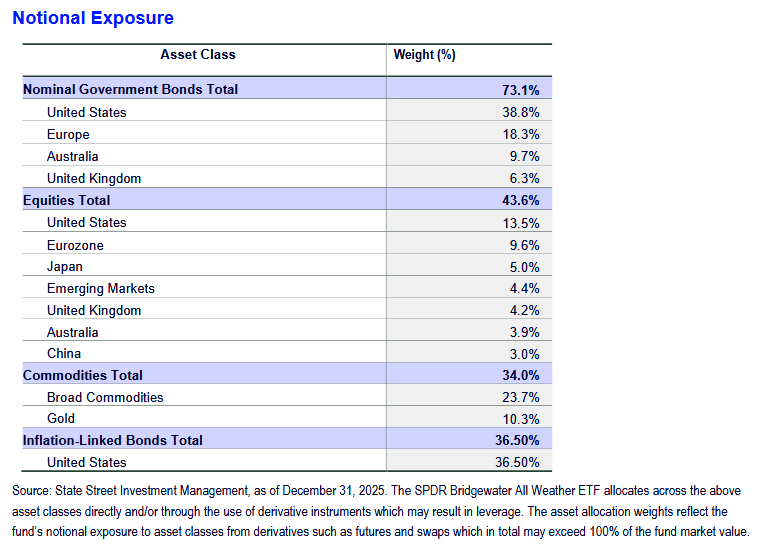
These allocations add up to well over 100%, which reflects the use of leverage. That leverage is implemented primarily through futures and swaps.
The choice of these four asset classes is deliberate. The All Weather framework is designed to hold up across what Dalio describes as the major economic environments: periods of rising growth, falling growth, rising inflation, and falling inflation.
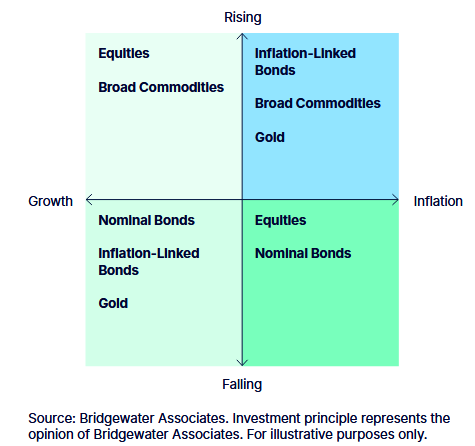
These conditions can occur independently or in combination. Different assets tend to perform well in different regimes, and the aim is to build a portfolio where no single economic outcome dominates overall performance.
In practice, Bridgewater develops the macroeconomic model and asset allocation framework, which is then implemented by State Street’s investment team through portfolio construction and rebalancing. The result is a systematic strategy rather than discretionary macro trading.
Despite its short track record, early results have been encouraging. From March 6, 2025 through January 30, 2026, ALLW delivered a higher risk-adjusted return (Sharpe ratio) than both a global 60/40 portfolio and a global all-equity portfolio.
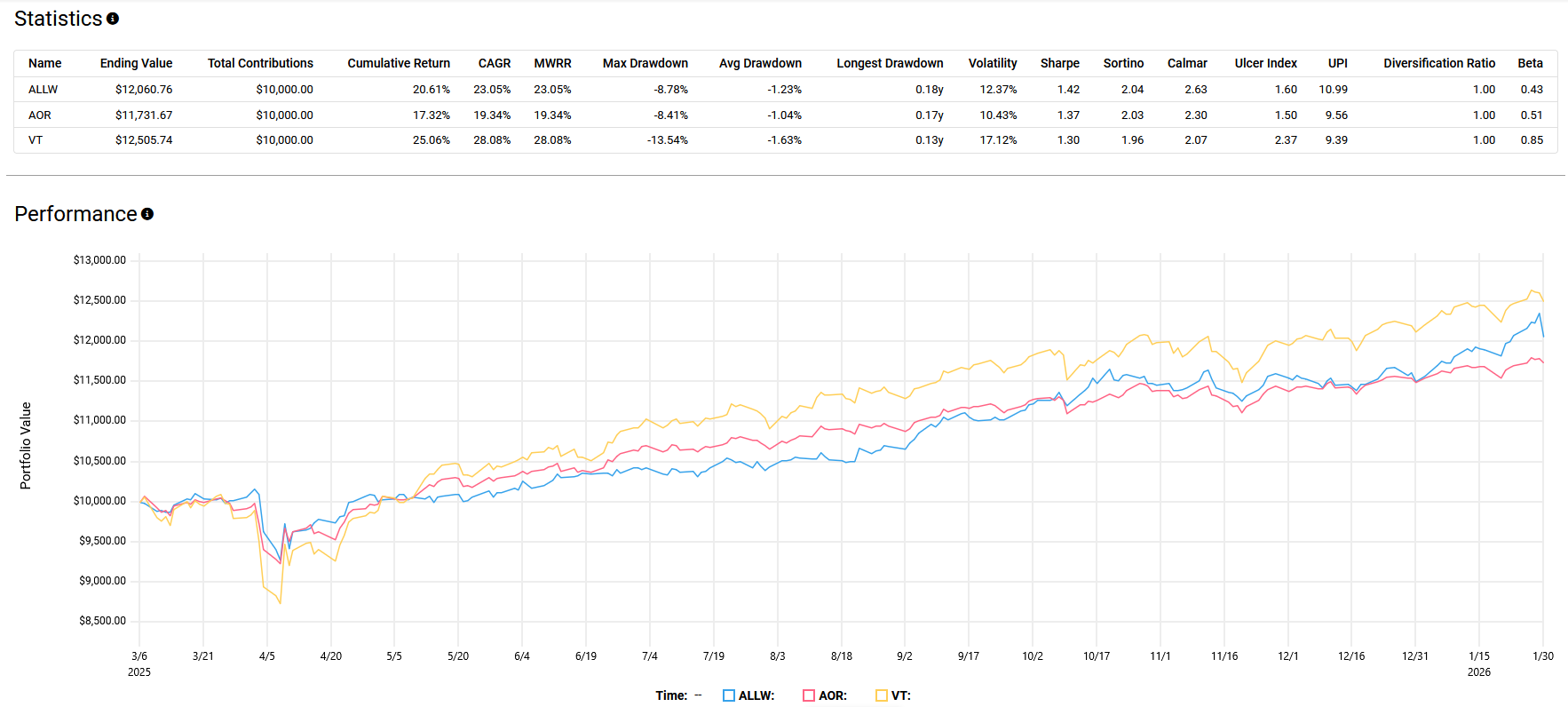
That outcome is consistent with the fund’s objective. ALLW is not designed to chase maximum returns in any single year. It is meant to serve as a steady anchor holding that can hold up across market environments, even when conditions are uncomfortable.
ALLW: What I Dislike
No ETF is perfect. Despite a strong launch and growth to just under $800 million in assets under management, the ALLW has several shortcomings worth calling out.
The biggest issue is its heavy reliance on U.S. government debt. Ray Dalio has written extensively about how countries rise and fall through long-term debt cycles, and more recently he has argued that the U.S. is approaching a turning point in that cycle.
The drivers he points to are familiar: persistent fiscal deficits, repeated government shutdowns and debt-ceiling standoffs, rising debt-service costs, rapid growth in the money supply, and an expanded Federal Reserve balance sheet.
Against that backdrop, it is puzzling that such a large share of ALLW’s nominal government bond exposure is concentrated in U.S. Treasuries. Expanding that allocation further into other developed markets, such as Canada, or even selectively into more stable emerging markets, could better align the portfolio with the risks Dalio himself highlights.
That concern also extends to the fund’s reliance on U.S. inflation-linked bonds in the form of Treasury Inflation-Protected Securities. TIPS play an important role during inflationary periods, but they still represent lending to the U.S. government.
If the core thesis is that the U.S. is in a late-stage debt cycle, concentrating both nominal and inflation-linked bond exposure in one sovereign issuer introduces a tension within the strategy.
The next drawback is cost. The 0.85% expense ratio is high. The use of futures and swaps, active management, and Bridgewater’s intellectual property all come at a price, but even a reduction to around 0.75% would bring the fund closer to what many actively managed ETFs charge today.
Taxes are another consideration. As an actively managed ETF with complex underlying exposures, ALLW is likely to generate sizeable year-end capital gains distributions. In a taxable account, that can materially reduce after-tax returns.
State Street Investment Management estimates that since inception on March 5, 2025, the return after taxes on distributions would have been reduced from 15.14% to 13.16%, largely due to year-end capital gains. This is difficult to avoid and reflects the limits of the ETF creation and redemption mechanism when applied to highly active strategies built on futures and swaps.
Finally, there is leverage. As of December 30, 2025, total portfolio leverage stood at roughly 188%, or about 1.88 times notional exposure. While the strategy is designed to balance risk across assets, leverage increases vulnerability to scenarios where correlations spike across stocks, bonds, inflation-linked securities, and commodities at the same time.
Such an outcome is unlikely but not impossible. Therefore, I think a modest reduction in target leverage could improve resilience at the margin. That said, leverage levels are not static and will evolve as Bridgewater’s models adjust to changing conditions.
None of these issues invalidate the strategy, but they are important trade-offs to understand before treating ALLW as a core holding.
ALLW: My Verdict
Overall, I give the SPDR Bridgewater All Weather ETF an 8/10.
What I like is the thoughtful risk parity construction, the breadth of asset class exposure, and the ability to access an institutional-style macro framework in a single, liquid ETF.
What I do not like are the heavy reliance on U.S. government debt, the elevated expense ratio, the tax inefficiency in taxable accounts, and the high level of leverage embedded in the portfolio.
Personally, I do not use ALLW in my own portfolio. I believe my five-ETF “cockroach” portfolio can achieve similar risk-adjusted returns over multiple market cycles with far less complexity and at a fraction of the cost.
That said, ALLW is the ETF I use for my girlfriend’s Registered Retirement Savings Plan (RRSP). It is something she can dollar-cost average into without worrying about rebalancing, regime changes, or how different asset classes behave in different environments.
However, there is a strong case for simplicity here. If ALLW’s strategy feels too abstract, or the fee feels too high on principle, that is entirely reasonable. You do not need complexity to reach your financial goals.
But if you are going to use a more sophisticated, global macro-driven approach in ETF form, ALLW is one of the better executions available today.