Why Light Leverage in Asset Allocation ETFs Is Changing Portfolio Design
Last Updated:

When most Canadians think about leverage, they picture margin calls, sleepless nights, and oversized bets on individual stocks.
But leverage does not have to look like that. Inside a diversified asset allocation ETF, leverage becomes a controlled tool that simply scales a balanced portfolio rather than amplifying a narrow trade.
For growth-oriented investors using TFSAs, RRSPs, or corporate accounts, this approach can potentially offer a cleaner way to access more market exposure, without concentrating risk in a single sector, geography, or theme.
The portfolio is built first across diversified equities, and only then is it lightly levered. That structure makes it fundamentally different from trying to “juice” returns through concentrated bets. Instead, it provides a disciplined way to enhance growth without taking on concentrated risk.
Why Global Diversification Still Matters for Investors
One of the biggest risks for growth-focused investors is drifting into concentration without realizing it. You get excited about U.S. technology stocks, or Canadian financials, or a strong run in emerging markets, and before long most of your portfolio’s outcome depends on a single region.
The issue is that market leadership always rotates. The U.S. can dominate for a cycle, but that leadership can shift to Europe, Japan, or emerging markets in the next one.
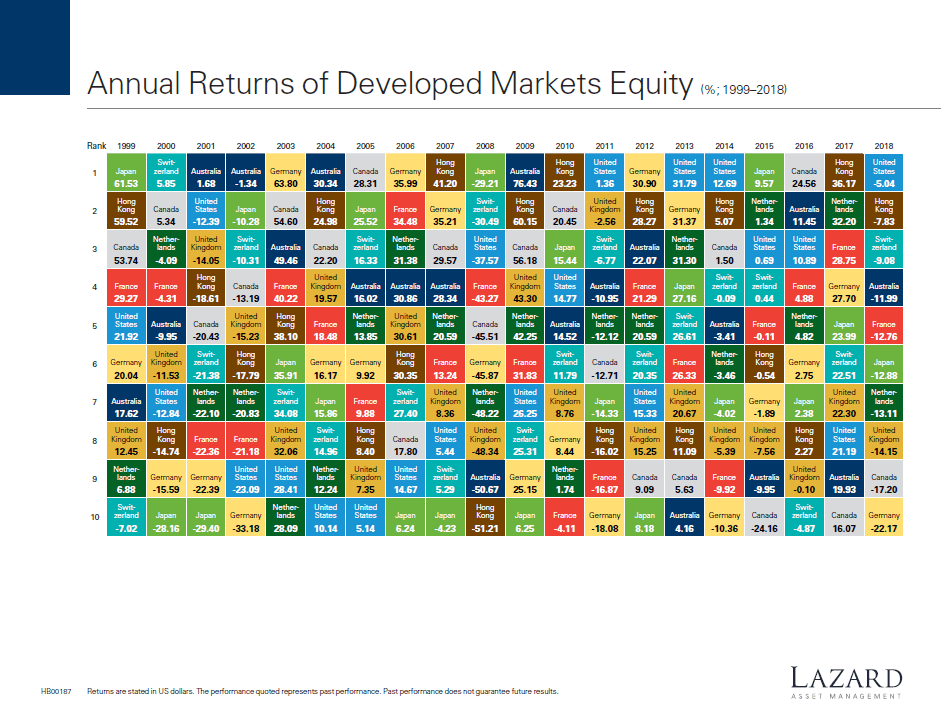
Source: Lazard Asset Management via Top Foreign Stocks, April 2019
A globally diversified allocation helps prevent your portfolio from being tied to whichever market happened to outperform in the recent past.
By spreading exposure across multiple regions and economic cycles, investors can help reduce the risk of anchoring returns to a single geography and create a more stable foundation for long-term growth.
Sector Rotation Creates the Same Problem
The same type of rotation that occurs across regions also plays out across sectors. Technology can lead for long stretches, but there are full years where energy takes the spotlight. Financials, industrials, health care, and defensive sectors each have periods where they outperform.
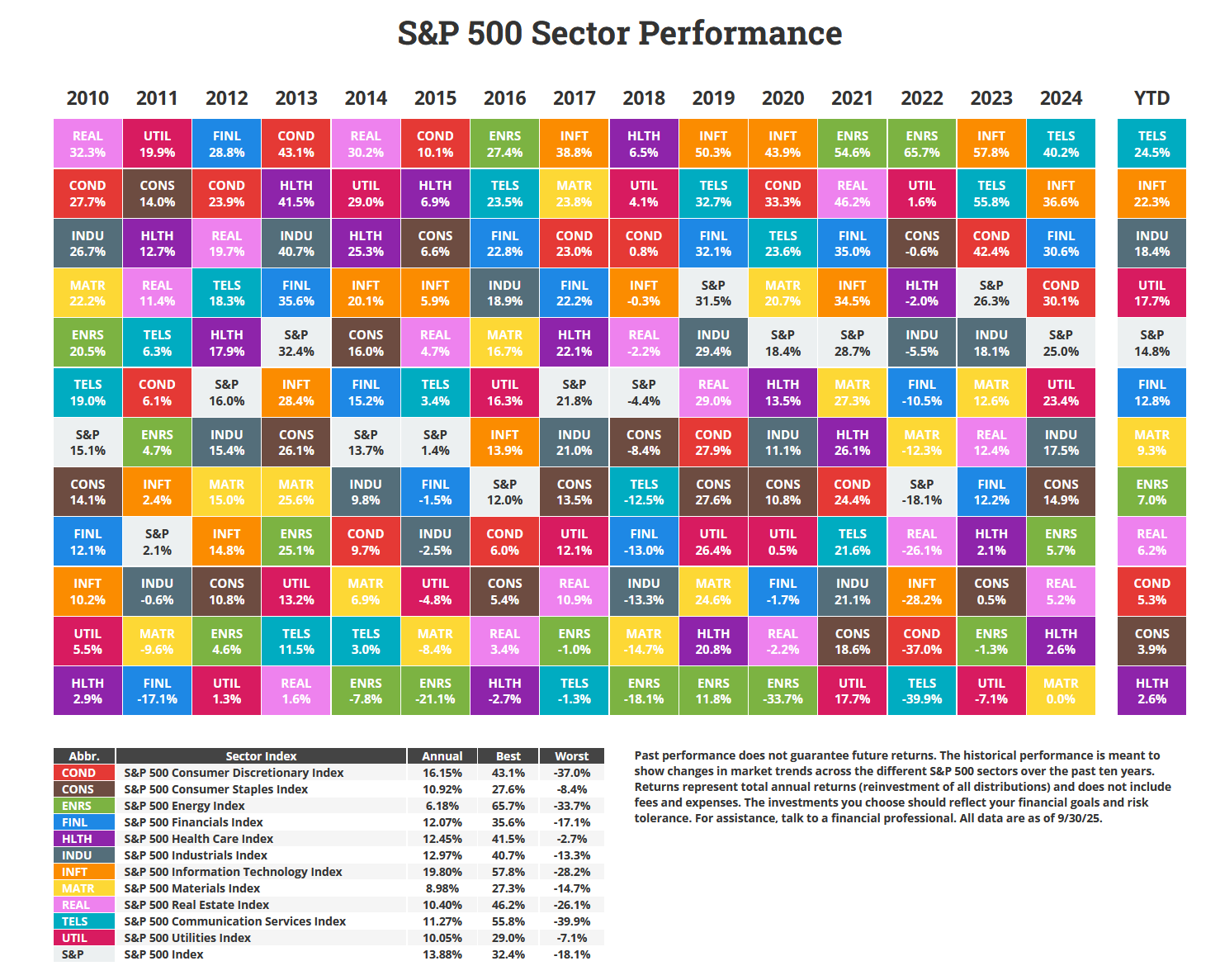
Source: Novel Investor, April 2025
Relying on a single sector increases the likelihood of being positioned in the wrong place at the wrong time. Instead, a broad allocation across all eleven GICS sectors helps avoid tying your portfolio to any one economic narrative.
Rather than trying to predict when leadership will change, a diversified sector mix keeps you invested through the rotation and can help reduce the impact of performance gaps driven by narrow exposure.
What the Global X Asset Allocation ETF Building Blocks Look Like
The standard Global X All-Equity Asset Allocation ETF (HEQT) follows a fund-of-funds structure built on Global X index ETFs, providing investors with the opportunity to gain exposure to the core components of global equity markets.
The building blocks include U.S. large caps, international developed markets, Canadian equities through the TSX 60, emerging markets, U.S. small caps, and the Nasdaq 100. Together, these holdings cover the major regions, sectors, and size segments that drive global equity performance.
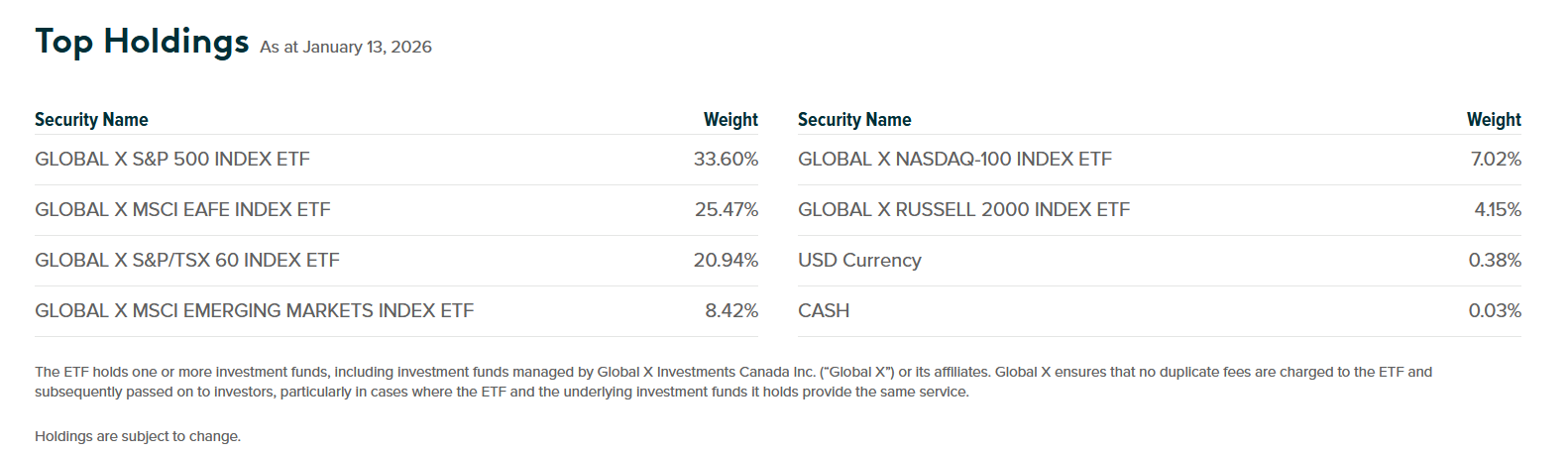
Source: Global X Canada, January 2026
Before any leverage is applied, the ETF first establishes a fully diversified global equity allocation. This foundation helps provide broad, balanced exposure rather than narrow convictions.
Only once that structure is in place does the strategy scale the position, allowing investors to gain additional market exposure from a base of disciplined diversification.
Introducing Leverage Only After Diversification Is Established
Once the globally diversified base is in place, the question becomes how to scale it for long-term investors who want greater market exposure.
Instead of taking on concentration risk or stacking thematic bets, the Global X Enhanced All Equity Asset Allocation ETF (HEQL) applies approximately 1.25× leverage to the entire diversified portfolio. Every region, sector, and size category scales together, so no single segment dominates the risk profile.
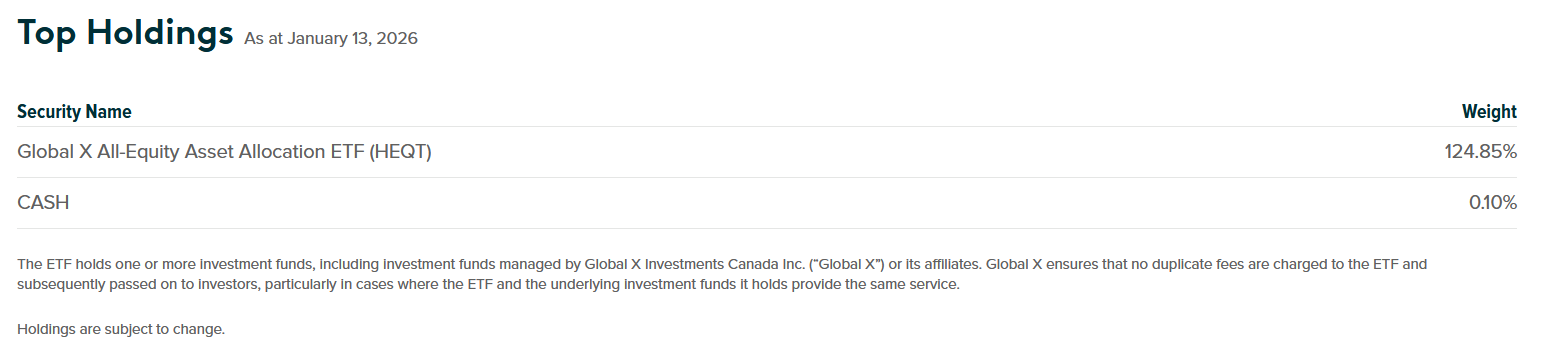
Source: Global X Canada, January 2026
This is where the difference becomes clear. A sector-specific leveraged fund ties the entire investment outcome to a single narrative. If that sector’s cycle turns, the whole position absorbs the reversal.
A lightly levered global portfolio distributes exposure across all sectors that rotate in and out of leadership. It participates in upside across multiple economic drivers rather than relying on a single one.
The approach is not meant to forecast winners. It is designed to help diversify the sources of returns before any leverage is applied.
For long-term investors, that reduces the risk of becoming overly exposed to the wrong sector at the wrong time. In practical terms, it avoids amplifying sector and stock-specific risks by borrowing against a concentrated basket.
How Light Leverage Can Help Offset Covered Call Drawbacks
Covered call strategies come with well-known trade-offs. They can generate consistent cash flow, but the option overlay may limit some of the upside during strong equity markets. One way to balance that effect is to pair the covered call exposure with light leverage applied to the same diversified underlying portfolio.
That is the structure behind the Global X Enhanced All-Equity Asset Allocation Covered Call ETF (EQCL). It starts with the same global equity allocation used in the core asset allocation ETF, ensuring broad diversification across regions, sectors, and size categories.
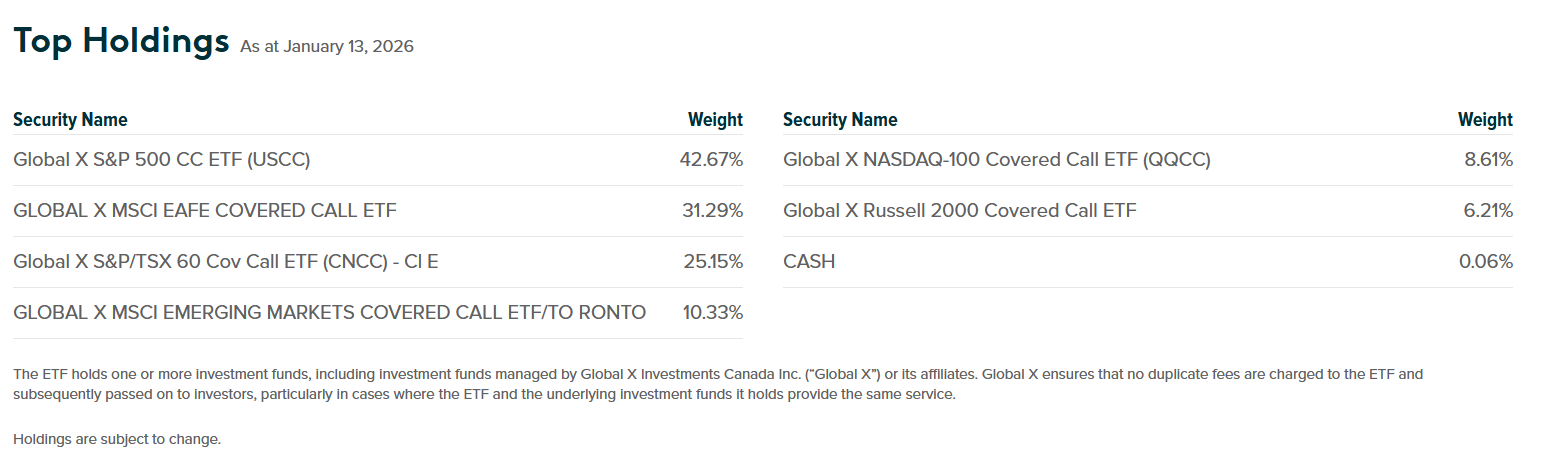
Source: Global X Canada, January 2026
However, the underlying ETFs use dynamic covered call overlays to produce income and applies a 1.25x portfolio leverage mechanic similar to HEQL. The leverage helps counteract the muted upside that covered calls can create, while the income overlay provides steady cash flow.
The combination aims to deliver a stable monthly distribution — recently 11.60% annualized as of January 13, 2026 — without anchoring investors to a single region or sector.
For income-focused investors with a higher risk tolerance, this approach offers a way to meaningfully increase distributions while keeping exposure tied to a balanced global portfolio rather than relying on concentrated sources of return.
Why Embedded Leverage Can Help Canadian Investors
Canadian investors also face several structural challenges when it comes to using leverage on their own. Margin borrowing through retail brokerages is costly, with rates that can meaningfully erode returns.
Moreover, registered accounts such as RRSPs and TFSAs prohibit borrowing entirely, which makes direct leverage impossible inside the very accounts many long-term investors rely on.
And even if you attempt to build a leveraged structure manually across multiple ETFs, you are left managing borrowing costs, rebalancing, and volatility exposure yourself.
Embedded leverage solves these issues by shifting the borrowing to the fund level. The leverage is institutional, monitored, and integrated directly into the ETF’s asset allocation framework.
That means the portfolio automatically maintains its target weights even as markets move, and investors do not have to track collateral, adjust loan balances, or worry about margin calls.
Because the leverage is inside the fund rather than the account, the ETF remains fully eligible for RRSPs, TFSAs, and corporate accounts.
For Canadians who want additional market exposure but face constraints around cost, account type, or operational complexity, embedded leverage offers a streamlined and more accessible solution.
A Smarter Way to Use Leverage in a Long-Term Portfolio
Ultimately, the differentiator is not leverage by itself. It is where and how that leverage is applied.
When leverage is layered onto a fully diversified global allocation — and when it is paired with tools such as covered calls — the structure can support a range of long-term investor needs.
Some may want higher market participation, while others prioritize income, and both objectives can be met within the same disciplined framework.
The aim is not to chase themes or time sector rotations. It is to build a global foundation, keep exposure broad, and scale it in a controlled manner that fits the constraints of Canadian accounts.
For investors focused on long-horizon growth, these types of allocations offer another way to remain diversified, stay fully invested, and maintain a disciplined approach through different market cycles.