
Alpha Architects Tail Risk ETF (CAOS) Review
Last Updated:

Hedging against tail risk usually comes with a cost. In plain terms, when markets are calm and not crashing, most tail hedges steadily lose money.
Long VIX futures bleed from contango. Laddered put options decay from theta. You are effectively paying an insurance premium month after month in exchange for protection when things break.
There is, however, one ETF that claims to buck that convention: the Alpha Architect Tail Risk ETF (CAOS). The strategy originally launched in August 2013 as mutual fund AVOLX under Arin Risk Advisors. It was later converted into an ETF structure in March 2023 and rebranded to CAOS under Alpha Architect.
Historically, AVOLX showed the type of convex payoff profile investors expect from a tail hedge. During the March 2020 COVID crash, it delivered meaningful upside and held up better than traditional bonds during crashes while maintaining positive or at least uncorrelated returns in normal markets. In other words, a hedge you do not have to time.
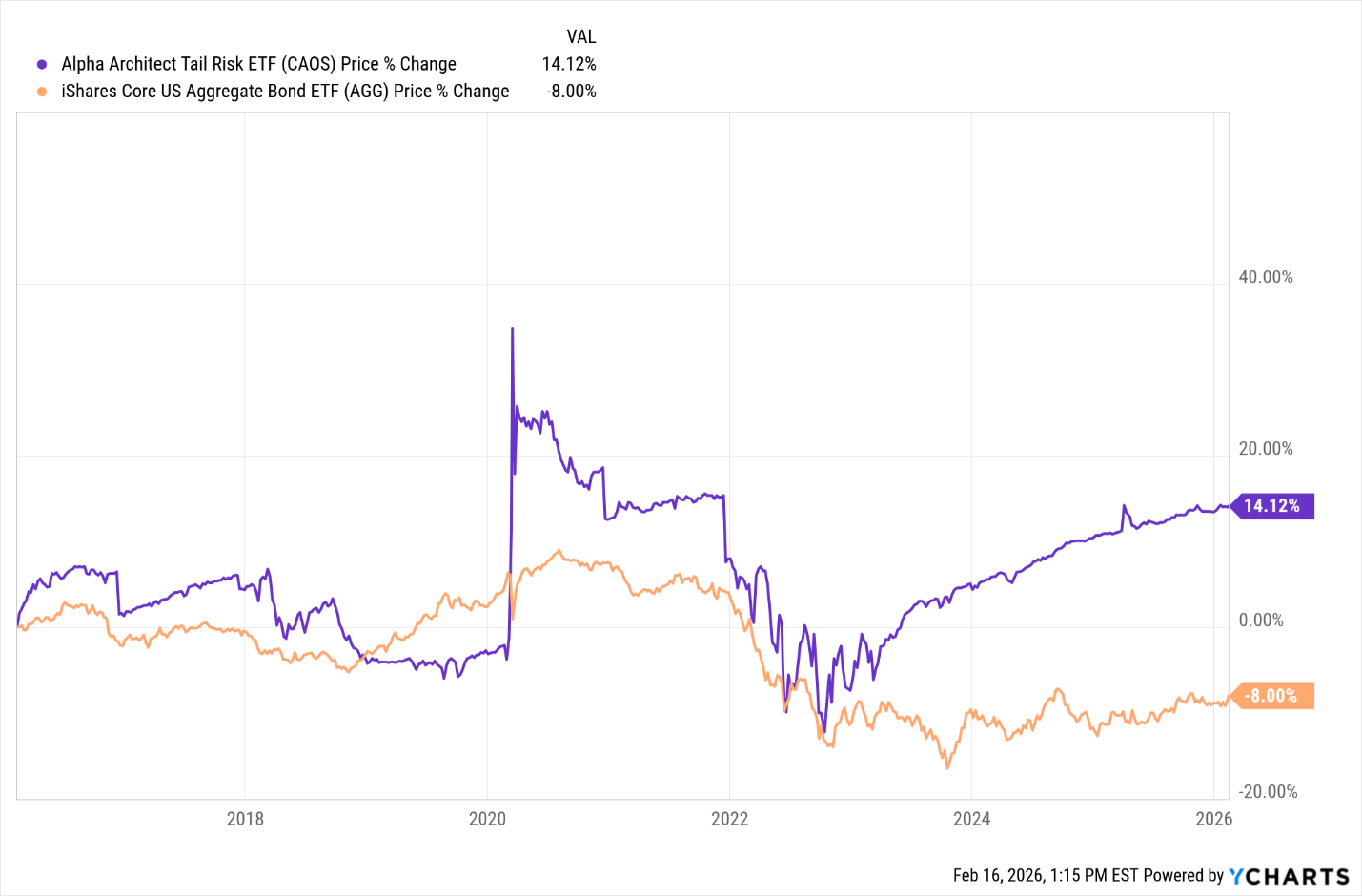
Whenever a product suggests something close to a free lunch, skepticism is warranted. What worked in mutual fund form under one mandate may not translate perfectly into the ETF wrapper today.
With that in mind, this review takes a fresh look at CAOS as it exists in 2026 and asks a simple question: does it truly earn a place in a modern portfolio as a dedicated tail risk hedge?
CAOS: What I Like
There is actually quite a bit to like about CAOS. The key is understanding how the strategy is constructed. Alpha Architect runs CAOS using a three-part framework designed to balance crash protection with attempts at positive carry.
- The first component is protective puts. These are deep out-of-the-money put options, primarily on the S&P 500 index. In a sharp, fast-moving drawdown, those puts can move dramatically in value once the index falls below their strike prices.
That is where the convexity comes in. Convexity means the payoff accelerates as losses deepen. A small decline may not move the needle much, but a severe crash can produce disproportionately large gains. That is what creates the potential for asymmetric upside during market stress.
The trade-off is well known. If the market keeps grinding higher, those puts decay over time. Option premium erodes due to theta. Left alone, that negative carry would steadily drag on returns in normal market, which is what older tail risk strategies are weak to.
- The second component is box spreads. A box spread is a multi-leg options strategy that combines a long call and short put at one strike with a short call and long put at another strike, typically on the same underlying and expiration.
The payoff resembles a fixed-income instrument. When structured properly, it behaves similarly to short-term Treasury bills, with a yield that tracks the prevailing Fed funds rate.
Institutional investors have long used box spreads as a capital-efficient way to replicate lending or borrowing. CAOS uses one- to three-month index box spreads to generate income that closely tracks short-term interest rates. The return from these positions helps offset drag from the protective puts.
- The third component is put spreads. This involves simultaneously buying and selling put options at different strike prices on the same index and expiration.
The structure limits both potential gains and losses. In exchange for taking on bounded downside risk, CAOS collects premium. That premium further offsets the cost of maintaining the crash protection.
Put together, these three sleeves create a more balanced profile than most traditional tail hedges. During bull markets, the box spreads and put spreads can generate enough carry to reduce or even eliminate the negative drift that plagues older tail risk strategies.
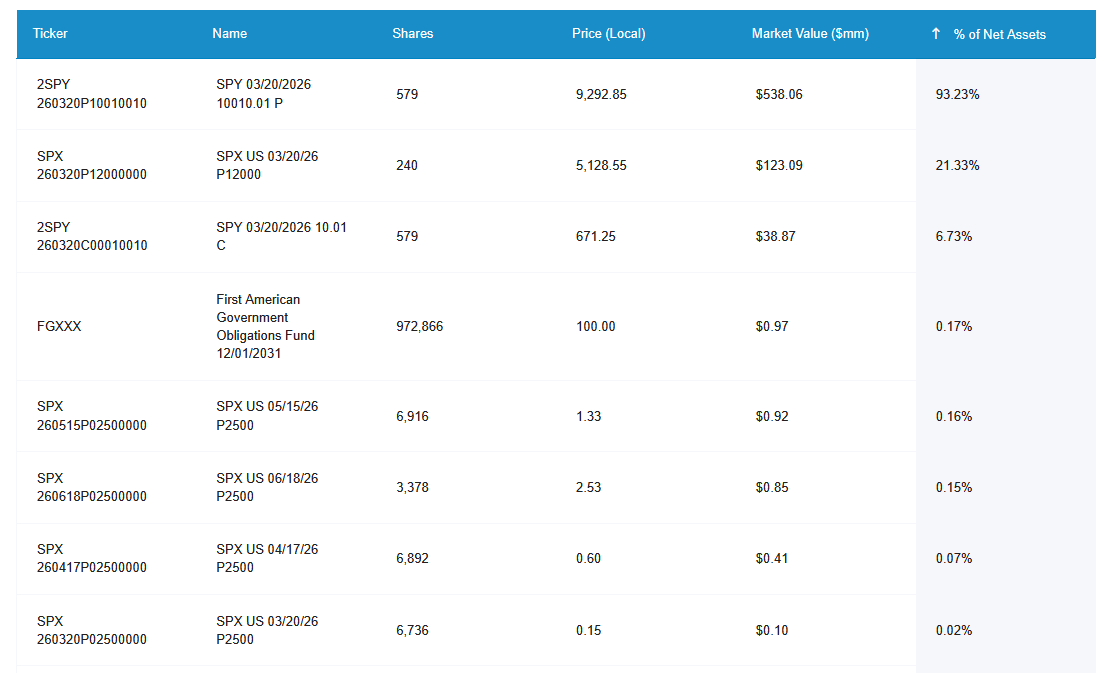
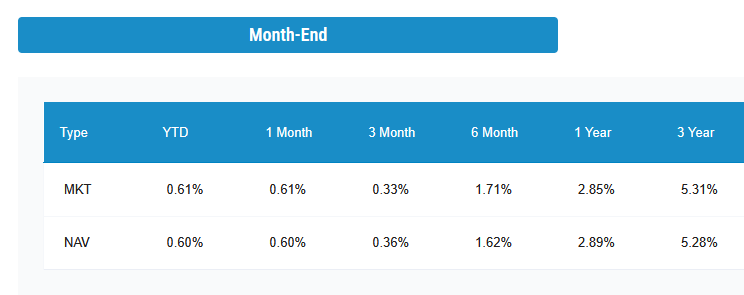
That helps explain why, over the trailing three- and one-year periods, CAOS has delivered annualized pre-tax total returns. Many other tail risk funds have posted persistent losses over similar stretches.
On top of that, the expense ratio of 0.63% is refreshingly reasonable for a specialized tail risk ETF that relies on active options management.
So, there is clear thought behind the construction. The strategy attempts to solve the biggest flaw in tail hedging, which is persistent negative carry. The question, of course, is what trade-offs investors are accepting in exchange for that improvement.
CAOS: What I Don’t Like
CAOS does an admirable job of managing, and in many periods even offsetting, the negative carry that typically comes with tail risk strategies. But there is no free lunch.
If the drag is reduced in normal markets, something else has to give. In this case, it shows up in the magnitude of convexity during sharper selloffs. To illustrate that trade-off, it is helpful to compare CAOS with the Cambria Tail Risk ETF (TAIL), which holds Treasury bonds and laddered S&P 500 put options.
With TAIL, there is little in the way of yield-enhancing overlays. You can think of it as Treasuries plus laddered crash insurance. TAIL tends to experience much more negative carry in normal markets compared to CAOS. However, when markets fall sharply, TAIL’s convexity can be more pronounced.
Looking at the period from July 2024 through February 2026, we saw two notable equity sell-offs: one in August 2024 and another in April 2025 during the Liberation Day tariff rollout. In both episodes, CAOS and TAIL generated positive returns while equities were falling.
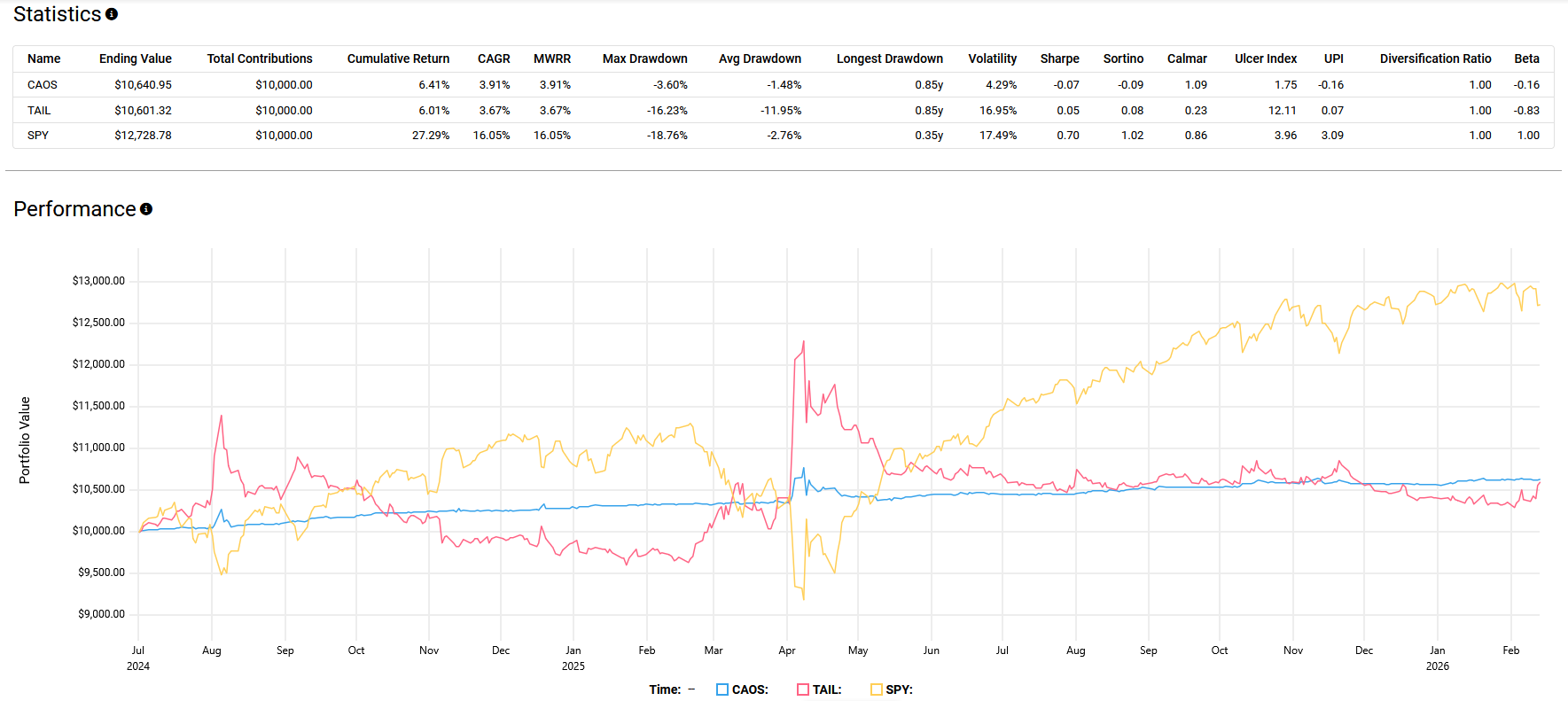
But the magnitude differed. In each of those shorter, sharp drawdowns, TAIL exhibited stronger upside spikes. CAOS did respond positively, but the moves were much more muted. That difference is not surprising. The crashes in that window were sharp but relatively brief and not especially deep.
Remember, CAOS’s use of put spreads and yield-generating box spreads tempers its upside during moderate stress events. However, the same mechanisms that help reduce negative carry in normal markets also dampen the convex payoff profile in smaller corrections.
True, over longer stretches, CAOS has delivered stronger total returns than TAIL precisely because it does not bleed as heavily outside of crises. That is a strong selling point for many investors.
However, in exchange for not having to endure persistent negative carry, you accept that CAOS may not explode higher during every moderate or short-lived correction.
In a truly severe and prolonged crash, such as the 2008 financial crisis, it could still provide meaningful convexity. But in shorter, shallower selloffs, its response has been more measured compared to more traditional, purer tail hedges that accept negative carry.
If your objective is to actively trade around volatility spikes or tactically position for short-term drawdowns, CAOS may not be the ideal instrument. It is better suited as a strategic allocation you hold continuously rather than something you attempt to time.
CAOS: My Verdict
Overall, I give CAOS a 9/10. The risk management nerd in me genuinely appreciates this ETF.
It is thoughtfully engineered and managed by a team that has published an extensive body of research on quantitative strategies and who clearly have skin in the game.
The use of SPX index options, structured box spreads to harvest short-term rates, and disciplined put spread overlays reflects careful design rather than marketing spin.
So far, CAOS has largely delivered on its central promise. It has generated relatively stable positive carry that has behaved similarly to Treasury bills, while still providing upside during market stress.
Since converting from AVOLX to its ETF structure, we have seen two short-lived corrections. In both cases, CAOS delivered positive returns and demonstrated crisis alpha.
While the convex payoff was not as dramatic as some purer tail risk funds, the absence of persistent negative carry makes it far more attractive as a long-term allocation.
I also ran a simple backtest to see how it behaves in portfolio context. I compared two portfolios over a 2.94-year period from March 2023 to February 2026. One portfolio was 80% S&P 500 and 20% CAOS. The other was 80% S&P 500 and 20% aggregate bonds. Both were rebalanced monthly.
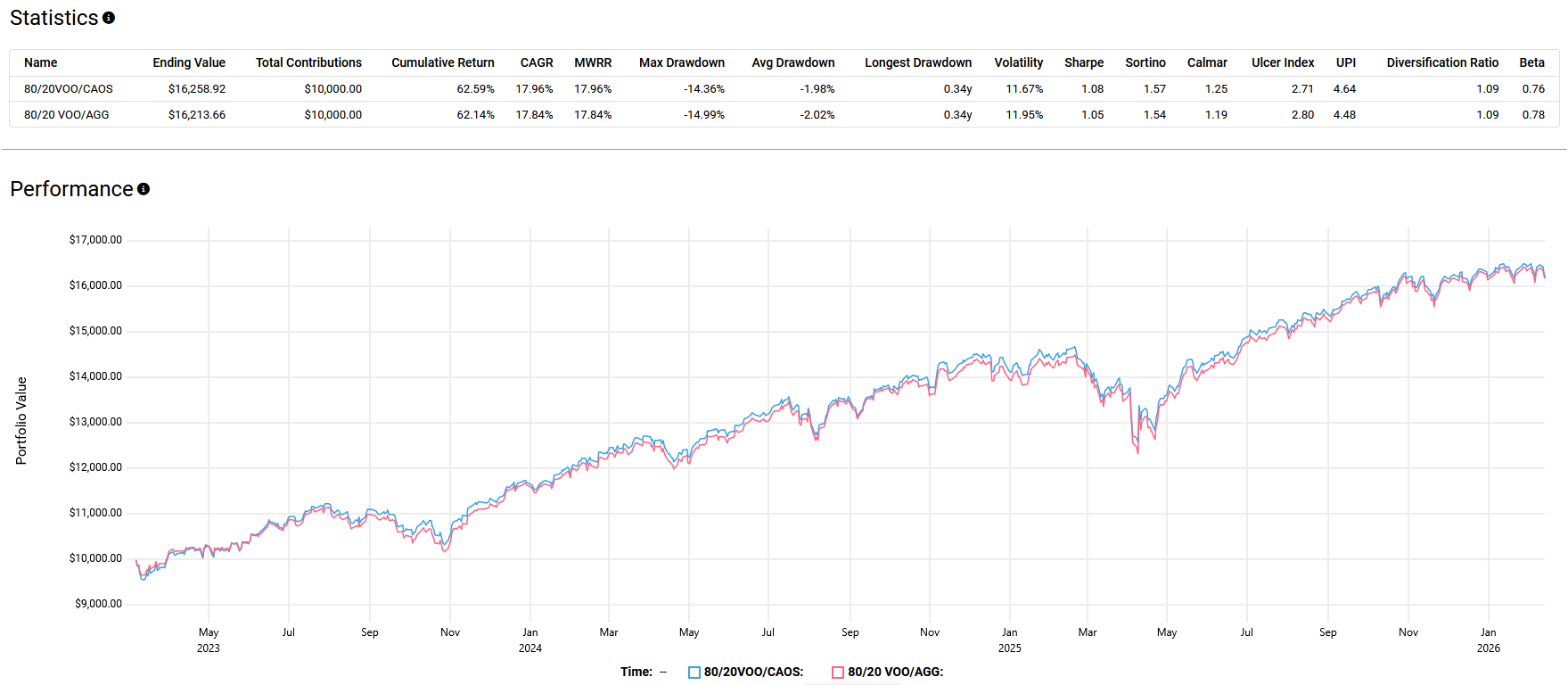
The results were telling. Even after accounting for CAOS’s 0.63% expense ratio, the CAOS portfolio delivered a 17.96% cumulative return versus 17.84% for the bond portfolio. More importantly, risk-adjusted performance was slightly better. The CAOS portfolio posted a Sharpe ratio of 1.08 compared to 1.05 for the aggregate bond version.
That matters because with most other tail risk strategies I have back-tested, whether laddered puts or long VIX futures, risk-adjusted returns tend to deteriorate over stable periods due to persistent negative carry. CAOS has avoided that trap so far.
This evaluation comes during a relatively calm market regime with only modest corrections. If a more severe, prolonged drawdown materializes, I am confident CAOS would demonstrate its value even more.
For investors who want a set-it-and-forget-it hedge without bleeding capital year after year, I personally believe CAOS is one of the most compelling implementations available today.