
How To Build a Tax-Efficient Infrastructure Income Portfolio with ETFs
Last Updated:

Institutional investors have long favored infrastructure assets, and for good reason. These businesses tend to operate under long-lived contracts, generate stable cash flows, and often benefit from inflation-linked pricing or regulated returns.
Airports, toll roads, pipelines, utilities, and data infrastructure frequently exhibit lower demand elasticity and higher barriers to entry than most traditional equities. For pensions, endowments, and sovereign wealth funds, infrastructure has been a core building block for decades.
The way institutions access these assets, however, looks very different from how individual investors do. Large allocators typically invest through private infrastructure funds, direct ownership stakes, co-investments alongside developers, or long-duration partnerships that lock up capital for years. Those structures are not designed for everyday investors.
In public markets, the options are more limited. Retail investors are largely confined to mutual funds, closed-end funds, and ETFs.
Mutual funds often distribute taxable capital gains, making them less attractive in non-registered accounts. Closed-end funds frequently layer on leverage, charge higher fees, and can trade at persistent discounts or premiums to net asset value.
Infrastructure ETFs, by contrast, have become a rapidly growing category, offering liquid, transparent access to income-producing assets with far fewer structural drawbacks.
So, if I were building a satellite infrastructure allocation, perhaps inside a Roth IRA or a taxable brokerage account, here are the infrastructure-focused ETFs I would combine to create a diversified income portfolio across sectors and geographies.
75% in a Global Infrastructure Equity ETF
For the equity anchor, I would allocate 75% to the ProShares DJ Brookfield Global Infrastructure ETF (TOLZ). This fund is a bit of a departure from ProShares’ more familiar leveraged and inverse products, but it remains one of the cleaner ways to access listed infrastructure globally.
TOLZ tracks the Dow Jones Brookfield Global Infrastructure Composite Index and owns roughly 110 companies operating across airports, toll roads, ports, communications infrastructure, electricity transmission and distribution, oil and gas storage and transportation, and water utilities.
What sets this ETF apart from many competing infrastructure funds is its emphasis on purity. Companies must derive at least 70% of their cash flows from infrastructure-related lines of business, which reduces dilution from conglomerates or adjacent industries.
The portfolio has a meaningful allocation to oil and gas midstream transportation and storage, an area often excluded or underweighted in broader infrastructure ETFs.
Unlike many peers, TOLZ can also hold master limited partnerships, which currently account for about 8.4% of the portfolio. The second major exposure is electricity transmission and distribution utilities, a segment that benefits directly from electrification, grid upgrades, and renewable integration.
At a 0.46% expense ratio, TOLZ is not the cheapest ETF on the shelf, but the cost is reasonable given the global scope and the purity of exposure. The fund also offers decent income potential, with a trailing 12-month yield around 3.9%.
25% in a Municipal Infrastructure Bond ETF
Equity infrastructure alone can be volatile, especially during periods of rising rates or risk-off sentiment. To balance that risk, I would allocate the remaining 25% to a fixed income sleeve tied directly to infrastructure cash flows.
For that role, I like the Xtrackers Municipal Infrastructure Revenue Bond ETF (RVNU), a lesser known but highly differentiated product.
RVNU tracks the Solactive Municipal Infrastructure Revenue Bond Index, which focuses exclusively on municipal revenue bonds tied to infrastructure projects. For investors unfamiliar with the structure, revenue bonds differ from general obligation municipal bonds in a keyway.
Instead of being backed by a municipality’s taxing authority, revenue bonds are supported by cash flows from specific projects such as airports, toll roads, water systems, power utilities, and transportation networks. RVNU delivers this niche exposure at a reasonable cost, with an expense ratio of just 0.15%.
That makes the link to infrastructure direct and tangible, while avoiding the equity risk embedded in funds like TOLZ. The upside here is naturally more limited, but the trade-off is stability.
RVNU currently offers a 30-day SEC yield of about 4.24%, and because it holds municipal bonds, that income is generally exempt from U.S. federal income tax. For investors in higher tax brackets, the tax-equivalent yield can be meaningfully higher.
This pairing also allows for thoughtful asset location. TOLZ fits well inside tax-advantaged accounts like a Roth IRA, while RVNU can be held in a taxable account where its tax efficiency shines. Rebalancing becomes a bit more cumbersome, but the after-tax outcome is cleaner.
Putting It Together
When you look at the backtests, the strengths and weaknesses of this infrastructure income portfolio become clear. Relative to a simple global 75/25 stock-bond portfolio, the infrastructure mix has delivered lower long-term returns, with a cumulative return of about 52% versus nearly 89% for the traditional allocation over the same period. The annualized return gap is meaningful, roughly 5.9% versus 9.1%.
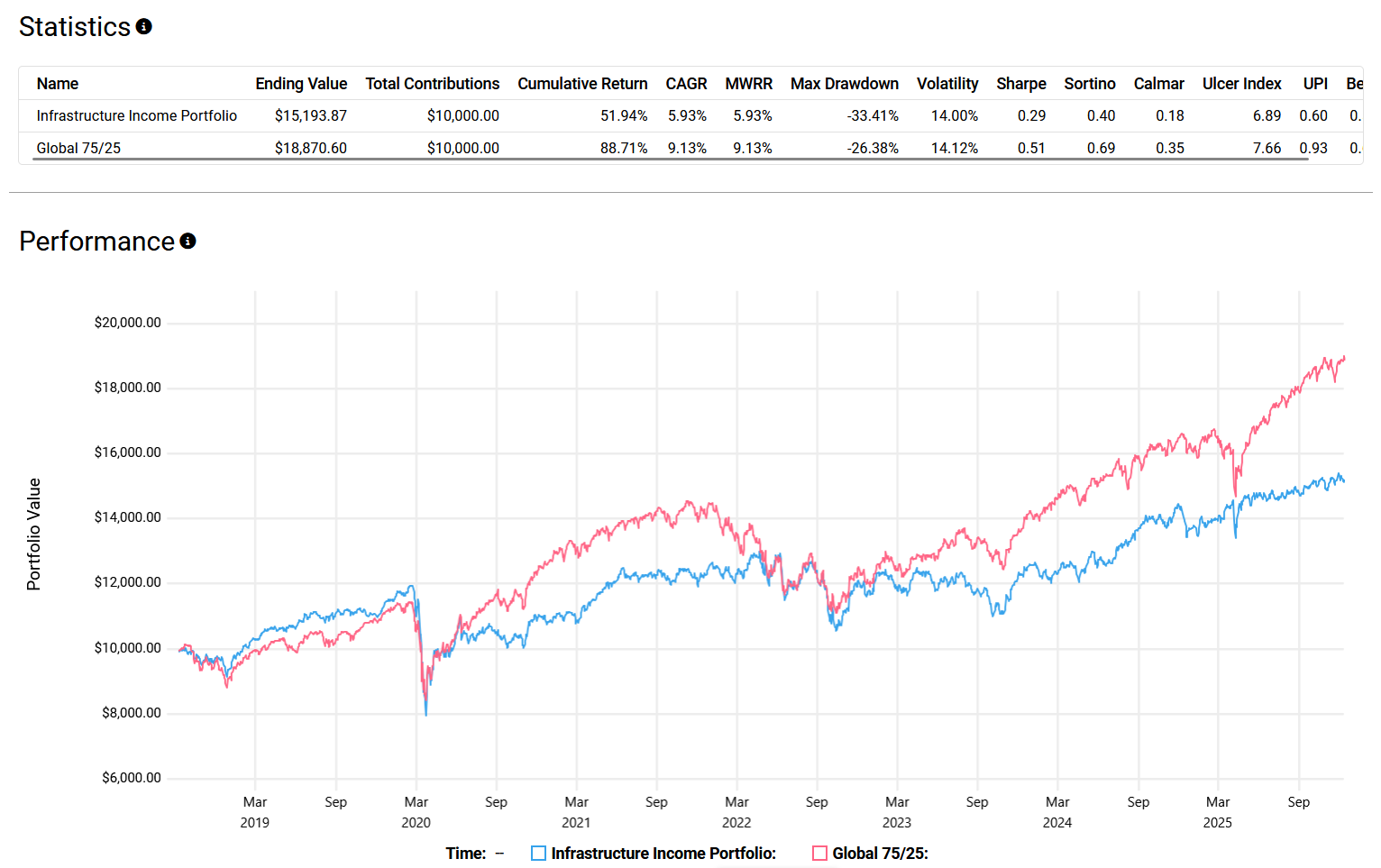
That said, the comparison isn’t entirely fair without context. Infrastructure equities are income-oriented, capital-intensive businesses that tend to lag during growth-driven equity rallies.
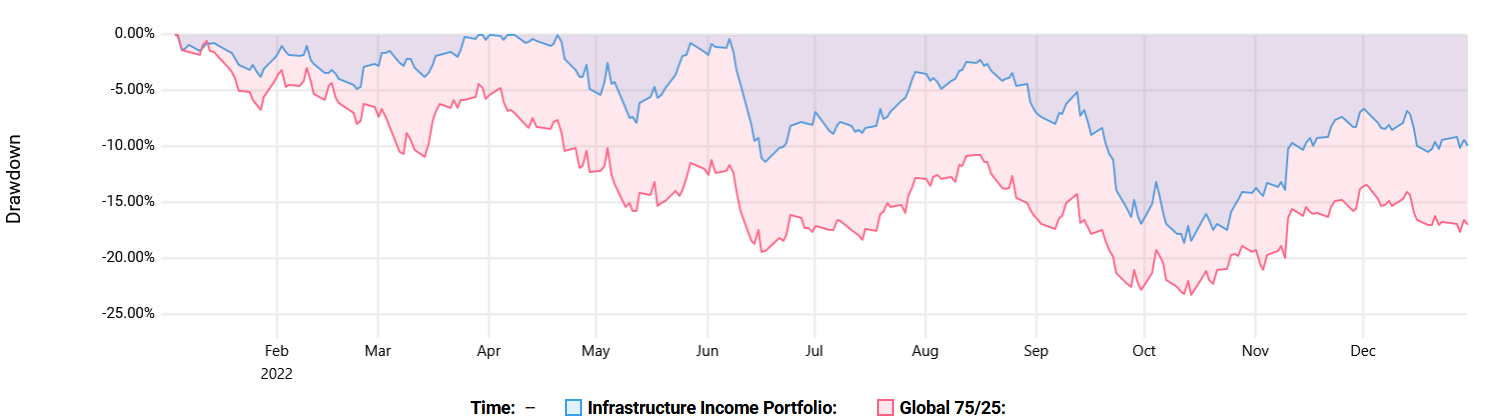
Where this portfolio shines is in periods (like 2022) when inflation is elevated, real assets are in demand, or investors rotate toward cash-flow stability. The income stream is steadier, and the underlying assets have a tangible connection to economic activity rather than financial engineering.
This is not a replacement for a core portfolio. It is a satellite allocation designed to complement one. For investors looking to add durable income, inflation-aware cash flows, and exposure to real-world assets that sit outside traditional equity sectors, a blended infrastructure equity and municipal revenue bond approach offers a disciplined and transparent way to do it.