
NBI Global Private Equity ETF (NGPE): What Canadian Investors Need to Know
Last Updated:

One advantage U.S. ETF investors have over their Canadian counterparts is the ability for certain ETFs to allocate a limited portion of their portfolios to illiquid investments.
Under SEC Rule 22e-4, most ETFs can invest up to 15% of their assets in illiquid securities. That has opened the door to products such as the KraneShares Public-Private AI & Technology ETF (AGIX), which currently holds private companies including Anthropic, Apptronik, Nuro, and Polymarket.
Canada doesn't really have an equivalent. If you want genuine private equity exposure, your options are fairly limited. The most accessible is arguably Wealthsimple's private equity fund-of-funds, although that comes with fee upon fees. Alternatively, investors can gain indirect exposure through niche publicly traded small caps such as Stack Capital Group (STCK).
So, imagine my surprise when I came across the NBI Global Private Equity ETF (NGPE). National Bank Investments classifies it as an "alternative private equity" ETF, which naturally suggests investors are buying exposure to private companies. As it turns out, that's not actually what's happening.
NGPE isn't necessarily a bad ETF. In fact, I think it's a perfectly reasonable way to gain exposure to publicly listed alternative asset managers. But if you're buying it expecting it to behave like a true private equity fund, you're likely to be disappointed. Here's a closer look at what the ETF actually owns and why I think its name overstates what investors are really getting.
What Is NGPE and How Does it Work?
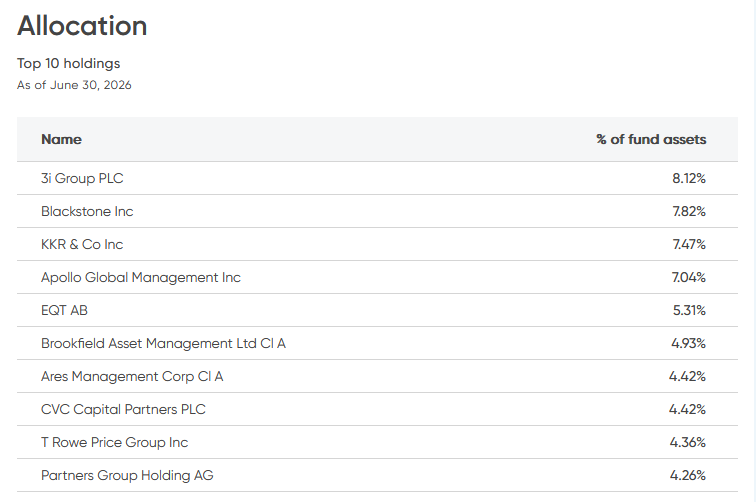
NGPE is a passive ETF that tracks the Morningstar PitchBook Developed Markets Listed Private Equity Select Index. The important word there is listed.
Rather than investing directly in private companies or private equity funds, the ETF owns the publicly traded firms that manage those investments. In other words, you're buying the parent companies behind the private equity industry, not the underlying private businesses themselves.
Source: National Bank Investments
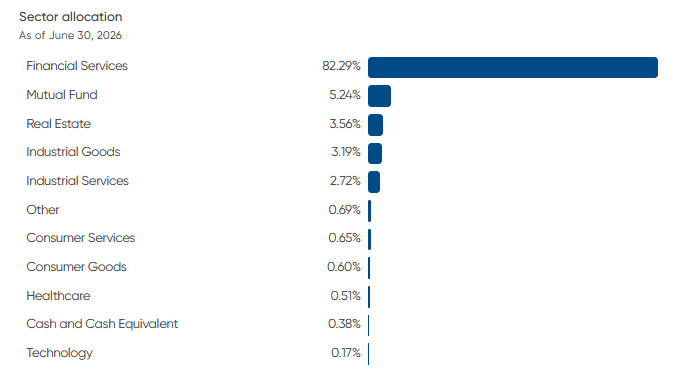
That means the portfolio consists of many of the world's largest listed alternative asset managers across North America, Europe, and Canada. Because of that construction, the ETF is effectively a concentrated financial services fund, with virtually all of its holdings coming from the asset management industry.
Source: National Bank Investments
National Bank Investments offers NGPE with a 0.63% management expense ratio. While that's expensive compared to a broad market ETF, it's fairly typical for a specialized thematic strategy. My larger concern is liquidity. Despite growing to $342 million in assets under management, NGPE is thinly traded.
For the 12 months ended March 31, 2026, the ETF posted an average 30-day median bid-ask spread of 0.31%. That's quite wide by ETF standards and means investors who frequently buy and sell the fund may incur meaningful transaction costs beyond the stated expense ratio.
Why NGPE Isn't Really a Private Equity Replacement
The investment thesis behind NGPE is one step removed from what most investors probably expect. When you buy the ETF, you're not betting directly on the performance of private companies. Instead, you're betting on the businesses that manage private equity funds.
Those businesses succeed for different reasons than the investments they oversee. Their earnings depend on factors such as raising additional assets under management, generating management and performance fees, expanding into new products, and maintaining healthy fundraising pipelines. Strong private equity returns certainly help attract capital, but they're only one input.
In other words, there is a relationship between private equity performance and the companies NGPE owns, but it is indirect. You're owning a publicly traded asset manager that sponsors private equity funds, which in turn own stakes in private companies. That's several layers removed from actually holding the private businesses themselves.
There's nothing inherently wrong with that. Publicly listed alternative asset managers can be attractive investments in their own right, particularly during periods when fundraising and deal activity are strong. The trade-off is that they also tend to amplify moves within the broader financial sector.
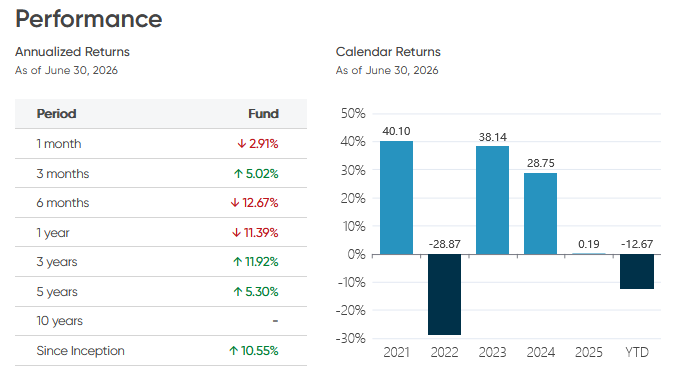
That downside has already been evident. During the 2022 bear market, NGPE declined 28.87%. More recently, ongoing uncertainty surrounding private markets and alternative assets has weighed on the ETF, leaving it down 12.67% year-to-date as of June 30, 2026.
Source: National Bank Investments
None of this makes NGPE a bad investment. Investors simply need to understand what they're buying. You're getting concentrated exposure to publicly traded financial companies, a relatively high expense ratio, a fairly wide bid-ask spread, and performance that can be considerably more volatile than the broad market. What you're not getting is direct ownership of private equity investments.
If your objective is obtaining genuine exposure to private businesses, the Canadian market still offers few straightforward solutions. One interesting TSX listed alternative is Alaris Equity Partners Income Trust (AD.UN), which provides preferred-based financing to private middle-market companies. The drawback, of course, is that a single stock cannot offer the diversification of an ETF.
For now, I think NGPE remains a reasonable thematic ETF for Canadian investors who want exposure to the economics of the private equity industry. It just shouldn't be mistaken for a true private equity fund.