
The Bitcoin Barbell Portfolio (Canadian Investor Edition)
Last Updated:

I'm a firm believer that investors don't always need to settle for the conventional middle ground. A lot of my thinking here comes from Nassim Nicholas Taleb, the statistician, former options trader and author of books including The Black Swan and Antifragile.
One of the concepts he's best known for is the barbell strategy: concentrate most of your capital at the extremely safe end of the risk spectrum while putting a small portion at the highly speculative end, deliberately minimizing exposure to everything in between.
I've previously applied that concept using U.S.-listed exchange-traded funds (ETFs), but Canadian investors can build the same portfolio entirely on the Toronto Stock Exchange. In fact, Canada was ahead of the U.S. when it came to making Bitcoin accessible through ETFs. Canadian spot Bitcoin ETFs arrived in 2021, almost three years before U.S. spot Bitcoin ETFs received approval in January 2024.
So, let's revisit the Bitcoin barbell portfolio from a Canadian perspective. We'll put 90% into short-term, high-quality Canadian fixed income and the remaining 10% into a Canadian-listed spot Bitcoin ETF, rebalance monthly, and see how the resulting portfolio compares against the S&P 500.
What Is the Barbell Strategy?
Taleb's barbell strategy involves dividing risk between two extremes rather than concentrating capital in the middle ground.
A simplified implementation might put 90% of the portfolio into something with minimal credit and interest-rate risk while allocating the remaining 10% to something capable of producing disproportionately large returns. The speculative allocation can fail badly without necessarily destroying the overall portfolio because its starting weight is deliberately limited.
The other side of the barbell is equally important. You don't want the supposedly safe 90% unexpectedly introducing substantial risk of its own. That's why I prefer short-term government securities here rather than intermediate- or long-term bonds. The objective is stability, liquidity and some positive carry while the risky side does the heavy lifting when conditions are favorable.
Bitcoin happens to fit the other side unusually well. It can experience drawdowns exceeding 50%, so I certainly wouldn't characterize it as defensive. But it has also demonstrated the ability to appreciate several hundred percent during favorable cycles.
With only 10% initially allocated to Bitcoin, we don't need it to behave defensively. We need the safe 90% to control portfolio-level risk while leaving enough exposure for a major Bitcoin rally to meaningfully affect overall returns.
The Safe Side of the Barbell
For the 90% defensive allocation, I'm looking for an ETF holding short-term, high-quality Canadian government securities. The objective here isn't maximizing yield. Extending duration or moving down the credit-quality spectrum might increase income, but doing so also introduces risks that undermine the purpose of this side of the barbell.
My ETF of choice for this allocation is the Harvest Canadian T-Bill ETF (TBIL). The ETF currently charges a management expense ratio (MER) of 0.11% and pays a current yield of 2.21%.
For this portfolio, that's exactly what I want. The safe allocation isn't supposed to outperform stocks or produce exciting returns. Its job is to preserve capital, provide liquidity and generate enough income to avoid the persistent negative carry associated with many traditional hedging strategies.
The Risky Side of the Barbell
The remaining 10% goes in the opposite direction. Rather than taking slightly more credit risk or adding another conventional equity allocation, I want something capable of producing highly asymmetric outcomes. Bitcoin remains one of the clearest examples available to Canadian ETF investors.
For this portfolio, I'm using the CI Galaxy Bitcoin ETF (BTCX.B). The ETF charges an MER of 0.68% and holds approximately $835 million in assets under management
There are no covered calls, leverage or futures required for this allocation. I simply want approximately 10 cents of every portfolio dollar exposed to spot Bitcoin. That distinction matters because I'm looking for the possibility of a melt-up.
Selling covered calls would sacrifice some of the upside I'm specifically trying to capture, while leverage would introduce additional path dependency and potentially allow the risky allocation to lose more rapidly than intended. Bitcoin itself is already volatile enough!
Putting the Bitcoin Barbell Together
The updated backtest makes a strong case for the basic barbell concept. From 2010 through 2026, the Bitcoin Barbell produced a 16.82% compound annual growth rate (CAGR), ahead of the S&P 500 at 15.01%. A hypothetical $10,000 investment grew to $122,043.89 versus $94,861.09 for the S&P 500.
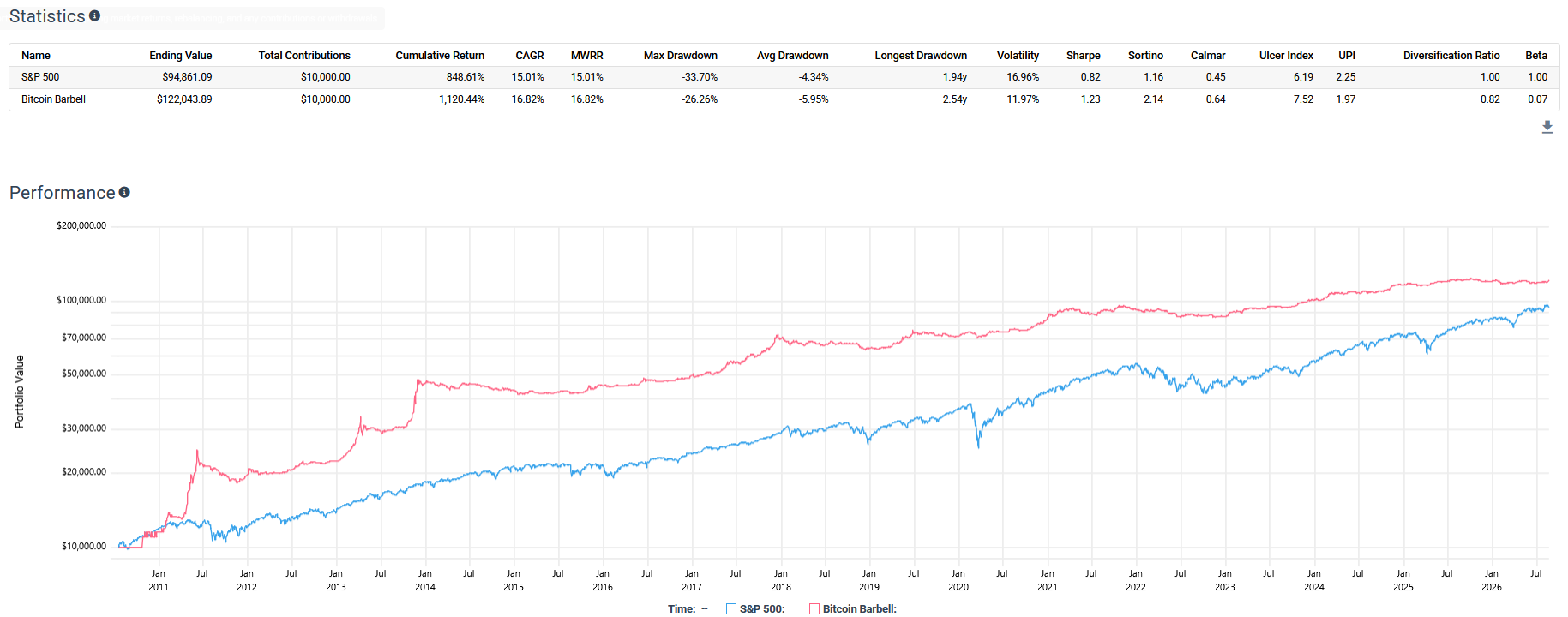
Source: Testfolio
More importantly, that additional return came with considerably less portfolio-level volatility. The Bitcoin Barbell posted annualized volatility of 11.97% versus 16.96% for the S&P 500. Its maximum drawdown was also shallower at 26.26% versus 33.70%. That combination resulted in a substantially better Sharpe ratio of 1.23 compared with 0.82 for the S&P 500.
There are some important limitations to this backtest. I used historical Bitcoin and Treasury bill returns represented through U.S.-listed investments because Canadian-listed spot Bitcoin ETFs only date back to 2021. A Canadian implementation won't reproduce these results exactly. Management expense ratios, trading costs, differences between the ETFs and, depending on the products selected, fluctuations between the Canadian and U.S. dollars could all cause returns to diverge.
Bitcoin's historical performance also provides an unusually favorable tailwind that investors shouldn't assume will repeat. The backtest nevertheless remains instructive for demonstrating the mechanics of the strategy. Most of the portfolio provides stability and positive carry, while a deliberately small allocation to a highly volatile asset provides enough upside potential to materially affect returns. For me, that's the main appeal of the Bitcoin barbell.