
United States Oil Fund LP (USO): Read This Article Before Investing!
Last Updated:

Donald Trump campaigned on a promise to make gas prices affordable again. But after killing Ayatollah Ali Khamenei alongside Israel, well, that is another campaign promise broken for MAGA.
As I write this, the price of West Texas Intermediate (WTI) crude oil is sitting at $94.89 per barrel. Some analysts are forecasting it could climb as high as $120 if the conflict is not resolved in a timely manner.
One thing I am noticing is a surge in investor interest in oil ETFs. Search queries like “how to invest in oil” or “best oil ETFs” tend to point people toward one in particular: the United States Oil Fund LP (USO).
On the surface, that makes sense. The name is straightforward, and it has been around for a long time. But for several reasons, investors should be very careful before buying this fund.
That does not mean you cannot use it to express a view on oil prices. You absolutely can. That is what it was designed for, and it works fairly well as a tactical trading tool.
However, many investors overlook details that can lead to long-term underperformance or unexpected complications when tax season arrives. Here is what you need to know before investing in USO.
What Is USO?
USO aims to track the price of WTI light sweet crude oil delivered to Cushing, Oklahoma. On a daily basis in percentage terms, the fund attempts to have its net asset value reflect the movement in oil prices.
It does this through a bit of financial engineering. The returns for USO comes from two sources: the daily change in the oil futures contracts it holds and any interest earned on the collateral backing those contracts, after subtracting expenses.
Over a 30-day period, the average daily return of the fund is expected to stay within that same ±10% band of the benchmark’s daily movements. That sounds complicated, but the simple takeaway is this: USO is designed to move roughly in line with short-term oil prices, not to perfectly mirror them.
Looking at the holdings as of March 9, 2026, USO is largely long the May 2026 WTI crude oil futures contract. A futures contract is simply an agreement to buy or sell a commodity at a predetermined price on a future date. In this case, the May contract reflects the market’s expectation of what a barrel of WTI crude will be worth when that contract expires in May.
The fund also supplements its exposure using swaps with banks such as Société Générale and Macquarie. All of these positions are backed by cash collateral held by the fund.
This is the point that often trips up new investors. Many people buy USO assuming they are effectively owning barrels of crude oil, similar to how a gold ETF holds physical bullion in a vault.
That is not what is happening here. When you buy USO, you are actually buying a bundle of financial derivatives tied to oil prices. That distinction introduces some complications, which brings us to the next concept investors need to understand contango.
The Problem with Contango
Oil futures exist for many delivery months into the future. The contract closest to expiration is called the front-month contract, followed by contracts for later months.
For example, in March the front-month contract might be April WTI crude, followed by May, June, July, and so on. Each of these contracts can trade at slightly different prices depending on market expectations. Plotting all those prices together creates what is called the futures curve.
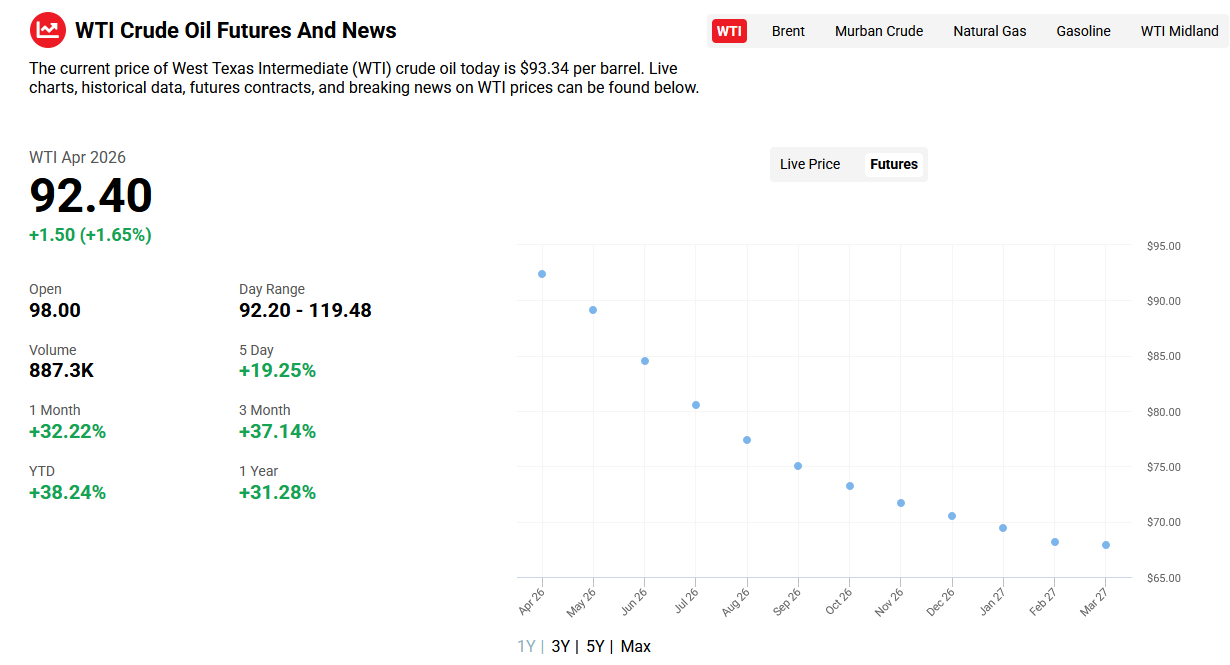
Contango occurs when contracts further out in time are trading at higher prices than the current spot price of oil. The further you go along the curve, the more expensive the contracts become.
This matters because USO typically holds near-term contracts, such as the May WTI contract right now. When that contract gets close to expiration, the fund cannot actually take delivery of crude oil in Oklahoma. Instead, it must sell the contract that is about to expire and buy a later-month contract.
If the futures curve is in contango, that process effectively means selling low and buying high. Over time, this creates what is known as negative roll yield, which becomes a persistent headwind for investors.
Commodity futures curves spend a lot of time in contango. Pricing incorporate the cost of storing and financing the commodity. Oil sitting in storage tanks costs money to maintain, insure, and transport. Those costs tend to push longer-dated contracts higher than the spot price.
The opposite situation is called backwardation, where near-term prices are higher than future prices. That typically occurs during periods of tight supply or immediate demand shocks. In those environments, rolling futures can actually generate positive roll yield. But those periods tend to be temporary, and they are not the dominant state of most commodity markets.
You can see the effect clearly when comparing USO to the actual price of oil. Over the past decade, even when crude oil has experienced major rallies, USO has massively underperformed the spot price of WTI due largely to contango. In other words, USO is a terrible buy-and-hold investment.
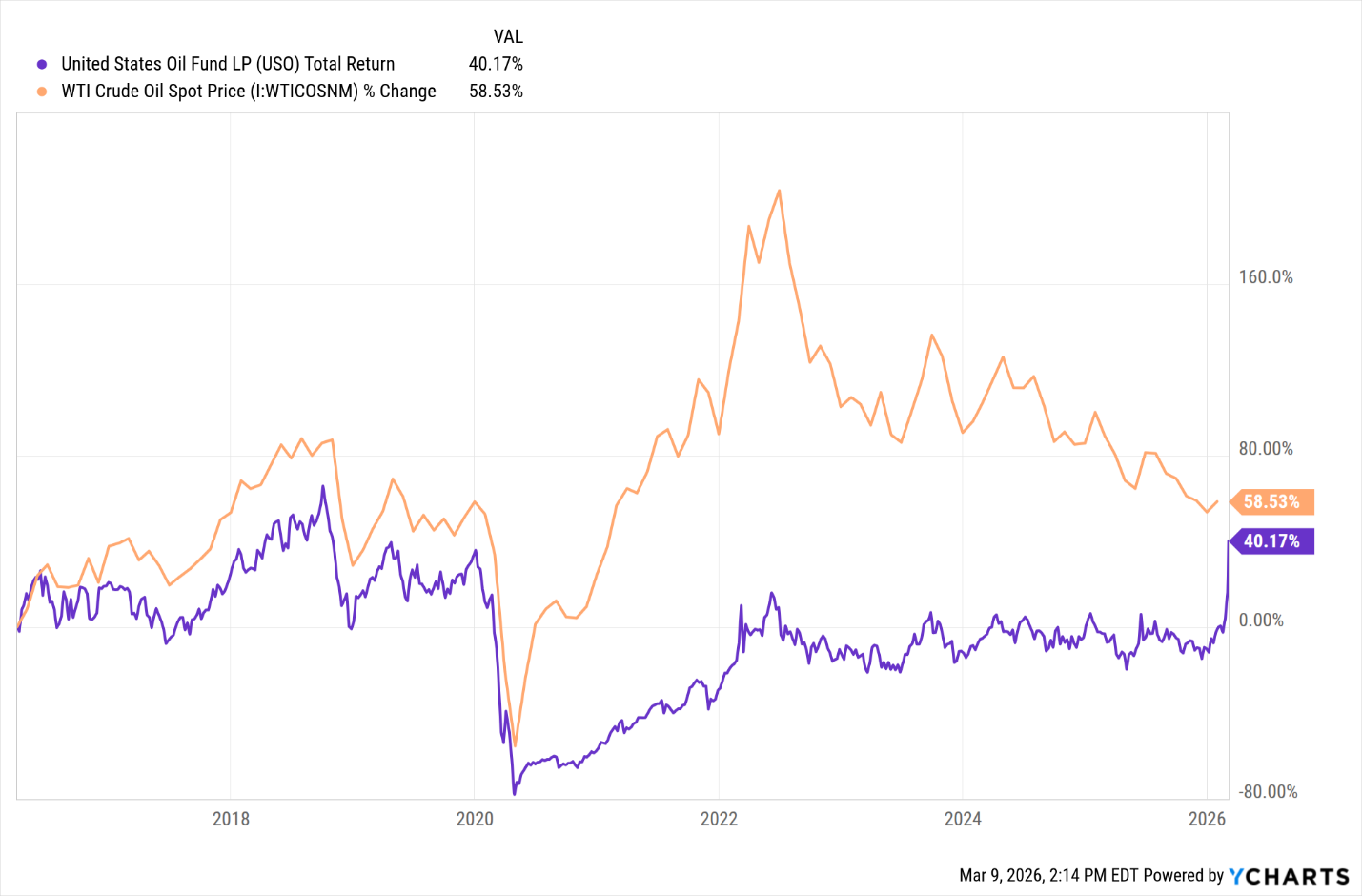
That does not mean the fund is useless. Because it holds near-month futures, USO tends to have a reasonably strong short-term correlation with the spot price of oil. Traders looking to express a short-term view on crude prices can potentially use it as a tool.
The Tax Headache: Schedule K-1
You might have noticed something about USO’s name. The “LP” is not just stylistic branding. It refers to how the fund is legally structured.
Most ETFs are organized as regulated investment companies under the Investment Company Act of 1940. Investors simply receive a Form 1099-DIV at tax time that summarizes dividends, interest, capital gains distributions, and return of capital, if any.
USO is different. Instead of a traditional ETF structure, USO is organized as a commodity pool structured as a limited partnership. That means the tax treatment works differently.
Any gains, losses, or income generated by the fund flow directly through to you as the partner. You have to report those on your personal tax return. To do that, the fund sends investors a Schedule K-1.
A Schedule K-1 is a much more complicated tax document than the standard 1099-DIV most ETF investors are used to. It outlines your share of the partnership’s income, gains, losses, deductions, and other adjustments that must be reported on your tax return.
If you have never dealt with one before, they are a massive pain in the ass. The forms are longer, the reporting is more complex, and they often involve additional tax calculations.
There is another problem: timing. K-1 forms frequently arrive later than typical brokerage tax documents. While most 1099 forms are available fairly early in the tax season, K-1s can show up weeks later. That can delay your tax filing if you are waiting for all your documents to arrive.
With USO, the K-1 applies regardless of how long you held the position. You could have bought and sold the fund once during the year, and you will still receive a K-1 because you were technically a partner in the commodity pool during that period.
For many investors (including myself), that tax complexity alone is enough to make them think twice about using USO outside of very short-term trading situations.