KORX: Meet Canada’s First Country-Specific South Korea ETF
Last Updated:
Canadian investors are hardly short of ETF choices. As of September 3, 2026, the Cboe ETF Market Canada screener counted 2,055 exchange-traded funds spanning everything from broad-market equities and fixed income to commodities, cryptocurrencies, and options strategies.
That breadth is not distributed evenly across every foreign market, however. Applying the screener’s country filters on that date returned just six Canada-listed ETFs focused on Japan and four focused on China. Meanwhile, South Korea was missing entirely, meaning Canadian investors seeking dedicated exposure to the country generally had to look to U.S.-listed ETFs.
That is a notable gap considering South Korea’s economic development. From 2016 through 2025, real gross domestic product growth averaged roughly 2.3% annually in South Korea, compared with about 0.5% in Japan. Compounded across those annual growth rates, that translates into roughly 26% cumulative real growth for Korea over the period, versus about 5% for Japan.
The composition of that economy is arguably more interesting from an investment perspective. South Korea has built globally competitive franchises across semiconductors, automobiles, displays, smartphones, appliances, and other consumer technology. Now, dedicated Canadian-listed access to that market has now arrived with the Global X Korea KOSPI 200 Index ETF (KORX).
But before getting into KORX itself, I want to look at what makes South Korea different from the other major Asian markets, where its economic strengths come from, the unique risks that accompany a Korean equity allocation, and how the KOSPI 200 (and KORX) is constructed.
The Industries Powering South Korea’s Economy
South Korea’s economy remains manufacturing intensive. Manufacturing generated roughly 27.4% of gross domestic product in 2025, while merchandise exports reached a record $709.7 billion. This was mostly enabled by an export-heavy economy of semiconductors, vehicles, and consumer electronics.
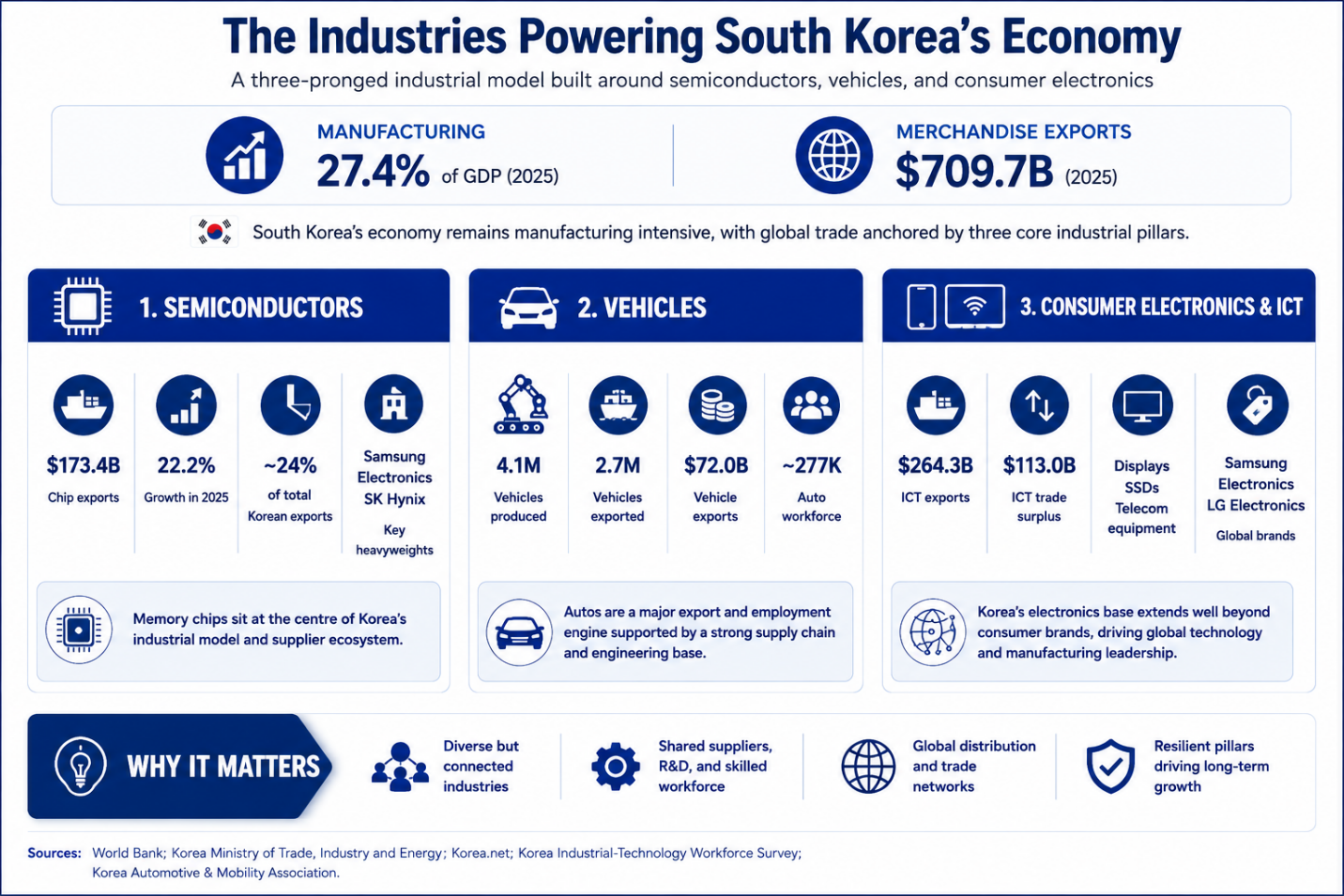
Semiconductors sit at the centre of that model. Chip exports climbed 22.2% to a record $173.4 billion in 2025, equivalent to about 24% of all Korean exports, as demand for high-bandwidth memory and other AI-related components accelerated, particularly in memory chips.
That ecosystem is economically important beyond exports. Korea’s industrial-technology workforce survey found employment in the semiconductor sector grew 4.3% in 2024, one of the fastest job growth rates among the country’s major strategic industries.
Automobiles form another major pillar. Korea produced roughly 4.1 million vehicles in 2025 and exported about 2.7 million of them, meaning approximately two-thirds of domestic production was sold overseas. Vehicle exports reached a record $72.0 billion, including $25.8 billion of eco-friendly vehicles and a record $14.8 billion of hybrids.
Hyundai Motor and Kia are the most visible manufacturers, but their scale supports a much broader domestic network of component makers, battery suppliers, engineering companies and manufacturing facilities. The employment footprint is correspondingly large: Korea’s automotive-industry workforce statistics counted approximately 277,000 workers in 2025.
Consumer electronics and information technology provide a third layer. Korea’s information and communications technology exports reached a record $264.3 billion in 2025, producing a $113.0 billion trade surplus. Semiconductors make up the largest portion of that total, but Korea also exports displays, solid-state drives, telecommunications equipment, smartphones and other electronics.
Samsung Electronics and LG Electronics give the country globally recognized consumer-facing brands, while companies throughout the supply chain manufacture OLED displays, batteries, storage products, electronic components, and the equipment used to support them. That breadth is noteworthy because South Korea’s industrial base is not dependent on a single export category.
Where Korea’s Economic Strengths Come From
South Korea’s industrial success did not develop in isolation from its demographics and social infrastructure, and the clearest socio-economic advantageous come from significant investments in education, research, and safety.
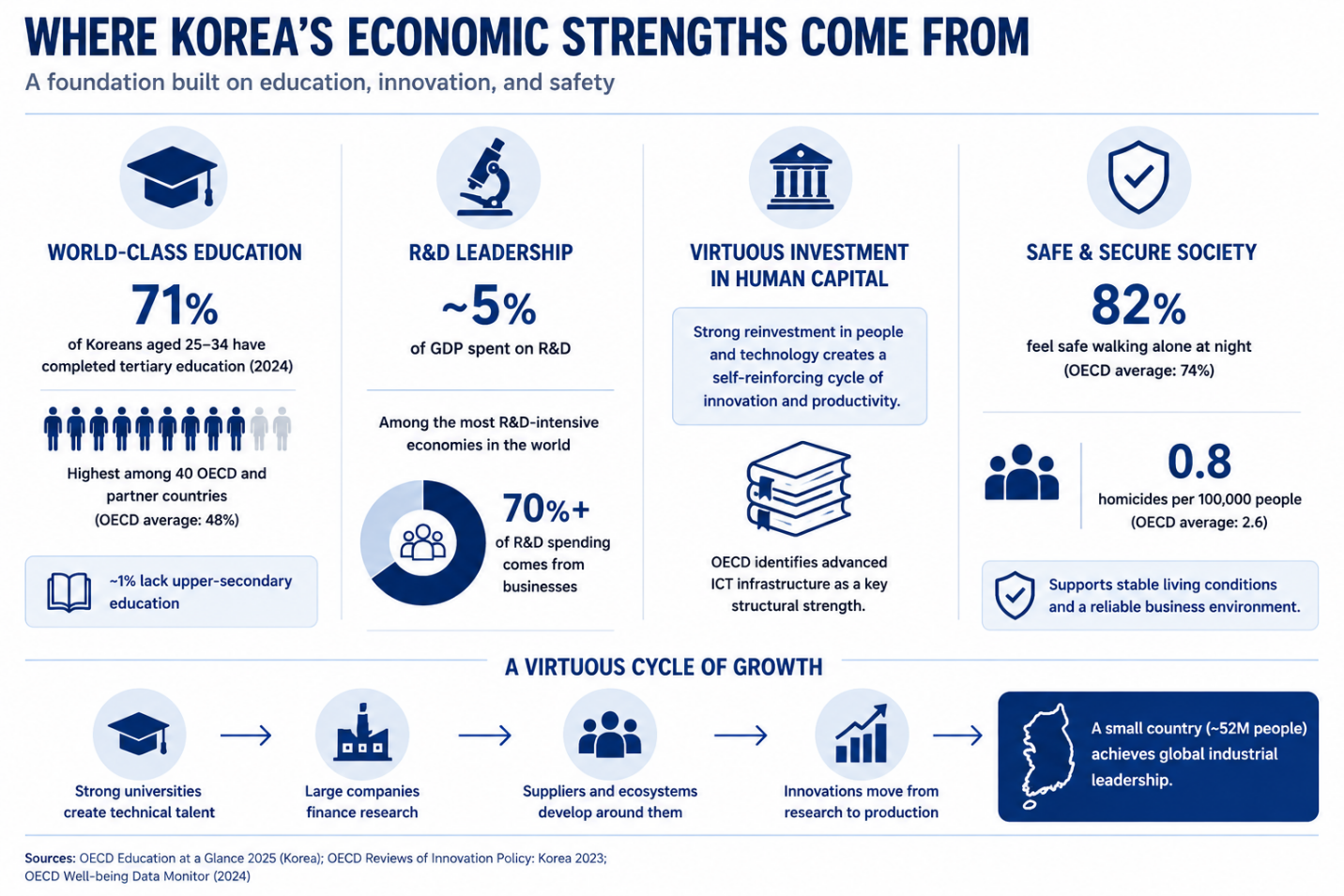
Roughly 71% of Koreans aged 25 to 34 had completed tertiary education in 2024, the highest proportion among the 40 Organization for Economic Co-operation and Development (OECD) and partner countries measured, compared with an OECD average of 48%. Only about 1% of young adults lacked an upper-secondary education.
That demographic provides Korea with a deep pool of engineers, researchers, technicians and other skilled workers for industries like semiconductors, where manufacturing increasingly depends on advanced science and engineering rather than simply inexpensive labour. Korea has also consistently reinvested in that human capital.
Research and development spending has approached 5% of GDP, placing the country among the most R&D-intensive economies in the world, with businesses responsible for the majority of that spending. The OECD also identifies Korea’s advanced information and communications technology infrastructure as one of the country’s structural strengths.
Those characteristics reinforce each other in a virtuous cycle: strong universities create technical talent, large manufacturers finance research, suppliers develop around them, and dense digital infrastructure helps new technologies move from research into commercial production.
There are less obvious advantages as well: Korea is a relatively safe place to live and operate a business. About 82% of Koreans report feeling safe walking alone at night, compared with a 74% OECD average, while the country’s homicide rate of 0.8 per 100,000 people is less than one-third of the OECD average.
Combine that with modern transportation networks, high urban density, digital connectivity and a highly educated workforce, and it becomes easier to understand how a country with a population of roughly 52 million built globally important positions in semiconductors, automobiles, and electronics.
The Risks That Accompany a Korean Equity Allocation
No discussion of dedicated South Korean equity exposure is complete without looking at the other side of the ledger. The main issue is concentration exacerbated by leverage. The KOSPI 200 may contain 200 companies, but the headline number overstates how diversified the basket currently is.
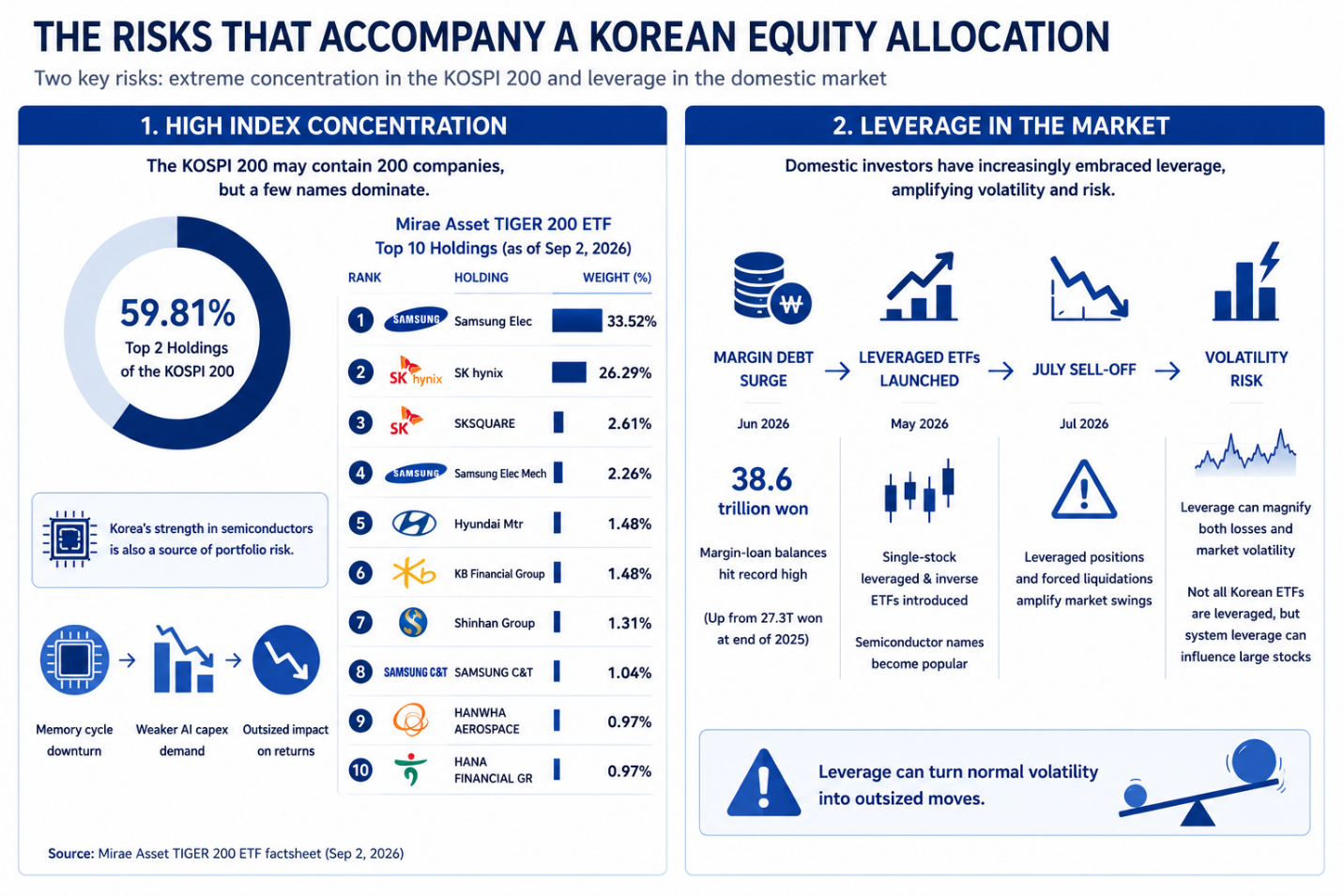
As of September 2, 2026, Samsung Electronics represented 33.52% of the index and SK Hynix another 26.29%. For an investor, that means South Korea’s semiconductor strength can also become a source of portfolio risk. A downturn in the memory cycle or weaker AI-related capital spending could have an outsized effect even if conditions elsewhere in the Korean economy remain relatively healthy.
Bringing the KOSPI 200 to Canadian Investors
For Canadian investors who decide they want a dedicated South Korean allocation, KORX packages that exposure around the country’s primary large-cap benchmark at a 0.45% management fee, available in both Canadian and U.S. denominated variants.
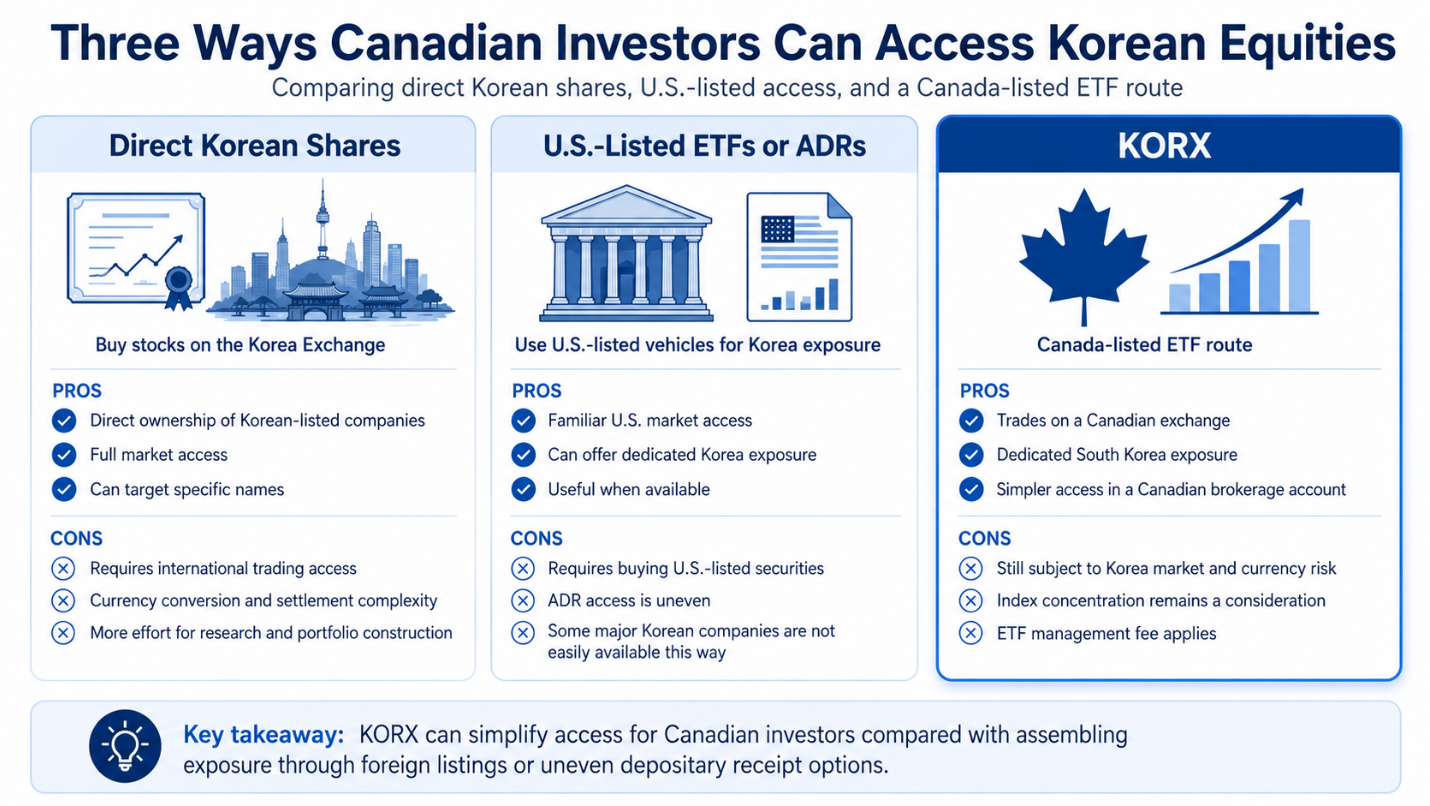
Until KORX, the straightforward ETF route for Canadians wanting dedicated South Korean exposure was largely through U.S.-listed ETFs. KORX trades on a Canadian exchange and removes the need to purchase a U.S.-listed ETF simply to obtain a dedicated Korea allocation.
Trying to build the same exposure stock by stock can be considerably less convenient. Canadian Depositary Receipts now provide Canadian-dollar access to more than 130 international companies, but the current CIBC CDR directory does not provide comparable coverage of Korea’s major corporate champions such as Samsung Electronics or SK Hynix.
U.S.-listed American Depositary Receipt access is similarly uneven. Samsung’s ordinary shares trade in Seoul, while its Global Depositary Receipts trade in London rather than on a major U.S. exchange. Hyundai Motor went a step further and delisted its GDRs from London and Luxembourg in December 2024 after citing low trading volume and the cost of maintaining the programs.
That creates an accessibility problem that is easy to overlook when discussing a country such as South Korea. Some of its most important companies are household names globally, yet their primary shares remain considerably less straightforward for a Canadian retail investor to purchase than other foreign companies with widely accessible North American listings.
Investors still need to be comfortable with the concentration, currency, semiconductor-cycle, demographic, and geopolitical risks discussed earlier. But for those who specifically want a South Korean allocation, KORX provides a homegrown route to the market rather than requiring a U.S.-listed ETF or a patchwork of individual overseas listings.