
The North American Dividend Growth ETF Portfolio (1.25x Leveraged Edition)
Last Updated:

What’s better than investing in high-quality blue-chip companies with long histories of growing dividends consistently? Investing more in them, but using someone else’s money. That’s the idea behind leveraged dividend strategies.
When done recklessly, leverage has a bad reputation. Most investors associate it with day trading, margin calls, and blowups. But when applied conservatively, at the portfolio level, and backed by durable cash-flowing businesses, leverage can be a tool to enhance total returns.
We previously explored this concept in The North American Dividend Growth ETF Portfolio (Canadian Investor Edition), where we combined the Hamilton CHAMPIONS™ U.S. Dividend Index ETF (SMVP) and the Hamilton CHAMPIONS™ Canadian Dividend Index ETF (CMVP) in a 70/30 allocation.
Today, we’re taking that same idea one step further. This version simply scales the exposure modestly through embedded leverage using the Hamilton CHAMPIONS™ Enhanced U.S. Dividend ETF (SWIN) and the Hamilton CHAMPIONS™ Enhanced Canadian Dividend ETF (CWIN).
The concept is identical, but the risk and return profile is different. And importantly, this is structurally different from the daily reset, swap-based leveraged ETFs commonly used for short-term speculation. Here’s how the enhanced version works.
SWIN: Enhanced U.S. Dividend Champions
SWIN provides exposure to a portfolio of U.S. dividend champions, defined as companies that have increased their dividends for at least 25 consecutive years without interruption.
This screening process naturally favors large-cap, blue-chip businesses with durable competitive advantages, stable cash flows, and disciplined capital allocation. The resulting portfolio tends to tilt toward sectors such as consumer staples, healthcare, and industrials.

What makes SWIN different is the use of 1.25x cash leverage. For every $100 invested, the ETF borrows approximately $25 and invests the full $125 into the same dividend champions portfolio. Backtested, this type of dividend growth strategy paired with modest leverage has delivered index-beating returns.
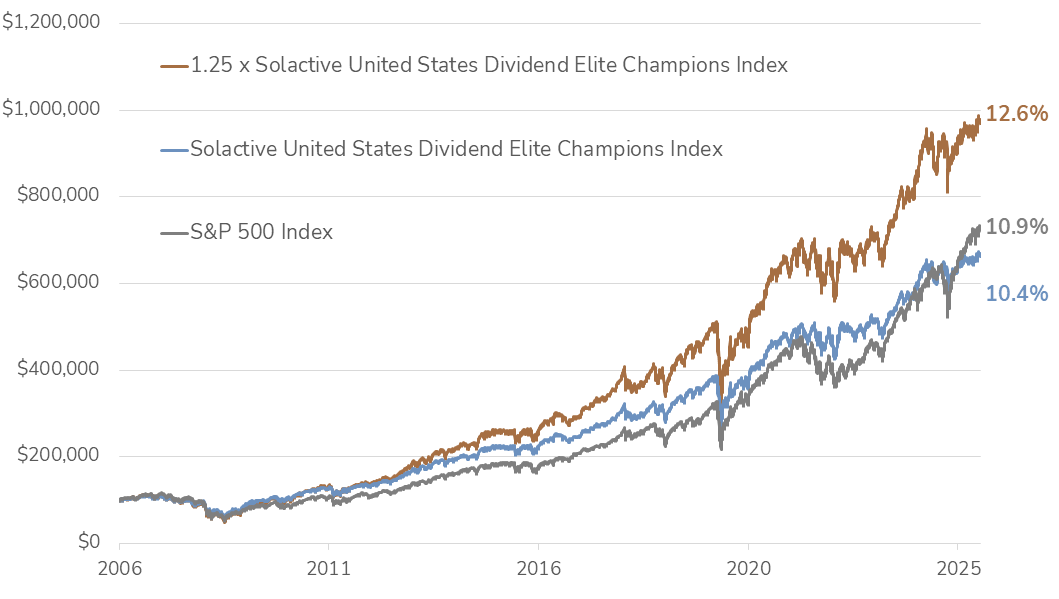
That modest leverage increases exposure to dividend growth and equity returns without requiring investors to borrow personally. There is no need for a margin-enabled brokerage account. The structure also allows the ETF to be held inside registered accounts such as a TFSA, RRSP, or FHSA.
The leverage is implemented centrally and financed at institutional rates, which are typically far more efficient than retail margin borrowing. The result is a smoother, more scalable way to enhance income and return potential from a conservative equity base.
CWIN: Enhanced Canadian Dividend Champions
CWIN applies the same enhanced structure to Canadian dividend growers. The underlying portfolio consists of Canadian companies that have raised dividends consistently over multiple years, resulting in a familiar lineup of banks, pipelines, utilities, railways, and energy infrastructure firms.

Like its U.S. counterpart, CWIN uses 1.25x leverage, borrowing approximately 25% of net assets and investing the proceeds into the same dividend growth portfolio. This amplifies income and return potential while keeping the strategy accessible within registered accounts.
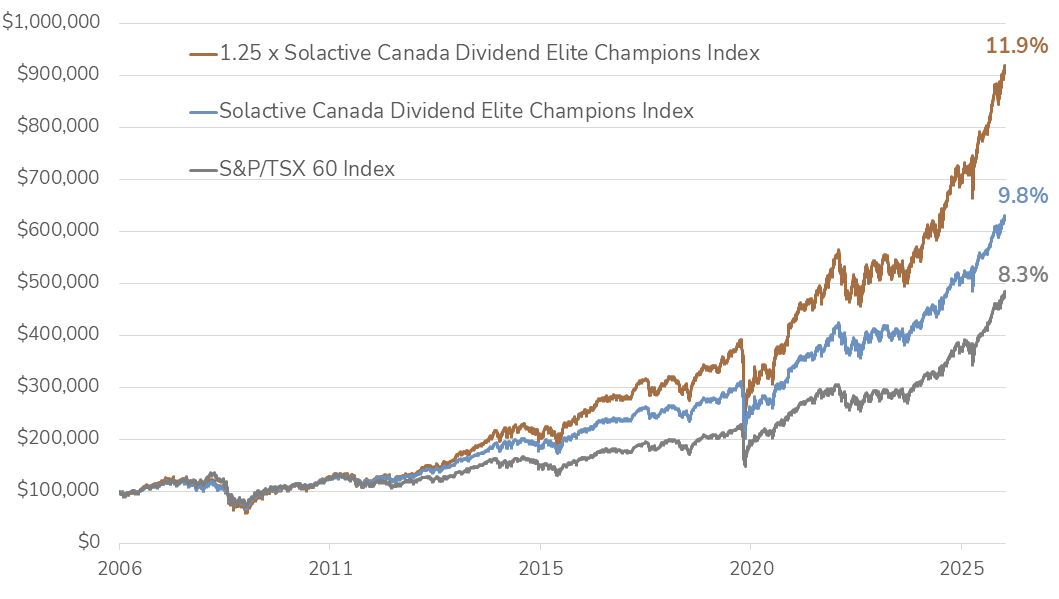
Because the holdings are Canadian equities, currency risk is not a factor here, and distributions are largely eligible Canadian dividends. From a portfolio construction standpoint, CWIN offers enhanced exposure to domestic income-generating equities without relying on complex derivatives.
The risk trade-off is straightforward. During strong equity markets, leverage works in your favor. During drawdowns, losses will be magnified relative to an unlevered dividend ETF. The strategy relies on the same principle that makes dividend growth investing work in the first place: resilience, patience, and a long time horizon.
Putting the Portfolio Together
A simple way to combine these ETFs is a 70% allocation to SWIN and 30% to CWIN. This mirrors the approximate weight of the U.S. within global equity markets, while maintaining a meaningful home-country allocation for tax efficiency and lower currency risk
The result is a North American dividend growth portfolio that prioritizes quality first, then scales exposure modestly through embedded leverage. It’s a deliberate choice to lean slightly harder into a proven equity income strategy, using institutional-grade leverage rather than personal margin, and letting dividend growth do the heavy lifting over time.
As always, there’s no free lunch. But for investors who already believe in dividend growth and want to responsibly enhance its impact, I believe this is one of the cleaner ways to do it.