
How to Create a Low-Cost, Tax-Efficient, and Inflation-Resistant Retirement Income ETF Portfolio
Last Updated:

One trend I've noticed in the ETF industry over the past few years is an increasing creep toward complexity. Don't get me wrong - as someone who spends a lot of time thinking about risk management, I'm actually a big fan of derivatives. They have legitimate use cases, whether that's hedging portfolio risk or producing tax-efficient income.
But we also need to acknowledge that greater complexity often brings greater risk, and almost always comes with higher fees. For investors who are less concerned with shooting the lights out and more focused on actually living off their portfolio, particularly during retirement, I think simplicity still wins.
In my view, a retirement income portfolio should be built around three core pillars: keeping fees low, keeping distributions as tax efficient as possible, and ensuring that returns have a reasonable chance of staying ahead of inflation over the long run, not just the Federal Reserve's 2% target.
Fortunately, you don't need complicated strategies to accomplish that. A handful of low-cost index ETFs can get you remarkably close. Today I'm going to walk through a simple four-fund portfolio built entirely with Vanguard ETFs that screens well across all three of those objectives.
The idea is straightforward. Combine a dividend growth ETF, a high-dividend-yield ETF, a Treasury Inflation-Protected Securities (TIPS) ETF, and a municipal bond ETF. If you prefer another provider such as State Street, iShares, Invesco, or Charles Schwab, you'll find comparable alternatives, but Vanguard's lineup makes for a clean example.
Together, they create a retirement income portfolio designed to keep costs low, improve tax efficiency, and help preserve purchasing power over time. Here's how the portfolio works.
60% in Dividend ETFs
The equity portion of this portfolio consists entirely of dividend ETFs, split evenly between 30% in the Vanguard Dividend Appreciation ETF (VIG) and 30% in the Vanguard High Dividend Yield ETF (VYM).
Before we get into the funds themselves, it's worth addressing one of the biggest misconceptions in retirement investing: dividends are not free money.
From a total return perspective, receiving a $1 dividend is economically equivalent to selling $1 worth of shares. All else being equal, an ETF's net asset value drops by the amount of the distribution on the ex-dividend date.
That said, investing isn't just about mathematics. Many retirees exhibit a form of mental accounting where dividend income feels like spending the portfolio's "income," while selling shares feels like depleting principal, even though the economic outcome is identical.
If using dividend ETFs helps you stay disciplined, avoid panic selling, and stick with your long-term plan, I think that's a perfectly reasonable behavioral advantage. Just remember to keep costs low, remain diversified, and recognize that every dividend distribution is a taxable event.
With that in mind, Vanguard offers two of the strongest options available. Both ETFs charge an expense ratio of just 0.04%, meaning investors incur only about $4 in annual fees for every $10,000 invested, all else being equal.
VIG tracks the S&P U.S. Dividend Growers Index, which requires companies to have increased their dividends for at least 10 consecutive years. The index also deliberately excludes the highest-yielding 25% of eligible companies, helping avoid many potential yield traps before weighting the remaining stocks by market capitalization, subject to a 4% cap on any individual holding.
VYM takes a different approach. It tracks the FTSE High Dividend Yield Index, excludes companies that have not paid a regular dividend over the past year or are not expected to pay one going forward, then ranks the remaining companies by forward dividend yield before weighting them by market capitalization.
From a tax-efficiency standpoint, both funds also make a sensible decision by excluding real estate investment trusts (REITs), whose distributions are generally taxed as ordinary income. As a result, based on their 2025 tax classifications, both VIG and VYM distributed 100% qualified dividends, making them relatively tax-efficient choices for taxable accounts.
The income characteristics complement each other nicely. VYM currently offers a higher 30-day SEC yield of approximately 2.25%, providing a stronger source of current cash flow, while VIG offers a lower 1.52% SEC yield but greater emphasis on long-term dividend growth.
One final point often goes unnoticed. These are effectively factor ETFs without marketing themselves as such. VIG naturally tilts toward the quality factor, emphasizing companies with durable earnings, strong profitability, and consistent dividend growth. VYM, meanwhile, has a natural value factor tilt because higher dividend yields often coincide with lower relative valuations.
40% in Bond ETFs
A lot of DIY investors default to an aggregate bond ETF, and I think that's a bit suboptimal. They're certainly diversified, inexpensive, and perfectly reasonable core holdings, but the large allocation to taxable corporate bonds tends to reduce tax efficiency, particularly for retirees investing in taxable brokerage accounts.
Instead, I would allocate 40% of the portfolio equally between 20% in the Vanguard Tax-Exempt Bond ETF (VTEB) and 20% in the Vanguard Short-Term Inflation-Protected Securities ETF (VTIP).
I like VTEB because, for an expense ratio of just 0.03%, it provides a broadly diversified portfolio of high-quality municipal bonds, the majority of which carry AA credit ratings. The fund currently offers a respectable 3.5% 30-day SEC yield.
While that may appear lower than many aggregate bond ETFs, remember that most of this income is exempt from federal income taxes and the alternative minimum tax (AMT), where applicable. For retirees holding fixed income outside tax-sheltered accounts, that can make the after-tax yield considerably more attractive.
That said, VTEB is not risk-free. Although the underlying credit quality is excellent, municipal bonds remain sensitive to interest rates. Rising-rate environments like 2022 demonstrated that even high-quality bonds can experience meaningful price declines. VTEB currently has an average duration of roughly seven years, giving it moderate interest rate sensitivity.
That's where VTIP complements the portfolio. VTIP also charges just 0.03%, but instead tracks the Bloomberg U.S. 0-5 Year Treasury Inflation-Protected Securities Index. By focusing on short-duration Treasury Inflation-Protected Securities (TIPS), the fund reduces interest rate risk substantially, with an average duration of approximately 2.4 years.
More importantly, VTIP helps protect purchasing power during inflationary periods. Unlike conventional bonds, the principal value of a TIPS bond is adjusted based on changes in the Consumer Price Index (CPI). As inflation rises, the principal value increases, and because coupon payments are calculated as a percentage of that inflation-adjusted principal, the dollar amount of interest payments rises as well.
VTIP currently reports a relatively modest 1.47% 30-day SEC yield, but it's important to understand what that number represents. The SEC yield reflects only the fund's real yield, before inflation adjustments. The actual return investors receive consists of both the real yield and whatever inflation adjustment is applied to the underlying securities.
Because future inflation cannot be known in advance, Vanguard cannot incorporate those adjustments into the published SEC yield. During periods of elevated inflation, such as 2022, the fund's total income was substantially higher than the quoted SEC yield would have suggested. Finally, it’s worth nothing that VTIP’s distributions are free from state and local taxes.
Putting the Portfolio Together
Because this portfolio is designed for retirement income rather than maximizing growth, I've deliberately opted for a conservative 60% equity / 40% fixed-income split.The final allocation is 30% VIG, 30% VYM. 20% VTEB, 20% VTIP.
To minimize taxable transactions and keep the portfolio as hands-off as possible, I assumed annual rebalancing throughout the backtest. Using testfolio, I compared this portfolio against a traditional 60/40 allocation consisting of the Vanguard Total Stock Market ETF (VTI) and the Vanguard Total Bond Market ETF (BND).
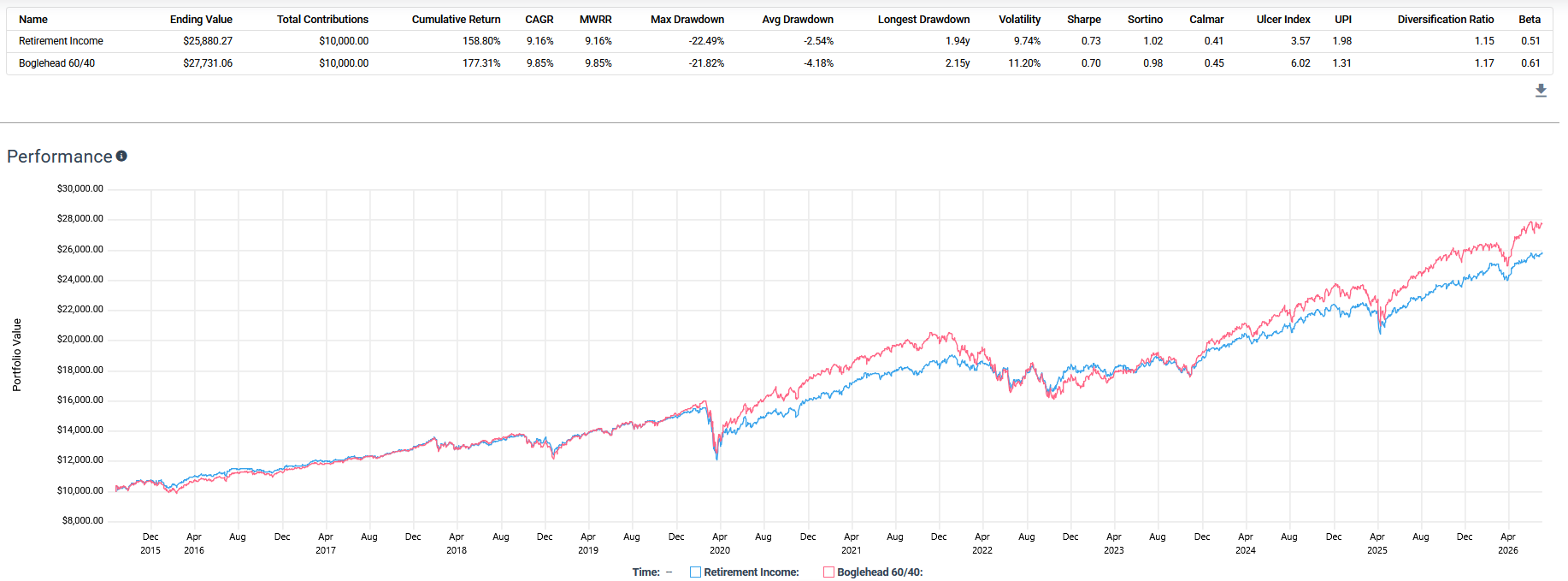
Source: testfolio
Over the 10.85-year period from August 25, 2015 through July 2, 2026, the portfolio generated a 9.16% annualized total return, modestly trailing the Boglehead-style VTI/BND portfolio, which returned 9.85% annually. However, the portfolio achieved that return with meaningfully lower annualized volatility, resulting in a superior Sharpe ratio of 0.73 versus 0.70 for the VTI/BND portfolio.
The tax picture is also notably different. VTI is already highly tax-efficient thanks to its low turnover, but BND generates largely ordinary interest income that is fully taxable at the federal level. By comparison, this portfolio combines qualified dividend income on the equity side through VIG and VYM with federally tax-exempt municipal bond income through VTEB, while VTIP provides inflation protection through U.S. Treasuries that spit out state tax exempt income.
For retirees investing outside tax-advantaged accounts, that combination can materially improve after-tax outcomes while maintaining a diversified, low-cost retirement income portfolio.