The Cockroach Portfolio: Active ETF Edition
Last Updated:

The ETF landscape has continued to grow, and one thing I’ve noticed is the increase in active ETFs. Some of these are actually pretty good. We’re seeing lower fees, strategies that go beyond closet indexing, and partnerships with notable hedge funds bringing their approaches into the ETF wrapper.
With that in mind, I’m revisiting my Cockroach Portfolio. For those unaware, this is a combination of five ETFs that historically has produced very strong risk-adjusted returns compared to both 100% equities and a standard 60/40 portfolio.
It’s pretty simple. You allocate one-fifth each to large-cap healthcare, utilities, consumer staples, gold, and Treasuries, and then you just rebalance the mix quarterly. The weighted average cost of the underlying ETFs is around 10 basis points.
That said, the Cockroach Portfolio is more of a mindset than a rigid formula. The goal was to find something that could survive almost anything. With that philosophy in mind, I think it’s worthwhile exploring an alternative built with active ETFs.
Today, we’re going to look at how to recreate the Cockroach Portfolio using the SPDR Bridgewater All Weather ETF (ALLW) and the Alpha Architect Tail Risk ETF (CAOS), both of which I’ve reviewed here and here. For convenience, I’ll summarize them again below and compare how this active version stacks up.
ALLW (80% Allocation)
ALLW is not a standard global stock-and-bond ETF. It is built on Bridgewater’s risk parity framework, which allocates assets based on their contribution to overall portfolio risk rather than expected returns.
In a traditional 60/40 portfolio, equities typically drive more than 90% of volatility. Risk parity attempts to balance that by sizing exposures so that no single asset class dominates the portfolio’s risk profile.
To accomplish that, ALLW expands beyond just stocks and nominal bonds. It includes four core asset classes: nominal government bonds, global equities, commodities, and inflation-linked bonds.
As of December 31, 2025, nominal government bonds made up 73.1% of the allocation, equities 43.6%, commodities 34%, and inflation-linked bonds 36.5%. These exposures add up to more than 100%, reflecting the use of leverage, primarily implemented through futures and swaps. Notional leverage has hovered around 1.8 to 1.9 times.
The goal is not to maximize returns in any one environment. The All Weather framework is designed to hold up across the four major economic regimes Ray Dalio often references: rising growth, falling growth, rising inflation, and falling inflation.
Different assets tend to perform well in different combinations of those conditions. By combining them and scaling the overall portfolio, the strategy seeks to deliver steadier, more consistent performance across cycles.
In practice, Bridgewater builds the macroeconomic allocation model and State Street implements it systematically. It is not discretionary macro trading, but a rules-based execution of a regime-aware framework.
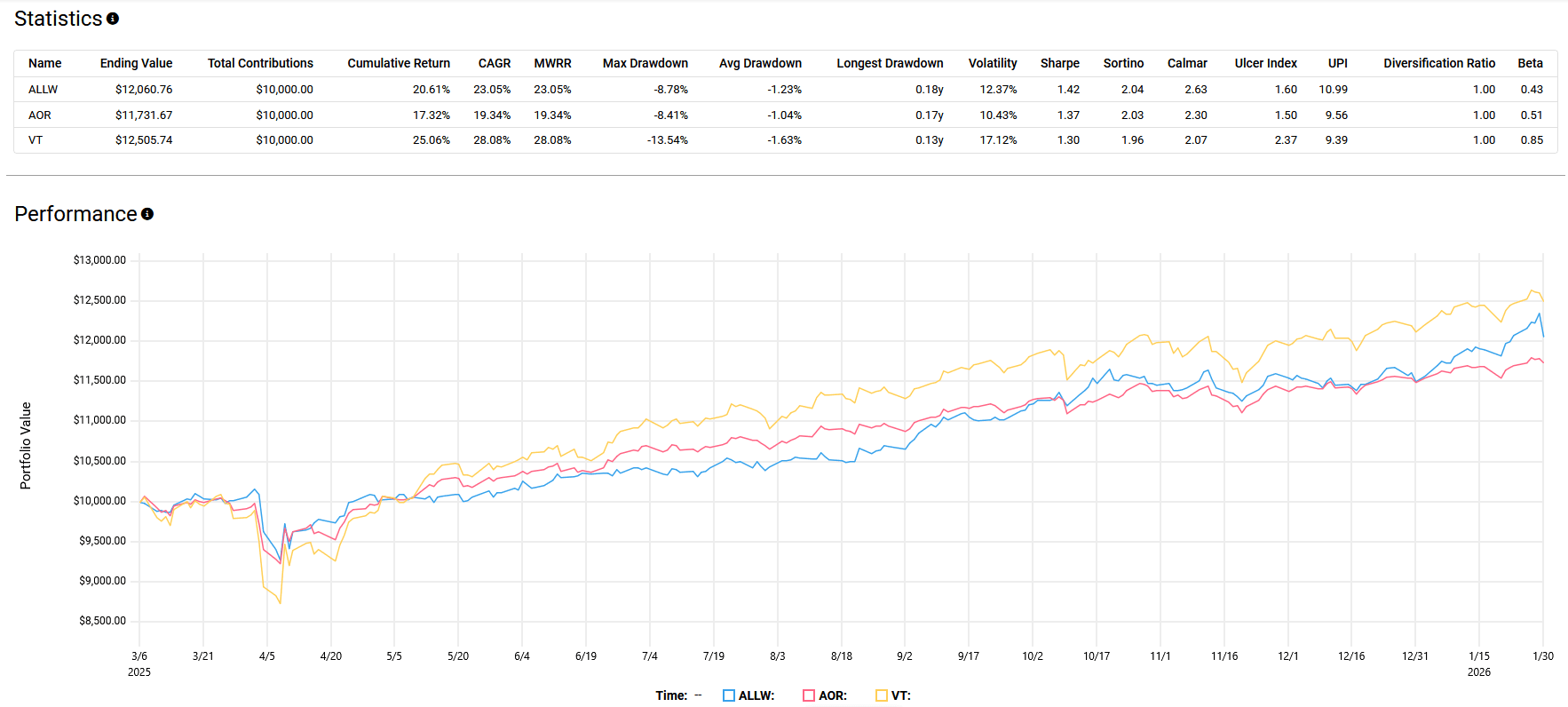
Despite its short track record, early results have been encouraging. From March 6, 2025, through January 30, 2026, ALLW delivered higher risk-adjusted returns than both a global 60/40 portfolio and a global all-equity portfolio, with lower maximum drawdowns. That is consistent with its mandate to act as a steady anchor holding rather than a return-chasing vehicle.
There are trade-offs. The 0.85% expense ratio is elevated. Leverage introduces additional complexity and potential vulnerability if correlations spike across asset classes. Tax efficiency can also be a concern in taxable accounts due to capital gains distributions.
Even with those caveats, as an 80% core allocation, ALLW serves as the regime-diversified backbone of this updated Cockroach Portfolio. It replaces multiple defensive sector ETFs, gold, and Treasuries with a single, globally diversified, macro-aware structure designed to survive a wide range of outcomes.
CAOS (20% Allocation)
Hedging tail risk usually comes with a cost. When markets are calm, most tail hedges steadily lose money. Long VIX futures bleed from contango. Laddered put options decay from theta. You are effectively paying an insurance premium month after month in exchange for protection.
CAOS attempts to reduce that structural drag. The strategy, originally launched in 2013 as mutual fund AVOLX and later converted to an ETF in 2023, uses a three-part framework designed to balance crash protection with positive carry.
First, it holds deep out-of-the-money protective puts, primarily on the S&P 500. These provide convexity. In plain terms, as losses deepen, the payoff accelerates. A small decline may not move the needle much, but a severe crash can generate disproportionately large gains. That is the asymmetric upside investors want in a crisis.
Second, CAOS uses box spreads. These multi-leg index option structures resemble short-term fixed income exposure and generate returns that track prevailing short-term interest rates. The yield from these positions helps offset the negative carry from the protective puts.
Third, the fund sells put spreads. By simultaneously buying and selling puts at different strike prices, CAOS collects premium while limiting both upside and downside from those trades. That additional income further reduces drag.
Put together, these three sleeves create a tail hedge that has historically exhibited positive or at least low-drag returns during normal markets while still delivering crisis alpha during sell-offs. Over recent trailing one- and three-year periods, CAOS has produced positive annualized returns, something many traditional tail risk strategies have struggled to achieve.
There are trade-offs. Compared with a purer hedge like the Cambria Tail Risk ETF (TAIL), which combines Treasuries with laddered put options, CAOS exhibits less explosive convexity during short-lived corrections.
In episodes such as the August 2024 and April 2025 sell-offs, both funds generated positive returns, but TAIL’s spikes were larger. That difference reflects CAOS’s design. The same mechanisms that reduce negative carry also temper upside during moderate drawdowns.
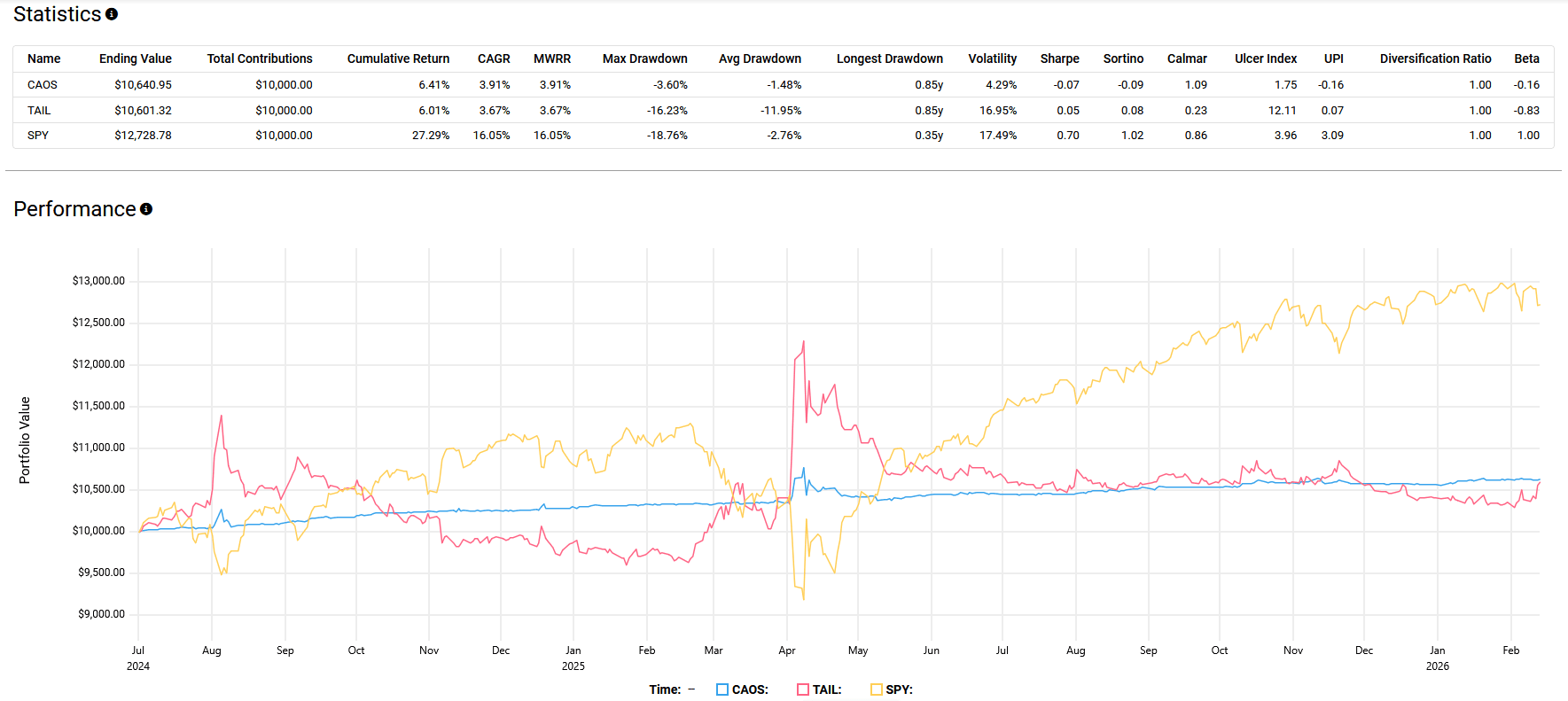
Over longer stretches, CAOS has delivered stronger total returns than more traditional tail hedges precisely because it does not bleed as heavily outside of crises. That makes it better suited as a strategic allocation held continuously rather than a tactical instrument to trade in and out of.
At 20% of the portfolio, CAOS functions as the explicit crash hedge layered on top of ALLW’s regime-diversified core. Together, the two funds aim to replicate the spirit of the original Cockroach Portfolio: survive across environments, reduce reliance on any single economic outcome, and improve risk-adjusted returns over a full cycle.
Backtest: Active Cockroach vs. Original Cockroach
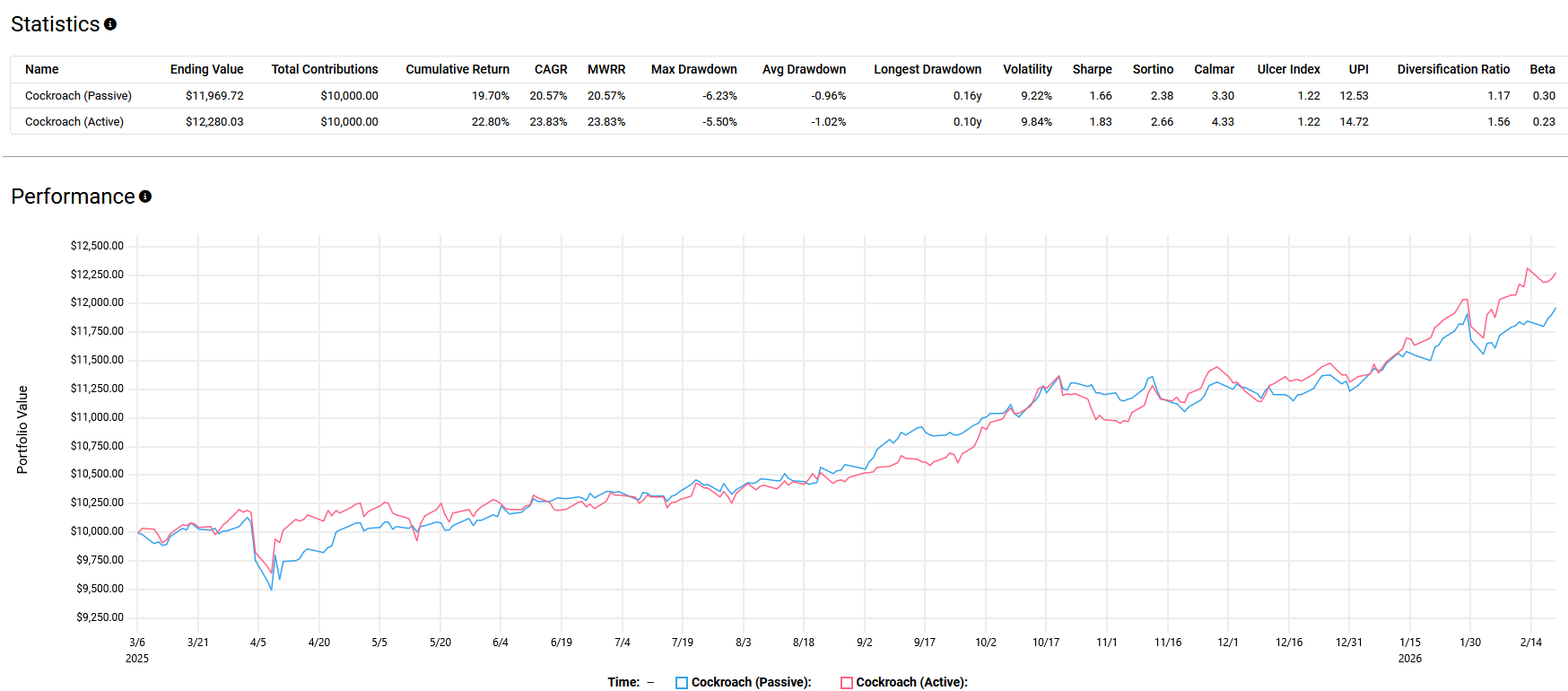
The main limitation here is history. The ALLW/CAOS combination only has a common live track record dating back to March 2025, so we are working with just under a year of data. That said, the results were encouraging.
During the April 2025 Liberation Day tariff sell-off, the active combination experienced shallower drawdowns than the original passive Cockroach mix. Over the full period, it also outperformed on both an absolute and risk-adjusted basis.