The BNY Mellon Zero Expense Ratio ETF Portfolio
Last Updated:

Every major asset manager is now rushing to launch ETF share classes of their existing mutual funds after the SEC gave the green light. It was only a matter of time. The ETF wrapper offers better tax efficiency, intraday liquidity, and broader accessibility, so the incentive is obvious.
Personally, I would still like to see Fidelity Investments take it a step further and bring ETF share classes of its popular Fidelity ZERO mutual funds to market.
Those funds already charge a 0% expense ratio, require no minimum investment, and come with no sales loads. That is made possible by tracking proprietary indexes, which avoids licensing fees, along with cost offsets from securities lending and efficient index sampling instead of full replication.
That said, Fidelity does not get everything right. Charging a $100 “servicing fee” surcharge on certain ETF purchases feels anti-competitive and undermines some of that low-cost appeal.
If you want a truly zero-cost portfolio without relying on mutual funds, there is now an ETF-based alternative through BNY Mellon. The firm offers two ETFs, one focused on large-cap U.S. equities and another on aggregate U.S. bonds, both with a 0% expense ratio.
Unlike mutual funds, these ETFs trade throughout the day with bid and ask spreads just like stocks, making them easy to buy, sell, and rebalance. Here are the two you can use to build a simple 80/20 stock and bond portfolio at effectively no cost, assuming you are not paying brokerage commissions or taxes.
BNY Mellon U.S. Large Cap Core Equity ETF (BKLC)
BKLC tracks the Solactive GBS United States 500 Index Total Return. It is not the S&P 500. That distinction matters more than you think.
The S&P 500 uses a committee-based approach that decides which companies are included, with considerations around liquidity, trading volume, profitability, and overall size.
BKLC’s index takes a much more straightforward route. It simply selects the 500 largest U.S. companies at each reconstitution and weights them by market capitalization. The result is a clean, rules-based large-cap exposure without the added layer of human discretion.
Despite that simplicity, this is not a small ETF. It sits at just under $1.2 billion in assets under management, though it still flies under the radar compared to more established names.
Costs are where it stands out. BKLC charges a 0% expense ratio and currently offers a 1.11% 30-day SEC yield. Liquidity is also solid, with a 0.03% 30-day median bid-ask spread.
Performance has held up well. Over the past five years, BKLC has actually delivered a positive tracking difference, returning 12.26% annualized versus 11.77% for its benchmark.
BNY Mellon Core Bond ETF (BKAG)
The remaining 20% of the portfolio goes into BKAG, which tracks the Bloomberg U.S. Aggregate Total Return Index. That benchmark represents a broad slice of the U.S. investment-grade bond market. Like BKLC, BKAG charges no fees
It includes U.S. Treasuries, agency mortgage-backed securities, and investment-grade corporate bonds, all rated BBB or higher, with many holdings in the A to AA range. The portfolio spans a range of maturities but averages out to an intermediate duration, meaning moderate sensitivity to interest rates.
BKAG’s weighted average yield to maturity currently sits at 4.58%. This is not the income you receive, but rather a measure of expected total return if the underlying bonds were held to maturity, which is not how bond ETFs operate in practice.
For income-focused investors, the 30-day SEC yield of 4.42% is the more relevant figure. Liquidity is slightly lower than BKLC, with a 0.07% 30-day median bid-ask spread, but still well within a reasonable range.
Putting the Portfolio Together
The allocation can be adjusted based on your situation. You might go 90/10 if you are more aggressive or 60/40 if you want more stability. I think an 80/20 split strikes a reasonable balance, especially for investors with a longer time horizon.
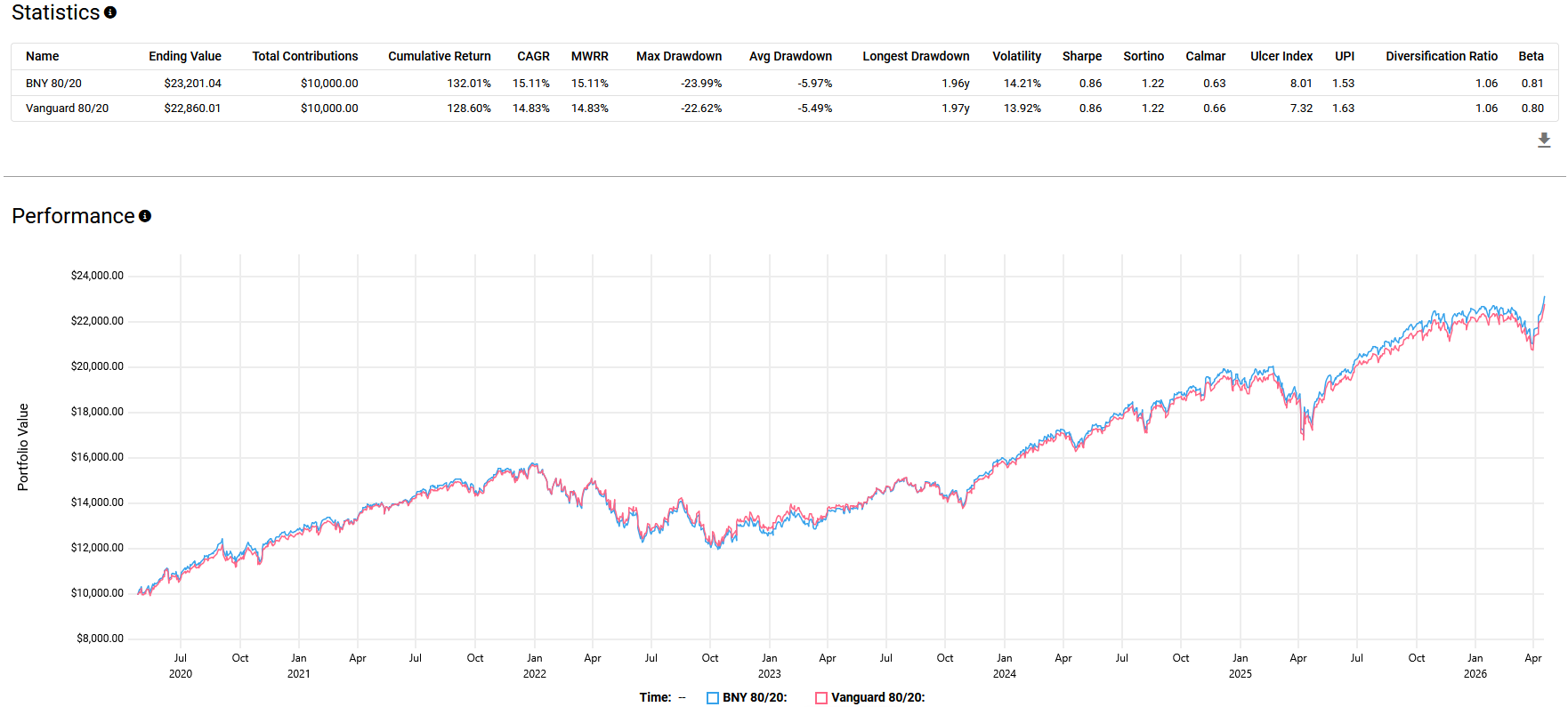
I compared this mix against a similar 80/20 allocation using the Vanguard S&P 500 ETF (VOO) and the Vanguard Total Bond Market ETF (BND). Over a period from April 2020 to today, the BNY Mellon zero-cost portfolio delivered 15.11% annualized, slightly ahead of Vanguard’s 14.83%.
Source: Testfolio.io
Volatility and maximum drawdown were marginally higher, but the Sharpe ratio, which measures risk-adjusted return, was identical at 0.86. At that point, you are splitting hairs.
Bigger and more established ETFs does not always mean better. If you are willing to look beyond the usual names, you can build a portfolio that does the same job for less, or in this case, for no cost at all.