
The Amplify Global Enhanced Dividend Income ETF Portfolio
Last Updated:

I think any article dealing with income-oriented ETFs, especially covered call ETFs, has to begin with one important reality: Distributions are not free money. At the end of the day, total return is what matters.
All else being equal, on the ex-distribution date, an ETF’s net asset value drops by the exact amount set to be paid out later. That is just how fund accounting works.
Still though, I do think these ETFs can serve a purpose. A lot of investors are psychologically uncomfortable selling shares to fund withdrawals in retirement or during periods where they need cash flow. To them, it feels like they are eating into principal.
Covered call ETFs essentially outsource that process. Instead of manually selling shares yourself, the manager uses option premiums and distributions to generate income on your behalf.
The problem is that many covered call ETFs are honestly not very good. After fees and the upside cap inherent to covered call writing, total returns can become pretty mediocre over time. That is especially true with the old-school buy-write indexes that mechanically sell at-the-money calls on 100% of the portfolio every single month regardless of market conditions.
Personally, I dislike that approach. It leaves a lot of upside on the table, and because the methodology is entirely systematic and transparent, it is also fairly easy for market participants to front-run. That is why, in this corner of the ETF market, I actually prefer active management.
In my opinion, the better covered call ETFs sell options on individual securities rather than broad indexes. Managers should be adjusting strike prices, expiries, and coverage ratios dynamically based on conditions such as implied volatility, earnings season, market sentiment, and relative valuations.
There are two ETFs from Amplify ETFs that I think do this fairly well. Both combine active stock selection with a tactically managed options overlay. If you paired them together in a 50/50 allocation, I think they could make for a fairly reasonable globally diversified monthly income portfolio.
Amplify CWP Enhanced Dividend Income ETF (DIVO)
DIVO is one of the standout covered call ETFs on the market right now. The ETF currently holds a five-star Morningstar rating, placing it near the top of the derivative income category among the roughly 80-plus funds currently classified there.
The strategy is managed by Kevin Simpson at Capital Wealth Planning. You may have seen him before on CNBC discussing portfolio positioning and options trades.
At its core, DIVO is a portfolio of large-cap U.S. companies screened for characteristics such as dividend growth and earnings growth. The ETF spans all 10 traditional S&P sectors, although Simpson has discretion regarding which sectors to overweight or underweight depending on market conditions.
From there, the portfolio becomes fairly concentrated. DIVO typically holds around 25 stocks selected based on factors such as market capitalization, management quality, earnings consistency, cash flow generation, and return on equity.
Once the stocks are selected, covered calls are written tactically on individual positions. Unlike passive buy-write indexes that mechanically overwrite the entire portfolio every month, DIVO’s managers can selectively adjust strike prices, expiries, and coverage levels depending on implied volatility, earnings events, and market conditions.
The broad goal here is fairly straightforward: generate roughly 1% to 2% annual yield from dividends and another 2% to 3% from covered call premiums.
As of April 30, 2026, the ETF’s annualized distribution rate sits around 4.75%. That figure is calculated using the most recent monthly payout annualized against the ETF’s net asset value. Of course, distributions can fluctuate month to month depending on option premiums and portfolio activity.
One thing worth noting is that DIVO’s yield is actually fairly restrained compared to many covered call ETFs. You will often see products advertising double-digit yields, but that usually comes at the cost of far more aggressive option overwriting and reduced upside participation.
DIVO feels more like a total return-oriented equity strategy with a modest income overlay rather than a pure income maximization vehicle. Performance since inception has also been fairly respectable. DIVO has delivered roughly 12.58% annualized total returns.
That does lag the broader S&P 500 Total Return Index over the same period, but honestly, that is just the trade-off inherent to covered call investing. You are giving up some upside participation in exchange for current income and lower volatility.
My biggest criticism of the ETF is probably the expense ratio. At 0.56%, it is not outrageous for an actively managed covered call strategy, but it is noticeably more expensive than some competitors like the offerings from J.P. Morgan Asset Management, many of which charge closer to 0.35%.
Amplify CWP International Enhanced Dividend Income ETF (IDVO)
IDVO is essentially the international counterpart to DIVO. Like its U.S.-focused sibling, IDVO also carries a five-star Morningstar rating and ranks near the top of the derivative income peer category.
The strategy follows a very similar framework. Portfolio manager Kevin Simpson screens for high-quality large-cap companies with strong earnings growth, cash flow generation, return on equity, experienced management teams, and histories of dividend growth. The portfolio itself is also somewhat broader than DIVO, usually holding between 30 and 50 companies at a time.
The main difference is geographic exposure. Instead of focusing on U.S. companies, IDVO selects holdings from the MSCI ACWI ex USA Index, giving it exposure to both international developed and emerging market stocks. From there, Simpson applies the same actively managed covered call overlay.
The goal is to generate approximately 3% to 4% annual yield from dividends and another 2% to 4% from option premiums through tactical covered call writing on individual securities. Right now, based on the most recent monthly payout annualized against net asset value, IDVO is yielding approximately 5.95%.
One thing that stands out about IDVO is that, unlike many covered call ETFs, it has actually managed to outperform its benchmark since inception. On a net asset value basis, the ETF has delivered roughly 22.86% annualized returns since launch.
That is pretty impressive for an income-oriented options strategy, especially one focused on international equities, which historically have lagged U.S. markets for much of the past decade.
I think a big reason for this is the flexibility of the active management process. International markets tend to be less efficient than the U.S. market, and implied volatility around individual foreign stocks can often create better opportunities for tactical options selling.
Still though, the biggest drawback here is cost. At a 0.65% expense ratio, IDVO is even more expensive than DIVO. While I do think IDVO has justified its fee better than many competing covered call ETFs so far, that expense ratio is still going to create a noticeable hurdle long term.
Putting the Portfolio Together
This portfolio construction is pretty straightforward. You can adjust the allocations however you want, but for simplicity, I went with a 50/50 split between DIVO and IDVO with annual rebalancing.
To benchmark it, I compared the strategy against a more traditional “Boglehead” allocation consisting of a 50/50 split between the Vanguard Total Stock Market ETF (VTI) and the Vanguard Total International Stock ETF (VXUS).
Over the 3.66-year period from September 8, 2022, through May 8, 2026, the Amplify covered call combination delivered an 18.14% annualized return. That did lag the Vanguard combination slightly, which returned 19.51% annualized over the same stretch.
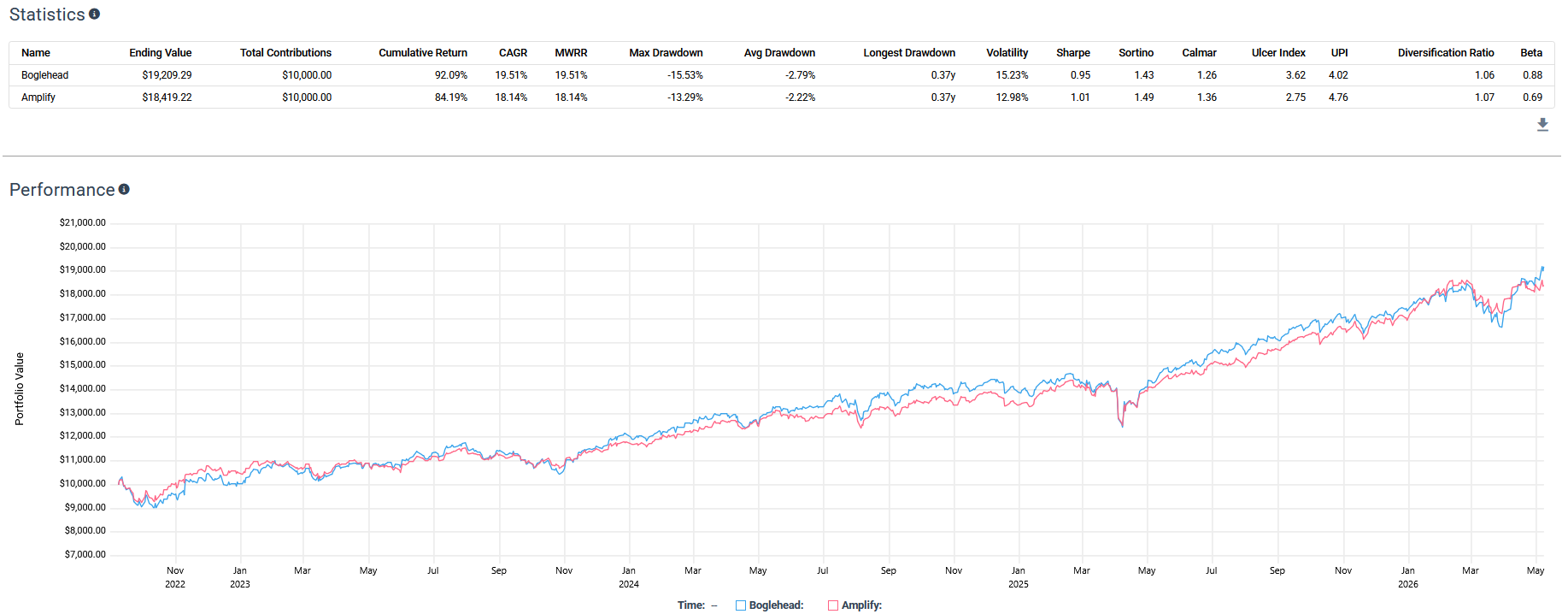
Source: testfolio.io
Honestly though, that is about as good as you are realistically going to get with covered call ETFs. Most covered call strategies tend to lag on both a total return and risk-adjusted basis because the upside cap from the options overlay simply becomes too restrictive over long periods.
The better ones, like DIVO and IDVO, may still trail on raw total returns, but they can at least improve the ride getting there. That is exactly what we saw here.
The Amplify combination actually delivered better risk-adjusted returns with a Sharpe ratio of 1.10 versus 0.95 for the Vanguard portfolio. Maximum drawdowns were also lower at 13.29% compared to 15.53% for the VTI/VXUS mix. Volatility was meaningfully reduced as well, with annualized volatility coming in at 12.98% versus 15.23%.
So, if your goal is simply maximizing long-term capital appreciation, broad market index ETFs are probably still the better choice. But if your objective is generating above-average monthly income while reducing volatility somewhat, I do think the DIVO and IDVO pairing is one of the more reasonable covered call combinations currently available.
Just keep in mind the tax side of things. These strategies generate fairly large ongoing distributions, and depending on the account type and the composition of the payouts, that can introduce noticeable tax drag over time relative to lower-turnover broad market index ETFs.