
Why Do Some Master Limited Partnership (MLP) ETFs Have High Tracking Error?
Last Updated:

The Alerian MLP ETF (AMLP) deserves credit where it's due. It was one of the pioneers in making master limited partnerships (MLPs) accessible through the ETF wrapper.
Instead of purchasing individual MLPs and dealing with the administrative headache of Schedule K-1 tax forms, investors receive a market-cap-weighted basket of many of the largest midstream energy infrastructure companies in a single trade.
That simplicity has proven popular. AMLP has grown into one of the largest MLP ETFs on the market with roughly $12 billion in assets under management and a track record stretching back to August 2010. Income-focused investors have also been drawn to its generous payouts, with the ETF recently offering a 12-month trailing distribution yield of 7.81%.
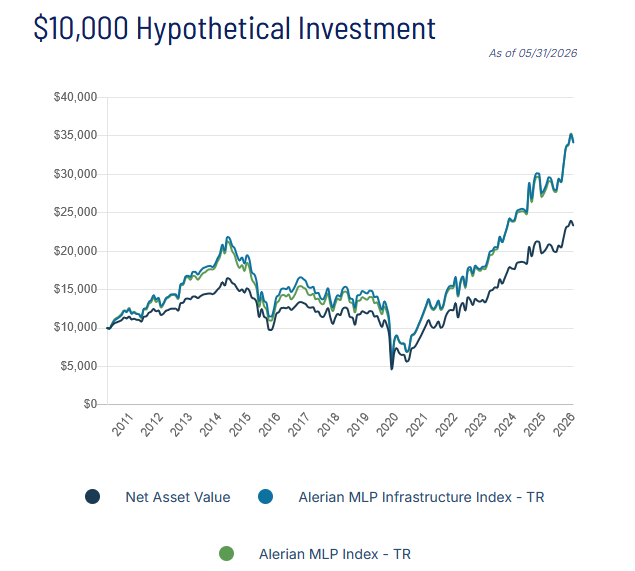
Where AMLP falls short, however, is tracking its benchmark. Over the trailing 10 years, AMLP's net asset value (NAV), assuming distributions were reinvested, compounded at 8.22% annually. Over the same period, the Alerian MLP Index Total Return gained 11.03% per year. So, what explains the difference?
The short answer is that it largely comes down to two factors: high management fees, but more so the unique deferred tax liabilities that affect many pure-play MLP ETFs structured as C-corporations. These costs create a persistent drag on returns that can compound negatively over time, particularly during strong bull markets for energy infrastructure.
Let’s break down exactly how these deferred tax liabilities work, why they contribute to higher historical tracking error, and examine two alternative MLP ETFs that address this structural drawbacks.
The Root Cause of AMLP's Tracking Error
The first source of drag is straightforward: AMLP is expensive. Today, the ETF carries a total operating expense ratio of 1.01%. That consists of a 0.84% management fee plus a 0.17% income tax expense. It is that second component that makes MLP ETFs fundamentally different from most equity ETFs.
Most stock ETFs are organized as regulated investment companies (RICs). Under this structure, the fund itself generally does not pay corporate income tax so long as it distributes substantially all of its taxable income and satisfies certain diversification requirements. Taxation occurs only at the shareholder level.
Pure-play MLP ETFs cannot generally use this structure. Because of U.S. tax rules limiting the amount of MLP exposure a RIC can hold (25%), an ETF seeking to invest almost entirely in MLPs must typically be organized as a C-corporation instead.
That allows the fund to hold a concentrated portfolio of MLPs, but it also means the ETF itself becomes subject to corporate income taxes. Specifically, C-corporation funds pay the 21% U.S. federal corporate income tax at the fund level, reducing the return on each incremental dollar of taxable income before it ever reaches shareholders.
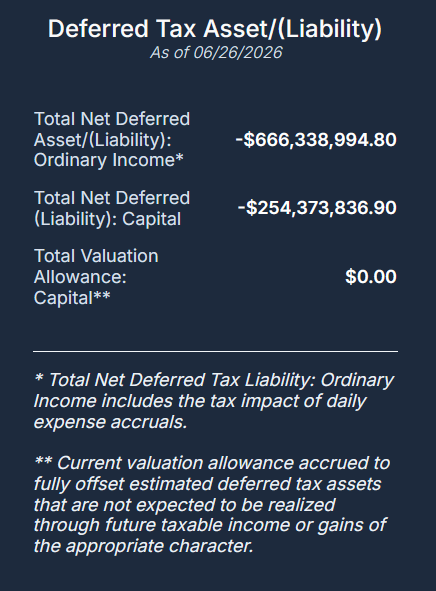
As a result, AMLP must continually account for what is known as a deferred tax liability. As the underlying MLP holdings appreciate or generate taxable income, the fund estimates the taxes it would owe if those unrealized gains were eventually realized. That estimated future tax obligation is reflected each day in the ETF's net asset value (NAV).
Source: ALPS Funds
On the financial statements, investors will typically see this recorded as a deferred income tax expense or, in some periods, a deferred income tax benefit. In addition to reducing returns over time, these deferred tax liability adjustments can introduce additional volatility that is unrelated to the underlying fundamentals of the MLP holdings themselves.
The important point is that these are estimates. The deferred tax balance changes as the portfolio's unrealized gains and losses fluctuate alongside its income. Because both market performance and taxable income vary over time, the deferred tax adjustment cannot be known with certainty in advance.
This creates an unusual performance profile. During strong bull markets, unrealized gains tend to accumulate rapidly. The deferred tax liability grows alongside them, creating an additional drag on NAV that causes AMLP to lag its underlying index by more than management fees alone would suggest.
The opposite can occur during bear markets. As unrealized gains shrink or turn into losses, previously accrued deferred tax liabilities may be reduced or even reversed, producing a deferred tax benefit. In those periods, AMLP can outperform its benchmark because part of the earlier tax drag is effectively released back into the fund's NAV. That makes deferred taxes something of a double-edged sword.
Source: ALPS Funds
Midstream energy infrastructure has enjoyed a very strong run over the past several years amid elevated energy prices and heightened geopolitical uncertainty. While those gains have benefited investors in absolute terms, they have also increased AMLP's deferred tax liability, creating a persistent headwind that has contributed meaningfully to its historical tracking error.
How to Mitigate MLP ETF Tracking Error
Fortunately, there are two ways investors can largely avoid AMLP's structural drawbacks. Which approach is preferable depends on whether your priority is maximizing MLP exposure or focusing on tax efficiency and long-term total returns.
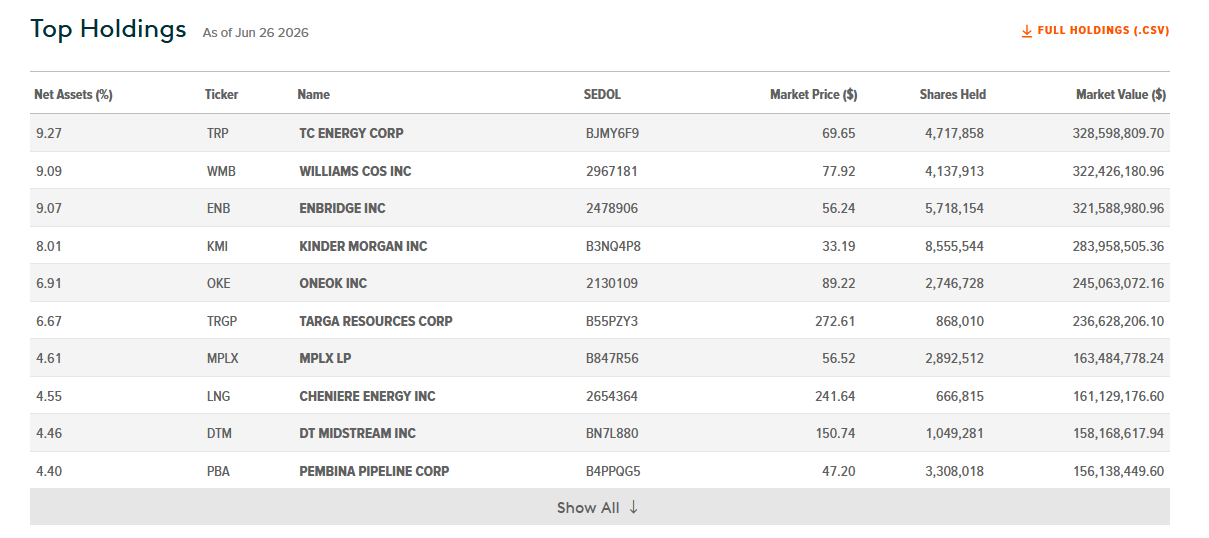
The first approach is to accept a lower degree of direct MLP exposure and instead use a RIC that limits MLP allocations to no more than 25% of assets. One of the better examples is the Global X MLP & Energy Infrastructure ETF (MLPX). MLPX only allocates up to 25% of its portfolio to MLPs, with the remainder invested in midstream energy infrastructure corporations.
Source: Global X ETFs
While these corporations generally don't offer yields quite as high as MLPs, they also avoid the complicated partnership tax rules. Investors who purchase these companies directly likewise receive a standard Form 1099-DIV instead of a Schedule K-1.
The trade-off is income. Because MLPs are pass-through entities that distribute a significant portion of their available cash flow to unitholders, they typically offer higher yields than their corporate counterparts. As a result, MLPX currently sports a more modest 30-day SEC yield of 4.18%.
Still, total return is ultimately what matters. On that front, MLPX has rewarded investors. Over the trailing 10 years, the ETF has generated a 14.2% annualized NAV return, comfortably ahead of AMLP while charging a much lower 0.45% expense ratio.
If you prefer maintaining 100% MLP exposure, there is another option. The Tortoise MLP ETF (TMLP) delivers pure-play MLP exposure while remaining organized as a RIC. Because the fund is structured as an RIC, it avoids both the corporate tax drag and deferred tax liability mechanics that weigh on C-corporation MLP ETFs. The way TMLP accomplishes this is quite unique.
Rather than physically owning the underlying MLP units, the ETF uses a synthetic replication strategy. The portfolio primarily consists of U.S. Treasury bills, which serve as collateral for a total return swap with Goldman Sachs. Under the swap agreement, Goldman Sachs agrees to deliver the performance of the Tortoise MLP Total Return Index, while the fund provides the return generated by its collateral plus the negotiated financing spread.
In effect, investors exchange direct ownership of the MLPs for exposure through derivatives. The primary trade-off is counterparty risk. Instead of relying solely on the performance of the underlying MLPs, investors are also relying on Goldman Sachs to fulfill its obligations under the swap agreement. While this risk is generally mitigated through collateral requirements and daily mark-to-market adjustments, it is still a consideration that does not exist with a physically replicated ETF.
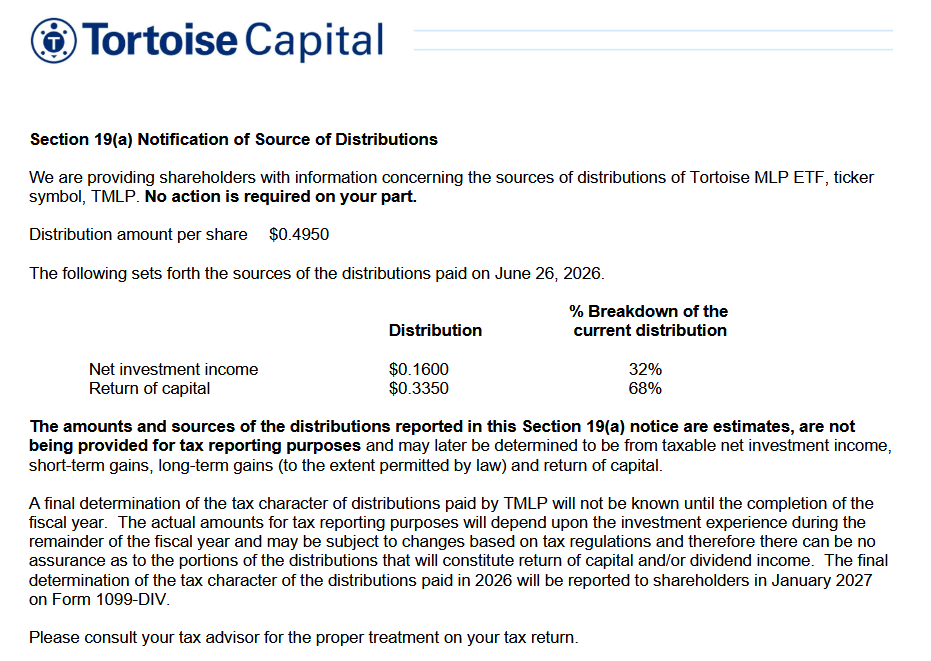
From a tax perspective, however, the structure can be quite efficient. While the final tax character of each year's distributions is only known after investors receive their Form 1099-DIV, the fund's June Section 19a notices suggest that a decent portion of quarterly distributions may ultimately be classified as return of capital.
Source: Tortoise Capital
Return of capital is generally not immediately taxable. Instead, it reduces an investor's adjusted cost basis, effectively deferring capital gains tax until the shares are eventually sold. TMLP also undercuts AMLP on cost, charging a much lower 0.50% expense ratio.