
Inside the JPMorgan Equity Premium Yield ETF (ROCY) and Nasdaq Equity Premium Yield ETF (ROCQ)
Last Updated:

The JPMorgan Equity Premium Income ETF (JEPI) and its higher-risk counterpart, the JPMorgan Nasdaq Equity Premium Income ETF (JEPQ), are not only two of the most popular actively managed ETFs on the market, but also two of the largest derivative income ETFs.
JEPI alone has grown to $45.8 billion in assets under management, with JEPQ not far behind at $39.9 billion. Both funds attracted widespread attention during the high inflation, rising interest rate bear market of 2022. Today, they continue to draw income investors seeking above-average yields.
JEPI offers an annualized distribution yield of 8.38%, while the more volatile JEPQ currently yields an even higher 11.17%. There has always been one notable drawback, however. Both funds obtain their covered call exposure synthetically through equity-linked notes (ELNs).
While this structure has proven effective from an investment standpoint, it has historically been less tax efficient than many investors realize. A significant portion of the distributions from both JEPI and JEPQ has typically been classified as ordinary income, which, outside of tax-advantaged accounts such as a Roth IRA, can meaningfully reduce total returns.
Recognizing that demand for derivative income strategies remains strong, but that investors increasingly care about tax efficiency, JPMorgan Asset Management introduced another pair of companion ETFs in March 2026: the JPMorgan Equity Premium Yield ETF (ROCY) and the JPMorgan Nasdaq Equity Premium Yield ETF (ROCQ).
At first glance, the similarities are obvious. Both charge the same 0.35% expense ratio as JEPI and JEPQ and are still managed by Hamilton Reiner. Dig a little deeper, however, and there are some meaningful differences in both portfolio construction, options overlays and tax efficiency.
ROCY and ROCQ: How They Differ from JEPI and JEPQ
Although ROCY and ROCQ are positioned as companions to JEPI and JEPQ, respectively, there are some meaningful differences in how they construct their portfolios.
On the equity side, ROCQ looks fairly similar to JEPQ. The portfolio remains heavily tilted toward technology and growth stocks, with the bulk of its holdings listed on the Nasdaq. That said, the latest holdings also include a handful of non-Nasdaq-listed companies and American depositary receipts (ADRs), giving the fund a modest amount of out-of-benchmark exposure.
ROCY, meanwhile, differs much more noticeably from JEPI. Whereas JEPI deliberately constructs a more defensive equity portfolio by selecting stocks with lower volatility, ROCY's holdings sit much closer to the composition of the S&P 500 itself. It's still actively managed rather than a pure index tracker, but investors should expect performance to resemble the U.S. large-cap universe.
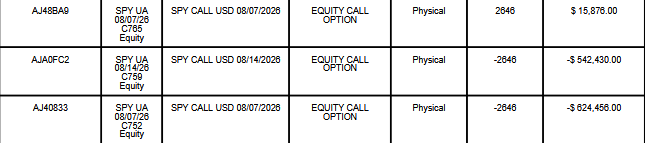
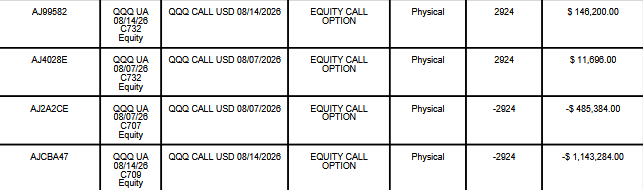
Based on the most recent monthly distributions, ROCY currently offers a 7.41% annualized distribution yield, while the more volatile ROCQ pays a higher 10.50%. The biggest distinction, however, lies in how the two ETFs generate income. Rather than synthetically obtaining their option exposure through ELNs, both funds use physically replicated index ETF option positions built around call spreads.
As of the latest portfolio disclosure, ROCY primarily uses listed options on the State Street SPDR S&P 500 ETF Trust (SPY). That's a sensible choice given SPY's exceptional options liquidity, deep open interest across hundreds of strike prices, and the availability of daily option expiries.
Source: JP Morgan Asset Management
ROCQ follows the same philosophy using listed options on the Invesco QQQ Trust (QQQ). Like SPY, QQQ boasts one of the deepest options markets in the world, providing ample liquidity, numerous available strike prices, and daily expirations that give portfolio managers considerable flexibility.
Source: JP Morgan Asset Management
One interesting alternative JPMorgan could have considered would have been using cash-settled SPX and NDX index options instead. Those contracts are treated as Section 1256 contracts, meaning gains and losses generally receive the more favorable 60/40 tax treatment regardless of holding period. But that’s an analysis for another day.
Why Pick ROCY or ROCQ over JEPI and JEPQ?
One trend I've been watching in recent years is the growth of relatively tax-efficient derivative income ETFs. NEOS Investments has been particularly active here through products such as the NEOS S&P 500 High Income ETF (SPYI) and NEOS Nasdaq-100 High Income ETF (QQQI) that pay high return of capital.
Return of capital can be preferable to ordinary income in a taxable account because it generally is not taxed immediately. Instead, it reduces your adjusted cost basis, effectively deferring the tax liability until you eventually sell the ETF. At that point, the lower cost basis results in a larger capital gain.
Used constructively, rather than simply to prop up an unsustainable distribution, return of capital can therefore provide a tax-efficient source of cash flow. It is not tax-free income, but it can give investors greater control over when the tax bill ultimately comes due. ROCY and ROCQ appear designed to compete directly in this increasingly tax-conscious segment of the derivative income market.
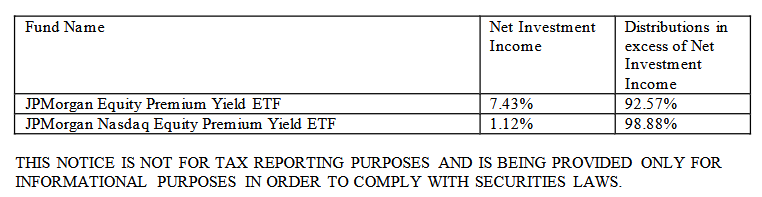
According to JPMorgan's June 1, 2026, Section 19a notice, ROCY received an estimated 7.43% of its distributions from net investment income, with the remaining 92.57% in excess of net investment income. For ROCQ, only 1.12% came from net investment income, while 98.88% exceeded it. But this does not automatically mean those excess distributions will ultimately be classified as return of capital
Source: JP Morgan Asset Management
The Section 19a figures are preliminary estimates rather than final tax classifications. JPMorgan explicitly notes that investors will not receive the official breakdown between ordinary income, qualified dividends, capital gains, and return of capital until Form 1099-DIV is issued in February 2027 for the 2026 tax year. The final characterization could differ significantly from the interim notice.
Still, the intended benefit is clear. If you like the general strategy behind JEPI and JEPQ but are less enthusiastic about receiving distributions that may be heavily taxed as ordinary income, ROCY and ROCQ offer a similar approach designed to seek more tax-deferred yield.
You still receive active management and a disciplined options overlay under Hamilton Reiner's team, while paying the same competitive 0.35% expense ratio. For an ETF industry increasingly focused on after-tax outcomes, that is a welcome development.