
Why I Personally Prefer Actively Managed Covered Call ETFs
Last Updated:

I'm not disputing the results of the S&P Indices Versus Active (SPIVA) scorecards. Across one-, three-, five-, 10- and 15-year periods, the evidence has generally been consistent: most actively managed funds eventually underperform their respective benchmarks.
That finding extends across numerous segments of the equity market. Large-, mid- and small-cap active managers have struggled, as have managers pursuing different styles such as growth and value. Fixed income hasn't been immune either, with SPIVA scorecards covering categories ranging from high-yield and investment-grade corporate bonds to municipal and government debt.
But there is one increasingly popular ETF category that doesn't fit particularly neatly into the conventional active-versus-passive debate: derivative income, and covered call ETFs in particular. There are plenty of established passive covered call ETFs that mechanically follow an index methodology. Yet many of the newer products attracting assets have instead opted for active management.
Unlike traditional stock picking, I think there is a stronger case for active management here because the manager isn't simply trying to identify securities that will outperform. They're also deciding when to sell calls, how much of the portfolio to overwrite, which strikes to use and how far out to go on expiration.
There is also a second factor working in favor of newer active entrants: fees have become increasingly competitive. Investors no longer necessarily have to pay a substantial premium over older, rules-based covered call ETFs to access active options management.
For those reasons, derivative income is one area where I don't think the usual SPIVA argument transfers quite as cleanly. Here's why I generally prefer actively managed covered call ETFs and where I think their flexibility can potentially add value.
Active Covered Call ETFs Can Be Cheaper
Covered call ETFs are something of an exception to the usual rule that active management costs more than passive indexing. Some of the oldest index-based covered call ETFs remain surprisingly expensive, while newer active competitors have entered the market at substantially lower expense ratios.
The Global X S&P 500 Covered Call ETF (XYLD) is a good example. Launched in June 2013, XYLD has grown to approximately $3.35 billion in assets under management. It tracks the Cboe S&P 500 BuyWrite Index, which owns the S&P 500 and systematically writes one-month, at-the-money index calls against essentially 100% of that exposure.
That generates plenty of cash flow. XYLD currently has a trailing 12-month distribution rate of 10.92%. Total return has been considerably less impressive, with an annualized return of 8.36% over the past decade. I'll come back to why its options methodology may have contributed to that shortly. For now, look at the cost. Despite being passive, XYLD charges a 0.60% expense ratio. Running an options portfolio isn't free, and neither is licensing a third-party index.
Compare that with the JPMorgan Equity Premium Income ETF (JEPI). JEPI charges just 0.35% despite being actively managed on both sides of its portfolio. Its managers select a portfolio of stocks emphasizing lower volatility and defensive characteristics, while allocating up to approximately 15% of assets to equity-linked notes (ELNs) that provide exposure to an out-of-the-money S&P 500 covered call strategy.
The Goldman Sachs S&P 500 Premium Income ETF (GPIX) goes even lower at a 0.29% net expense ratio. GPIX maintains S&P 500-oriented equity exposure while actively managing its index options overlay, including how much of the portfolio is overwritten as well as strike and expiration selection.
That makes the fee argument for passive management unusually weak here. An investor can currently pay 0.60% for XYLD's rigid index methodology, 0.35% for JEPI's active stock and options management or 0.29% for GPIX's actively managed options overlay.
Unless some of the older index-based products meaningfully reduce their expense ratios, I think active management has the advantage on cost. Given the substantial asset bases and fee revenue associated with several incumbent covered call ETFs, I'm not particularly optimistic that those reductions will happen anytime soon.
Active Management Provides More Flexibility
Cost is only part of my preference. The bigger issue I have with passive buy-write indices is how inflexible their options methodologies can be.
There is certainly an argument for systematic investing. Rules remove manager discretion, make a strategy easier to understand and can work particularly well when efficiently capturing broad equity markets. But covered call strategies are already inherently high turnover, and every call sold represents a new decision about how much upside to surrender in exchange for a particular premium.
That premium isn't necessarily equally attractive at every point in time. Option prices depend heavily on implied volatility, time to expiration, moneyness and supply and demand. Unlike large-cap stocks, where publicly available information is rapidly incorporated into prices, options markets involve a much larger matrix of strikes and expirations with varying liquidity and volatility skews.
Consider XYLD’s methodology. Selling an at-the-money call against essentially 100% of the S&P 500’s portfolio every month maximizes premium collection, but it also puts a fairly hard ceiling on upside participation. That can become particularly costly during a sustained bull market.
An active manager has several levers available. During a strong bull market, the fund might overwrite only part of the portfolio, allowing the remainder to participate fully in further gains. Calls can be moved further out of the money, accepting less premium in exchange for a higher threshold before upside becomes capped.
Expiration dates can also be staggered rather than concentrating the entire portfolio around a single monthly expiration. Managers can account for upcoming catalysts such as earnings announcements, changes in implied volatility or unusual option pricing before deciding whether writing a call offers adequate compensation.
Active ETFs can even move beyond conventional covered calls. One example is a call spread, where the fund sells one call but simultaneously purchases another at a higher strike. The purchased call costs some of the premium received from the short call, but if the market rallies sufficiently, it can restore upside participation above the second strike.
None of those decisions guarantees better performance. They do, however, give the manager considerably more control over the trade-off between income and capital appreciation than simply selling at-the-money calls against the entire portfolio every month.
What the Nasdaq-100 Covered Call ETFs Show
The past two years provide an interesting stress test for this argument because the environment was generally unfavorable for traditional covered calls. The Nasdaq-100 experienced a strong bull market with relatively subdued volatility for substantial stretches, exactly the type of environment where repeatedly selling away upside can become expensive.
I back tested five Nasdaq-100-oriented derivative income ETFs over this period: the Global X Nasdaq 100 Covered Call ETF (QYLD), NEOS Nasdaq-100 High Income ETF (QQQI), JPMorgan Nasdaq Equity Premium Income ETF (JEPQ), Amplify CWP Growth & Income ETF (QDVO) and First Trust Nasdaq BuyWrite Income ETF (FTQI).
QYLD is the passive outlier. Like XYLD, it follows a predetermined buy-write index methodology and systematically sells at-the-money calls against essentially 100% of its underlying exposure. QQQI, JEPQ, QDVO and FTQI all incorporate active management.
Over the period I tested, every one of those actively managed ETFs produced both a higher absolute total return and a better risk-adjusted return than QYLD. QYLD continued doing exactly what its index required as the Nasdaq-100 rallied, repeatedly exchanging upside participation for option premiums. The active strategies had greater freedom to adjust their overwrites, strikes, expirations or underlying portfolios, depending on the fund.
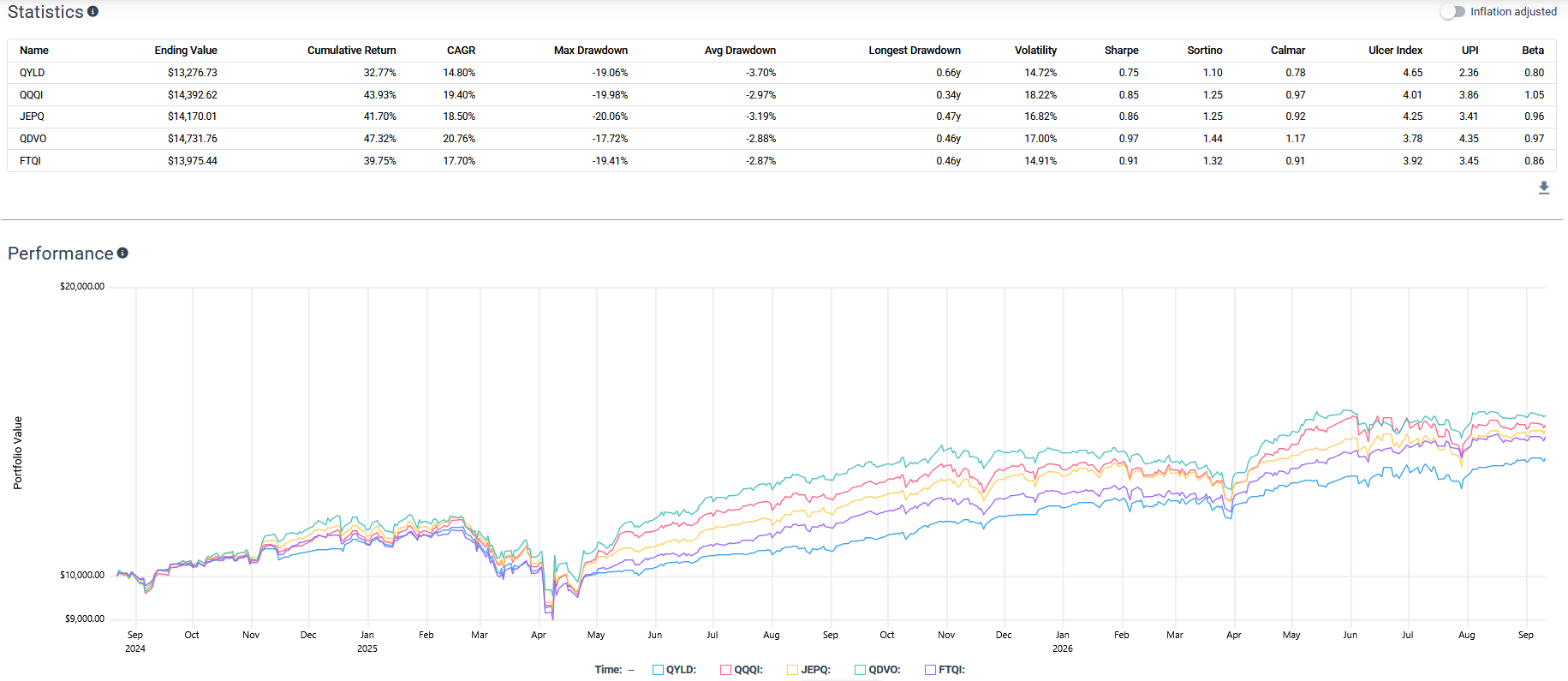
Source: Testfolio
I wouldn't treat this as definitive evidence that active covered call ETFs will always outperform. The comparison period is short, the ETFs don't have identical mandates, and several employ meaningfully different portfolio and options structures. A prolonged sideways or declining market with elevated implied volatility could produce a very different ranking.
Still, the results reinforce why I'm less convinced that the conventional active-versus-passive argument applies cleanly to derivative income ETFs. Stock picking asks a manager to consistently identify securities that an extremely competitive market has mispriced. Active options management involves adjusting a known trade-off between premium income and surrendered upside as market conditions change.
If anyone at S&P Global is reading, I'd genuinely like to see SPIVA extended to derivative income strategies someday. My five-ETF backtest is nowhere near rigorous enough to settle the question. A category-wide study comparing active and index-based covered call funds across multiple benchmarks, market environments and time periods would be far more useful.
Until then, competitive fees and greater control over the options overlay are enough to make me generally prefer active management in this particular corner of the ETF market.