Two Covered Call ETFs That Have Outperformed Their Index ETF Equivalents
Last Updated:

All else being equal, I expect the average covered call ETF to underperform its long-only counterpart over time. Start with fees. You can now get plain S&P 500 index exposure for as little as two basis points annually, while actively managed covered call ETFs can cost many multiples of that.
Then there is the fundamental trade-off of the strategy itself: systematically selling calls generates option premiums but caps some of the portfolio's price appreciation. Whether those premiums adequately compensate for the upside surrendered depends on factors including strike selection, time to expiry and, importantly, the relationship between implied and realized volatility.
Taxes can create another drag. Covered call ETFs frequently make large distributions, and those distributions can generate current tax liabilities in a taxable account. Even return of capital (ROC), while generally not immediately taxable, reduces an investor's adjusted cost basis and therefore typically defers rather than eliminates the eventual tax liability.
Put those factors together and you can throw a dart at much of the covered call ETF universe, backtest the result against a comparable low-cost index ETF, and frequently find that the covered call strategy lagged on a total return basis. That doesn't necessarily make the ETF unsuccessful, since many are explicitly designed to prioritize income or reduce volatility rather than maximize total return.
However, I found two covered call ETFs that have so far managed to clear that higher hurdle and outperform their comparable index ETFs on a total return basis. Both have relatively short track records, so their past performance should not be treated as evidence that the advantage will persist or that either is necessarily the best fund in its category.
Still, credit is due where it's earned. So far, the active options management behind each ETF has added enough value to overcome its higher fees and the usual covered call opportunity cost. Let's look at what it took to make that happen for both of these covered call ETFs.
IDVO: Active Stock Selection and Tactical Covered Calls
For covered call ETFs, I think active management has an inherent advantage over some of the more rigid index-based approaches. A strategy that mechanically sells one-month, at-the-money calls against 100% of its portfolio has little ability to respond to changing volatility, valuations or market conditions. It also places a fairly hard ceiling on upside whenever markets rally strongly.
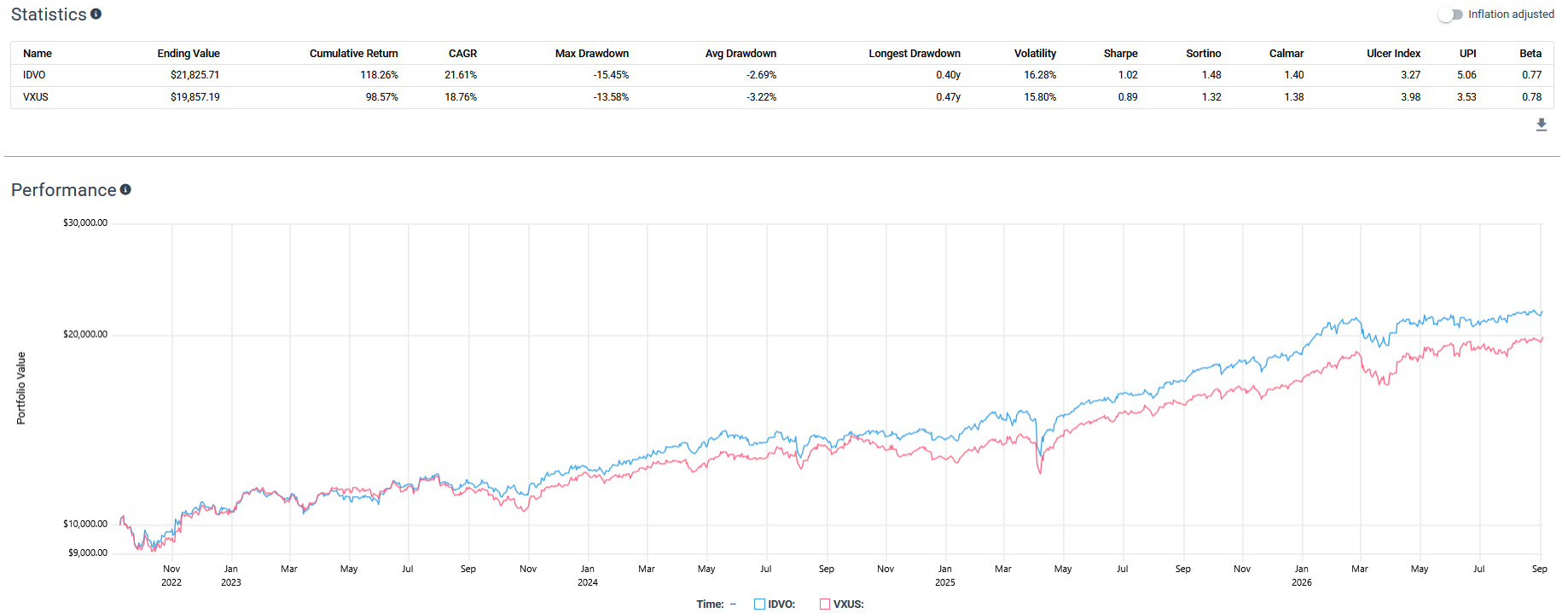
The Amplify CWP International Enhanced Dividend Income ETF (IDVO) takes a much more flexible approach, and so far, it has paid off. According to Testfolio, over the four-year period from September 8, 2022, through September 4, 2026, IDVO delivered a 118.26% cumulative total return. The Vanguard Total International Stock ETF (VXUS) returned 98.57% over the same period.
Source: Testfolio
That's a meaningful hurdle to clear given the difference in costs. VXUS charges just 0.05% annually, compared with IDVO's 0.65% expense ratio. IDVO also produced the stronger risk-adjusted result over this particular period, with a Sharpe ratio of 1.02 versus 0.89 for VXUS.
So how did IDVO manage it? The first component is stock selection. Portfolio manager Kevin Simpson and Capital Wealth Planning construct a concentrated portfolio of roughly 30 to 50 companies selected from the MSCI All Country World Index ex USA universe.
Rather than simply owning the international market, the managers look at factors including earnings growth, free cash flow growth, dividend growth, return on equity, market cap and management quality. They can also tactically overweight countries or sectors where they see greater potential.
The second component is income. IDVO targets roughly 3% to 4% from stock dividends and another 2% to 4% from covered call premiums. Importantly, those calls are written tactically on individual holdings rather than through a fixed portfolio-wide overwrite. The managers can vary which stocks have calls written against them as well as the strike prices and expirations. That gives IDVO considerably more flexibility to balance current option income against participation in further stock appreciation.
Based on its most recent monthly distribution annualized against net asset value, IDVO currently has a distribution rate of approximately 6.1%. That distribution isn't guaranteed and can change, but the more important result so far has been total return. IDVO has managed to generate meaningful monthly income while still outperforming VXUS over its relatively short history.
TDAQ: Using 0DTE Calls Without Giving Up Overnight Exposure
The TappAlpha Innovation 100 Growth & Daily Income ETF (TDAQ) is likely to catch the attention of income investors immediately because of its 17.55% distribution rate. Ordinarily, I'd be particularly skeptical of a covered call ETF paying that much. Very high distribution rates can come with heavily capped upside, and in more extreme cases distributions can coincide with a declining net asset value.
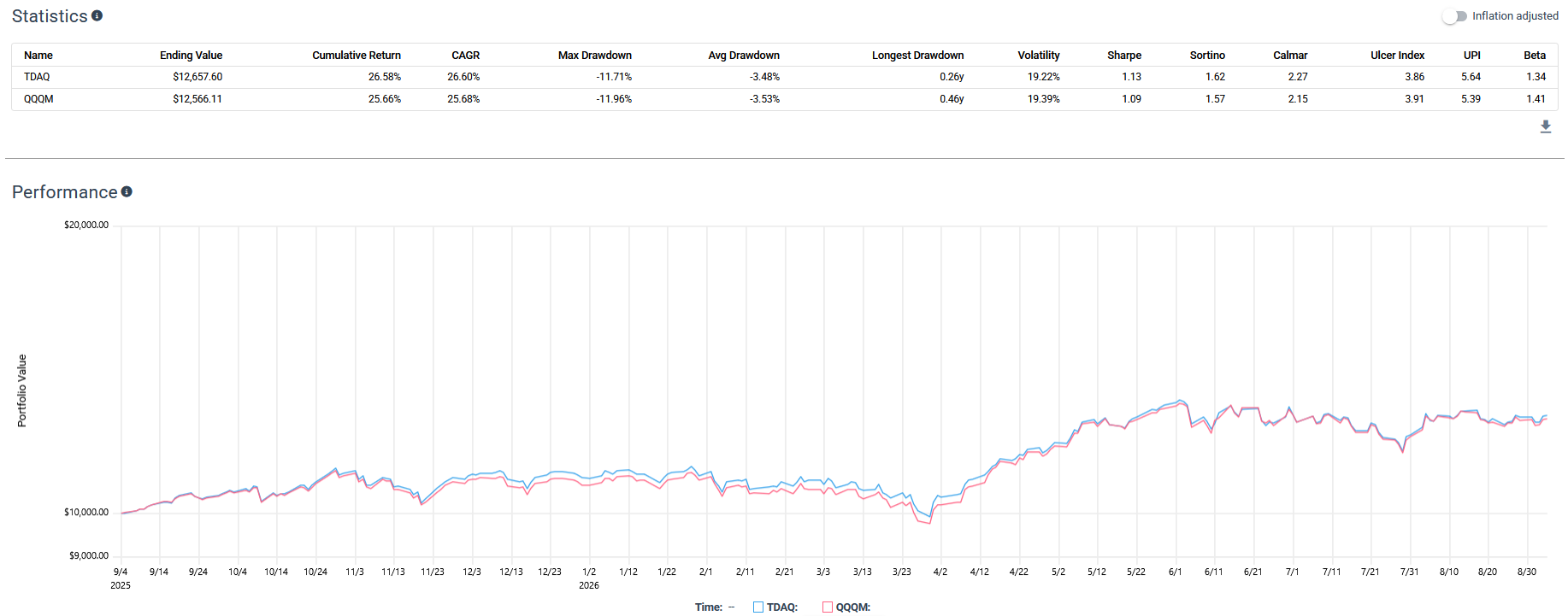
TDAQ also isn't cheap. Its 0.83% expense ratio consists of a 0.68% management fee plus 0.15% in acquired fund fees and expenses. Yet its short track record has so far been surprisingly competitive. According to Testfolio, over the one-year period ending September 4, 2026, TDAQ returned 26.58% on a cumulative total return basis. The Invesco NASDAQ 100 ETF (QQQM) returned 25.66%.
Source: Testfolio
TDAQ also posted a slightly higher Sharpe ratio of 1.13 versus 1.09 for QQQM. The differences are narrow and the comparison covers only one year, but TDAQ has so far managed to overcome both its considerably higher expenses and the opportunity cost normally associated with selling calls.
Its implementation helps explain why. TDAQ obtains its underlying Nasdaq-100 exposure through QQQM, then systematically sells out-of-the-money, zero-days-to-expiration (0DTE) Nasdaq index calls. A 0DTE option expires on the same trading day it is written, giving TDAQ repeated opportunities to collect short-duration option premiums while adjusting its strike selection as market conditions change.
Once the option expires, the portfolio retains its Nasdaq-100 exposure overnight and begins the next trading session without yesterday's call capping it. That structure allows TDAQ to repeatedly monetize intraday premiums while preserving participation in overnight market movements, an important consideration because a meaningful portion of equity returns can occur outside regular trading hours.
There is also a potentially useful tax characteristic for investors holding TDAQ in taxable accounts. Its latest Section 19(a)-1 notice estimated 100% of the distribution as return of capital (ROC). ROC generally reduces an investor's adjusted cost basis rather than creating an immediate tax liability, effectively deferring taxation until the shares are sold or the cost basis reaches zero. However, 19(a) notices are estimates rather than final tax classifications, and investors should rely on the eventual Form 1099-DIV.