
I Bought a Structured Note So You Don’t Have To: Here’s Why I Still Prefer ETFs
Last Updated:
Autocallable ETFs have finally arrived in Canada. After becoming a multibillion-dollar category in the U.S., thanks in large part to Calamos Investments, Canadian investors now have a domestic option in the form of the BMO Strategic Autocallable Income U.S. Large Cap ETF (ZACU), also available in Canadian-dollar hedged units (ZACU.F) and U.S.-dollar units (ZACU.U).
I want to make something clear from the outset. These are relatively complex investment products with higher-than-average fees, and if you've had success building wealth through a broadly diversified portfolio of low-cost index ETFs, you absolutely don't need to add them.
Autocallable strategies involve trade-offs between income, upside participation and downside risk that aren't necessarily appropriate for every investor. That said, some of the U.S.-listed autocallable ETFs I've followed have so far made a reasonable case for themselves. They've generally been able to deliver above-average, tax-efficient income while providing a measure of conditional downside protection.
Just as importantly, the ETF structure brings intraday liquidity, daily portfolio transparency and the ability to buy or sell without committing to a structured product's contractual maturity date. None of those features eliminates the underlying investment risks, but they do make the strategy more accessible.
I can't say I'm nearly as enthusiastic about individual structured notes, and I now have some firsthand experience to explain why. Recently, I purchased a product through CIBC Investor's Edge identified as the CIBC U.S. Large Cap Energy Select Index (AR) Autocallable Deposit Notes, Series 2 (USD) (CBL3162A), along with a market-linked GIC (read my analysis of these over at MoneySense).

I'll tell you upfront that this isn't an investment I expect to repeat. But part of my motivation was educational. I've spent plenty of time analyzing structured products from the outside, and I wanted to experience what buying and holding one actually entails, including the documentation, payoff mechanics, fees and limitations.
As with most investing decisions, there's value in understanding exactly what you're getting into before committing your money. So, here's what I bought, how the note works, what I learned from the experience and why, having tried it myself, I still think ETFs are the better investment overall.
What Exactly Did I Invest In?
This is a principal-protected note. CIBC promises to return 100% of the original principal at maturity, regardless of how poorly the underlying index performs. That protection depends on CIBC's ability to meet its obligations, and the note is not covered by the CDIC. It also doesn't mean you can sell early without taking a loss.
The return is linked to the Solactive United States Large Cap Energy Select Index AR. Despite the name, you're not actually buying the stocks in that index, receiving their dividends or participating directly in their full returns. Instead, you're entering into a contractual payoff arrangement with CIBC, where the amount you earn depends on the index's performance at specific observation dates.
Here's the interesting part. Starting in September 2027, CIBC checks the index annually. If its cumulative performance since issuance is at least 5%, the note is automatically called, and you receive your principal plus a predetermined return. The potential fixed returns are as follows:
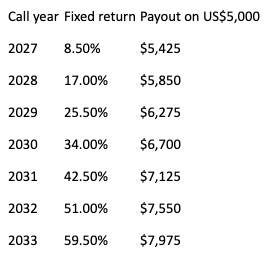
These are cumulative returns, not annual payouts. The table also excludes a small additional participation feature that I'll explain shortly.
For example, suppose the index is up 6% at the first observation date in September 2027. That exceeds the 5% call threshold, so the note terminates in October 2027 and CIBC pays back my US$5,000 plus US$425 in interest. That's an 8.5% return over approximately one year, even though the index itself gained only 6%.
If the index doesn't reach the 5% threshold in 2027, the note continues. If it reaches the threshold at the second observation date, I receive my principal plus a cumulative 17% return. The same process continues annually.
Limited Upside and Seven Years of Opportunity Cost
There's also a small amount of additional upside participation. If the index return exceeds the applicable fixed return, CIBC pays an additional 2.5% of that excess. For example, if the note is called in 2029 when the index is up 35.5%, the fixed return is 25.5%. The extra 10% of index appreciation generate another 0.25% of return, bringing my total payout to 25.75%.
Personally, I find that feature totally underwhelming. The participation rate is so low that even substantial index appreciation beyond the fixed return adds relatively little to the payoff. The more consequential issue is what happens if the index never reaches the call threshold.
Suppose the index remains below 5% at every annual observation date and finishes down 20% in September 2033. I receive my original US$5,000 back, but no investment return whatsoever. After seven years, inflation will have reduced the purchasing power of that money, and I'll have forfeited whatever return I could have earned elsewhere.
There is one unusual wrinkle: if the note survives until maturity and the index finishes at least 5% higher, the fixed return becomes 59.5%, even if the index failed to meet the call threshold at all six earlier observations. That translates into a 6.90% annualized compound return over seven years, before any additional participation.
On paper, that's a reasonable potential outcome for an investment offering principal protection at maturity. The problem is that the attractive payout is conditional, while the opportunity cost of tying up the money is very real.
The Index Has a Built-In Performance Deduction
One of the more important details appears in the index methodology. The reference index is based on the gross total return of the Solactive United States Large Cap Energy Select Index, but its performance is reduced by a synthetic dividend adjustment of 120 index points annually, calculated daily.
At the September 14, 2026, reference level of 4,274.87, that deduction was equivalent to approximately 2.81% of the index's value. Over seven years, the cumulative deduction would amount to 840 index points, or approximately 19.65% of that reference level.
For context, the underlying stocks had a trailing dividend yield of 2.36% at the same date. Investors in the note receive none of those dividends directly.
The 5% autocall threshold applies to the adjusted reference index, not the unadjusted performance of the underlying energy stocks. The deduction creates an additional hurdle that the underlying investments must overcome. Because the adjustment is a fixed number of index points, its percentage impact also changes as the index level changes.
Liquidity Is Another Major Drawback
CIBC intends to maintain a daily secondary market, but it has no obligation to do so and can stop providing one without advance notice. There is no alternative secondary market. Selling early also introduces an explicit trading adjustment.
The note starts with an early trading amount of 3.78% of principal, declining daily by 0.021% until reaching zero after 180 days. On a US$5,000 investment, that initial adjustment represents US$189. And importantly, the note's secondary-market value can already be below its original principal before that adjustment is applied.
This is where I find the comparison with ETFs particularly unfavourable. With an ETF, I can generally see an indicative market price, review the portfolio and trade during market hours. A structured note instead relies on the issuer's valuation and willingness to provide liquidity. Even principal protection doesn't prevent a loss if I need to sell before the contractual maturity date.
So, Is It a Good Deal?
I can see the appeal for some risk-averse investors prioritizing capital preservation. If the adjusted index performs reasonably well and triggers an early call, an 8.5% fixed return for each elapsed year could produce a respectable outcome. The principal guarantee at maturity also removes direct exposure to an index decline, provided CIBC remains solvent and I hold the note until redemption.
But the payoff is asymmetric in ways I don't particularly like. Strong index appreciation delivers only minimal additional participation, while weak performance could leave my money earning nothing for seven years. The synthetic dividend adjustment makes the call threshold harder to reach, and secondary-market liquidity is entirely dependent on the issuer.
There are also embedded distribution and structuring costs that deserve scrutiny. The supplied investment summary doesn't disclose the selling concession or the note's estimated initial value, so I can't quantify the full economic cost from this document alone. That's something I'd want to examine in the complete Information Statement before drawing a definitive conclusion about pricing.
For me, the biggest consideration is opportunity cost. I'm exchanging seven years of flexibility and the possibility of meaningful upside for principal protection at maturity and a conditional return schedule. There are better, cheaper, and more liquid ways to structure this yourself using options or a buffer ETF.
I understand why some investors might accept that arrangement. But after reading the terms, I'm considerably more comfortable owning a transparent, liquid ETF and deciding for myself how much equity risk, income and downside protection I want.