
The Calamos Hedged Income ETF Portfolio
Last Updated:

In October 2025, I wrote about a model portfolio built using two ETFs from J.P. Morgan Asset Management. The allocation was split evenly between the JPMorgan Hedged Equity Laddered Overlay ETF (HELO) and the JPMorgan Equity Premium Income ETF (JEPI), both managed by Hamilton Reiner.
There was a lot to like about the combination. In my backtest, it produced better risk-adjusted returns than a traditional 60/40 portfolio, generated considerably more income, and remained reasonably affordable with a weighted-average expense ratio of 0.425%.
The weak point was tax efficiency. J.P. Morgan's use of equity-linked notes, particularly within JEPI, has historically resulted in a substantial portion of distributions being characterized as ordinary income. That can create considerable tax drag for investors holding the strategy outside a tax-advantaged account.
So, today I'm revisiting the same basic idea: combine a derivative income ETF with a hedged equity ETF and see whether we can improve on the traditional 60/40 allocation. This time, however, I'm using two alternative ETFs from Calamos Investments, with an emphasis on tax efficiency.
Calamos Autocallable Income ETF (CAIE)
Launched in June 2025, CAIE has now crossed its first anniversary and accumulated more than $1.2 billion in assets under management, making it one of the ETFs responsible for bringing autocallable strategies into the mainstream ETF market.
An autocallable note is a structured product whose payoff is linked to an underlying asset, commonly an equity index. In a typical structure, the investor receives an elevated coupon while receiving conditional downside protection through a predetermined barrier. If the reference asset falls through that barrier, however, substantial principal losses can occur. Conversely, if the index reaches a specified level on an observation date, the note can be automatically redeemed early.
CAIE approaches the concept differently. The ETF doesn't directly own individual autocallable notes. Instead, most of its assets are held in the Calamos Tax-Aware Collateral ETF (CBOX) and U.S. Treasury bills. This offsets a total return swap with J.P. Morgan under which CAIE pays the Secured Overnight Financing Rate (SOFR) plus 10 basis points and receives the return of the MerQube U.S. Large Cap Vol Advantage Autocallable Index.
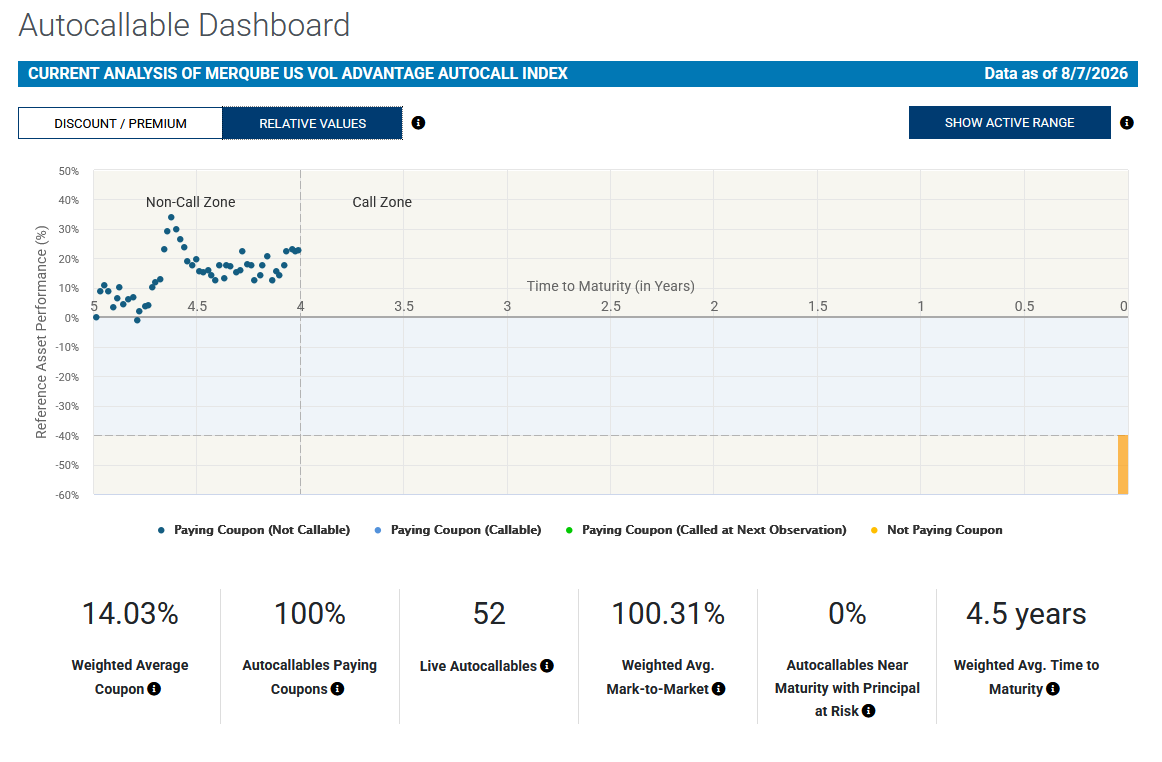
That index is where the actual strategy resides. Rather than relying on a single structured note with one observation schedule and maturity date, it maintains a ladder of at least 52 autocallable exposures. Calamos even provides a dashboard showing how many positions remain live, how many are currently paying coupons, and how many have principal potentially at risk.
Source: Calamos Investments
Economically, the strategy has characteristics similar to systematically selling equity downside risk via puts. Investors collect relatively high coupons in exchange for accepting potentially substantial losses when markets fall far enough. Investors can effectively be compensated for selling risk priced using substantially higher implied volatility than the volatility ultimately realized by the underlying portfolio.
One feature I particularly like is the MerQube index's 35% volatility-control target. Rather than maintaining constant exposure regardless of market conditions, the index can increase exposure during calmer environments and reduce it as volatility rises. The resulting income is substantial.
Based on the most recent monthly payout, CAIE currently has an annualized distribution rate of approximately 14.23%. Importantly, much of that distribution has so far based on 19a-1 notices been characterized as return of capital. That doesn't automatically mean CAIE is destructively handing investors their original investment back to maintain an unsustainable payout.
The ETF can realize gains through its swap exposure while using the tax characteristics of the portfolio to defer portions of distributions. Return of capital generally reduces an investor's adjusted cost basis rather than generating an immediate tax liability, although the final tax characterization isn't known until the year-end 1099-DIV form.
The swap does introduce counterparty risk. In this case, however, the counterparty is J.P. Morgan, a global systemically important bank subject to elevated capital requirements. The arrangement also incorporates a credit support annex, with collateral posted to a segregated account at State Street, helping mitigate the consequences of a counterparty failure.
I prefer this structure to simply buying an individual autocallable note. The 52-plus-position ladder diversifies entry points, observation dates and maturities, while the volatility-control mechanism can dynamically reduce exposure during more turbulent markets. Investors also retain the liquidity and operational convenience of an ETF. However, CAIE does charge a relatively high 0.74% expense ratio.
Calamos Laddered S&P 500 Structured Alt Protection ETF (CPSL)
A lot of investors became understandably skittish about traditional aggregate bond funds after the inflationary, rising-rate bear market of 2022. Duration risk didn't provide the diversification investors expected, with rising yields simultaneously weighing on both stocks and bonds. More recently, relatively tight credit spreads have also reduced the compensation available.
One response has been to replace some or all of the traditional 40% bond allocation in a 60/40 portfolio with short-term, high-quality fixed income such as Treasury bills. Treasury bills have minimal duration and credit risk, while their interest is generally exempt from state and local income taxes. But for investors willing to accept greater complexity and higher fees in pursuit of a different defensive payoff, CPSL is one alternative I think is worth watching.
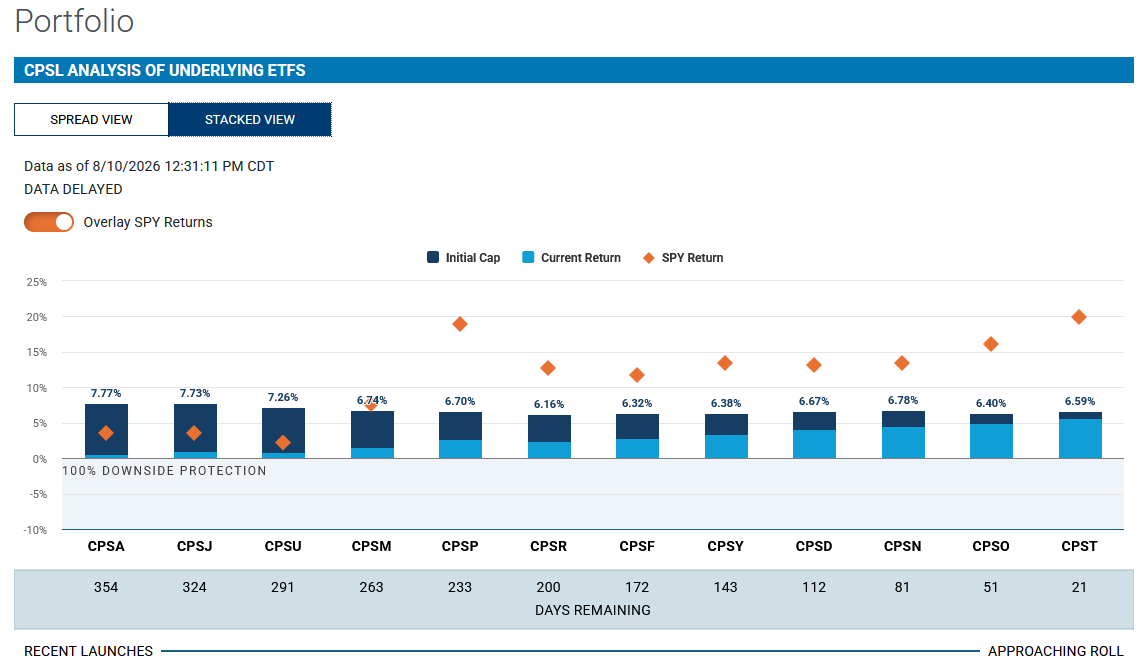
CPSL is a fund of funds that divides its portfolio evenly among 12 monthly vintages of Calamos S&P 500 Structured Alt Protection ETFs. Each underlying ETF uses FLEX options to seek 100% point-to-point protection against losses in the price return of the S&P 500 over a one-year outcome period, before fees and expenses. In exchange, investors accept a predetermined cap on their potential S&P 500 upside.
Calamos also provides a useful dashboard showing the mechanics behind each underlying Structured Alt Protection ETF held by CPSL, including the number of days remaining in its outcome period, its initial upside cap, its current return and the corresponding S&P 500 return. That makes an otherwise complicated strategy considerably easier to monitor.
Source: Calamos Investments
You can buy one of those individual ETFs directly if you want a more precisely defined payoff. Buy at the beginning of its outcome period and hold through the end, and you know the starting cap and protection parameters. CPSL sacrifices some of that precision by combining 12 overlapping outcome periods into a single evergreen portfolio.
For this particular application, I think that's a useful trade-off. By laddering the outcome periods monthly, CPSL diversifies the portfolio across different starting S&P 500 levels, caps and expiration dates. That helps smooth the sequence of returns rather than leaving the entire allocation dependent on what the market happens to do during one specific annual outcome period.
That can be particularly useful during the first several years of retirement, when sequence-of-returns risk is most consequential. A large portfolio decline combined with ongoing withdrawals can permanently impair the capital available to participate in a subsequent recovery. CPSL attempts to reduce that risk by sacrificing some equity upside in exchange for a much narrower range of potential outcomes.
Unlike CAIE, however, CPSL isn't designed to generate income. In fact, the ETF currently makes no distributions at all. The drawback is that investors don't receive the dividend component of the S&P 500's total return, an important contributor to total returns. The advantage is tax efficiency.
With no regular distributions, there's no recurring stream of bond interest or creating an annual tax liability, making CPSL potentially attractive compared with conventional fixed income in a taxable account. That said, CPSL is considerably more complicated than buying a Treasury bill or aggregate bond ETF, and it's also expensive, charging a 0.79% expense ratio.
Putting the Portfolio Together
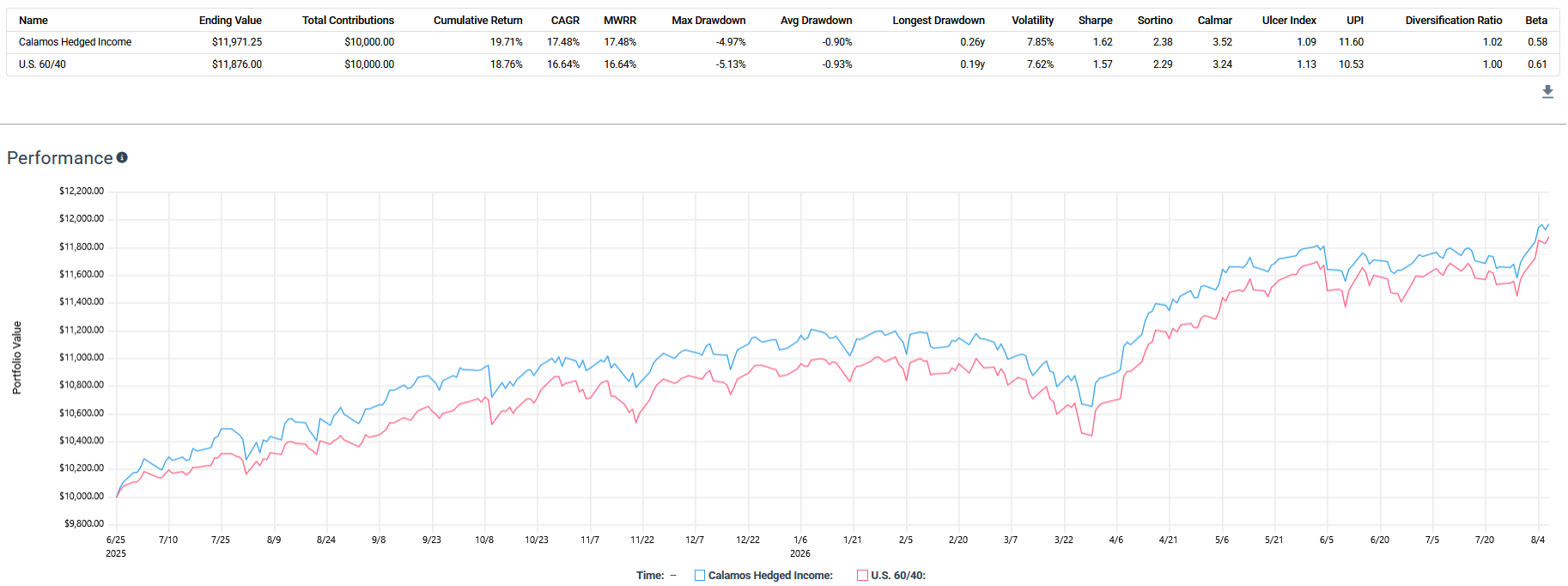
Using Testfolio's backtesting tool, I combined CAIE and CPSL into the Calamos Hedged Income Portfolio and compared it against a traditional 60/40 allocation using the iShares Core S&P 500 ETF (IVV) for equities and the iShares 0-3 Month Treasury Bond ETF (SGOV) for fixed income.
There is only a little more than one year of overlapping performance data to work with because both Calamos ETFs are relatively new, so I wouldn't draw any sweeping long-term conclusions from this backtest. The benchmark is also a fairly high hurdle. IVV charges an expense ratio of just 0.03%, while SGOV costs 0.09%, giving the conventional portfolio a substantial fee advantage from the outset.
Even with that handicap, the Calamos portfolio held up remarkably well. Over the test period, it produced a cumulative return of 19.71% compared with 18.76% for the IVV/SGOV portfolio. The Calamos portfolio also had marginally better risk-adjusted returns, recording a Sharpe ratio of 1.62 compared with 1.57 for the conventional 60/40 allocation.
Source: Testfolio
Of course, that doesn't make the strategy a free lunch. Investors have to be comfortable with considerably more complexity, higher fees, derivatives, swap counterparty exposure, capped equity participation and payoff structures that aren't nearly as intuitive as owning stocks and Treasury bills. Over sufficiently long periods, those higher costs and structural limitations could work against you.
Still, I think the early results make a reasonable case for sophistication when it serves a specific purpose. Here, CAIE is being used to harvest the volatility risk premium for enhanced and potentially tax-efficient income, while CPSL sacrifices equity upside in pursuit of better downside protection. With the limited data available so far, that combination has done what I would want it to do: beat a low-cost 60/40 portfolio on returns while reducing its downside risk capture.