
The NEOS Investments Monthly High Income ETF Trifecta
Last Updated:

When it comes to options-selling strategies, three index ETFs stand above most of the competition for the sheer depth of their options chains.
The State Street SPDR S&P 500 ETF Trust (SPY), Invesco QQQ Trust (QQQ) and iShares Russell 2000 ETF (IWM) all offer an extensive selection of strike prices and expiration dates, backed by substantial trading volume and open interest. The problem is capital efficiency.
With SPY trading around $763 per share, QQQ at $706 and IWM at $297, buying the 100 shares required to sell a single covered call would cost approximately $76,300, $70,600 and $29,700, respectively. Owning enough shares to sell one covered call on all three would require about $176,600.
I think that's one reason options-based ETFs from providers such as NEOS Investments have attracted so much interest. They let investors access a professionally managed, high-income options strategy tied to these major equity benchmarks with a fraction of the capital required to implement covered calls.
Of course, there are trade-offs. You'll pay considerably higher fees than you would for the underlying index ETFs, and selling calls means sacrificing some upside during strong bull markets. Still, for an investor primarily interested in monthly income, the convenience can be compelling.
Let's build a monthly high-income ETF trifecta using three NEOS ETFs tied to the S&P 500, Nasdaq-100 and Russell 2000 and see how it compares with simply owning SPY, QQQ and IWM.
The NEOS ETFs in the Portfolio
For this portfolio, the closest NEOS counterparts are the NEOS S&P 500 High Income ETF (SPYI), NEOS Nasdaq-100 High Income ETF (QQQI) and NEOS Russell 2000 High Income ETF (IWMI).
Right away, you're paying considerably more for the options overlay and active management. SPYI and QQQI each charge a 0.68% expense ratio, while IWMI costs 0.76%. However, the income potential is substantially higher. Annualizing each ETF's most recent monthly distribution against its net asset value produces distribution yields of 12.04% for SPYI, 14.01% for QQQI and 14.38% for IWMI.
All three start with long equity exposure corresponding broadly to their respective benchmarks. NEOS then overlays index options, including call spreads. In simplified terms, the strategy can sell a call to collect premium while purchasing another call at a higher strike. Compared with simply selling a covered call, that higher-strike long call can restore some participation if the market rallies far enough.
There are also some potentially useful tax characteristics. The ETFs use index options treated as Section 1256 contracts, for which gains and losses generally receive 60% long-term and 40% short-term capital gains treatment regardless of holding period. NEOS also employs tax-loss harvesting within the portfolio.
That combination has historically allowed a large portion of distributions to be estimated as return of capital (ROC). According to the August Section 19a-1 notices, an estimated 100% of QQQI's distribution, 97% of SPYI's and 100% of IWMI's was ROC.
Return of capital generally isn't immediately taxable. Instead, it reduces your adjusted cost basis, potentially deferring the tax liability until you eventually sell your shares. Once your basis reaches zero, however, additional ROC becomes taxable as a capital gain. And importantly, Section 19a-1 notices are estimates. The final tax character of distributions isn't determined until after the tax year closes.
Putting the High-Income Trifecta Together
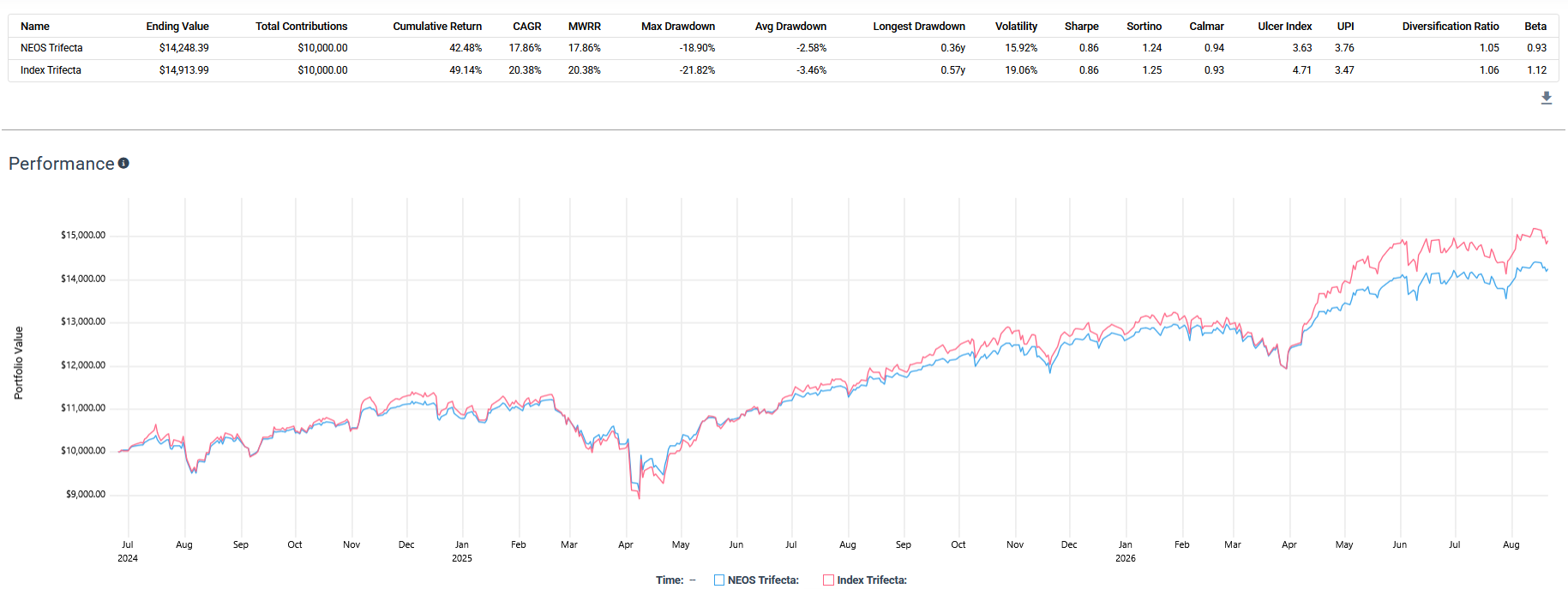
I'm keeping the portfolio construction simple: one-third SPYI, one-third QQQI and one-third IWMI, rebalanced annually. I then compared it with an equally weighted portfolio of SPY, QQQ and IWM.
Source: Testfolio
The vanilla index ETF portfolio won on raw performance over the backtest. It produced a 49.14% cumulative return and a 20.38% annualized return, compared with 42.48% and 17.86%, respectively, for the NEOS portfolio. When stocks keep climbing, repeatedly selling calls can leave money on the table.
Where the NEOS portfolio made up ground was risk. Its annualized volatility was 15.92%, compared with 19.06% for the vanilla portfolio. Maximum drawdown also improved from 21.82% to 18.90%, while average drawdowns were lower as well. Once adjusted for that difference in risk, the gap essentially disappeared. Both portfolios produced an identical Sharpe ratio of 0.86 over the backtest.
I think the call-spread structure deserves some credit here. Buying the higher-strike call allows the ETFs to regain some upside participation following sufficiently large rallies. Active management also means NEOS isn't mechanically required to overwrite the same percentage of the portfolio at the same moneyness and expiration every month.
There is an important caveat: these are pre-tax total returns. Your individual after-tax results will depend on your tax bracket, holding period and the final tax characterization of each distribution. So far, however, the substantial estimated ROC component has made these ETFs potentially more tax-efficient than their headline distribution yields might suggest.
For an investor primarily interested in maximum long-term total return, I'd still favor the vanilla index ETFs. But if you're an income-focused investor who would otherwise buy SPY, QQQ and IWM and sell calls against them yourself, the NEOS trifecta offers an automated and much less capital-intensive way to pursue a similar objective.