Forget Covered Calls: Two Put-Writing Monthly Income ETFs to Watch as a Canadian Investor
Last Updated:

Selling options isn't a free lunch. It's simply another way to transform how you realize risk and return, exchanging certain potential outcomes for others.
Take covered calls, for example. I like to think of selling one as getting paid to place a limit sell order. You collect an option premium upfront and establish a price at which you're willing to part with your shares. The trade-off is that you surrender control over the timing of that sale if assigned, along with foregoing any upside price appreciation beyond the strike price.
Selling a cash-secured put is effectively the opposite. Think of it as getting paid to place a limit buy order. If the underlying stock stays above your strike price through expiration, the option expires worthless, you keep the premium and you're free to repeat the process. But if the stock falls below your strike, you could be assigned and required to purchase the shares, potentially at a steep loss.
My personal philosophy for both strategies is to be comfortable with the underlying investment. With covered calls, I want to own a company I'm willing to hold for the long term, but paradoxically, one I'm also comfortable selling at a predetermined price. With cash-secured puts, I apply the same discipline in reverse. I want to own the company, but only at a strike price I've identified as representing an attractive valuation, even if the market subsequently falls much further.
Canadian exchange-traded fund (ETF) investors are generally more familiar with covered-call strategies. There's certainly no shortage of funds offering monthly distributions by systematically selling calls against their holdings. Cash-secured put-writing ETFs, however, are considerably less common.
That's unfortunate because put writing offers a different risk-and-return profile that some income-oriented investors may find attractive, particularly those who are comfortable assuming equity downside risk in exchange for recurring option premiums.
This week, I want to highlight two of the more notable Canadian-listed put-writing ETFs, offered by BMO Global Asset Management and LongPoint ETFs. Both pay above-average monthly income, but come with higher fees and greater complexity prospective investors should scrutinize before allocating.
BMO U.S. Put Write ETF (ZPW)
The BMO U.S. Put Write ETF (ZPW) has been around for quite some time, having launched in September 2015. ZPW is actively managed and focuses on generating income by writing short-dated, out-of-the-money put options on U.S. large-cap equities.
Despite its longevity, it remains relatively modest in size, with approximately $107.9 million in assets under management. For investors concerned about currency exposure, BMO also offers ZPW.H, which provides Canadian-dollar-hedged exposure. Alternatively, investors holding U.S. dollars can access the strategy through the USD-denominated ZPW.U
Short-dated generally refers to options with relatively little time remaining until expiration, typically a few weeks or less. Out-of-the-money means the put's strike price is below the underlying stock's current market price, providing a degree of downside cushion before the option finishes in the money.
The strategy collects premiums from selling these options, while the remainder of the portfolio is maintained as collateral, primarily through cash equivalents and short-term fixed-income securities.
If the underlying stocks remain above their respective strike prices through expiration, the options expire worthless and ZPW retains the premiums. If prices fall sufficiently, however, the ETF can incur losses on its written puts, potentially offsetting or exceeding the income collected.
In terms of income potential, ZPW currently offers a 9.37% annualized distribution yield based on its most recent monthly payout. However, the use of a managed distribution policy (fixed at $0.125 per share every month since February 2024) means the tax picture can be somewhat complicated for Canadian investors holding ZPW in a non-registered account.
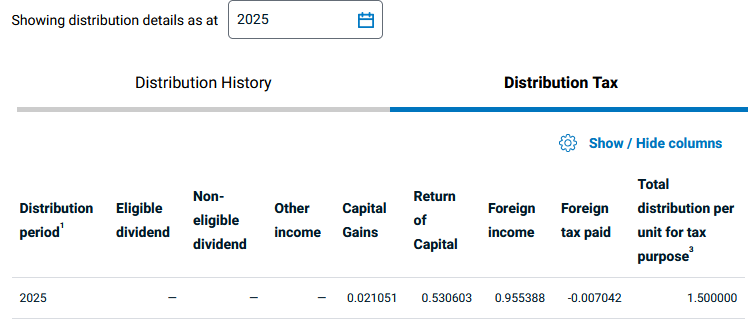
ZPW’s 2025 year-end distribution figures had many different sources, as seen below. Foreign income is generally taxed at an investor's marginal income tax rate without the preferential treatment afforded to eligible Canadian dividends. Return of capital, meanwhile, generally isn't immediately taxable but reduces the adjusted cost base of the ETF units.
Source: BMO Global Asset Management
Consequently, I wouldn't characterize ZPW as particularly tax-efficient, and I'd generally prefer to hold it in a registered account where possible to avoid the admirative headache.
Fees are another consideration. ZPW has a maximum annual management fee of 0.65%, which translates into a management expense ratio (MER) of 0.72% based on its latest audited fiscal year. That's fairly expensive compared with conventional index ETFs, although investors are paying for active options management and the associated collateral portfolio.
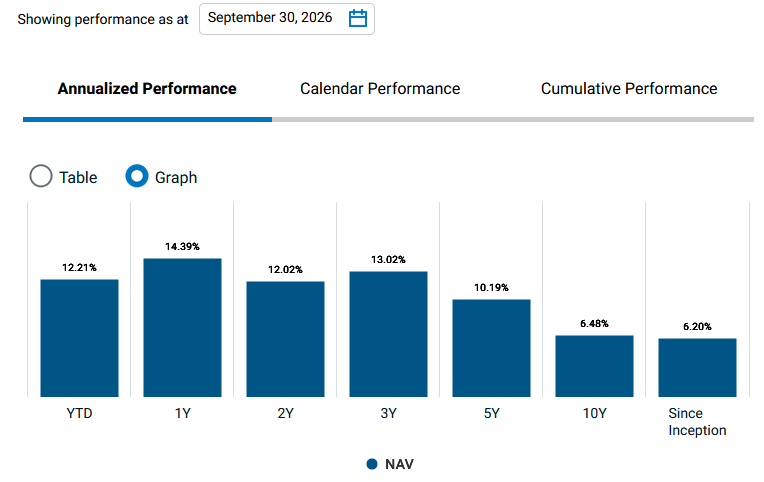
Finally, remember that distribution yield and total return are two very different things. I've included ZPW's historical performance below, and you'll notice that its total returns since inception have lagged those of a conventional U.S. equity strategy.
Source: BMO Global Asset Management
That's understandable given the mechanics of put writing. The ETF collects option premiums but generally doesn't participate fully in sustained equity market rallies. At the same time, it remains exposed to potentially substantial losses during sharp market declines.
I would loosely place ZPW’s expected risk-and-return profile somewhere between conventional fixed income and equities, perhaps comparable in some respects to a preferred share strategy, although the underlying risks and mechanics are quite different.
Moat Active Premium Yield ETF (MOAT)
Competing against ZPW, albeit at a much smaller scale, is the Moat Active Premium Yield ETF (MOAT), with approximately $15.6 million in assets under management. The fund operates through LongPoint ETFs' white-label platform, with Chris Thom of Moat Financial Limited serving as portfolio manager.
Like ZPW, MOAT generates income by selling short-dated, out-of-the-money, cash-secured put options. The collateral backing these positions is maintained primarily in Canadian-dollar cash and short-term fixed-income equivalents. The strategy therefore shares many of the same mechanics and risks, including the possibility of losses if the underlying securities decline substantially below their strike prices.
Where MOAT differs is in its approach to security selection. ZPW can broadly be characterized as a U.S. large-cap blend strategy, while MOAT places greater emphasis on companies possessing durable competitive advantages, commonly referred to as economic moats. The concept may be familiar to investors who follow Morningstar's equity research.
Morningstar identifies five primary sources of sustainable competitive advantage: intangible assets such as brands and patents, switching costs that discourage customers from leaving, network effects that make a product more valuable as its user base grows, cost advantages that competitors struggle to replicate, and efficient scale, where a market can support only a limited number of competitors.
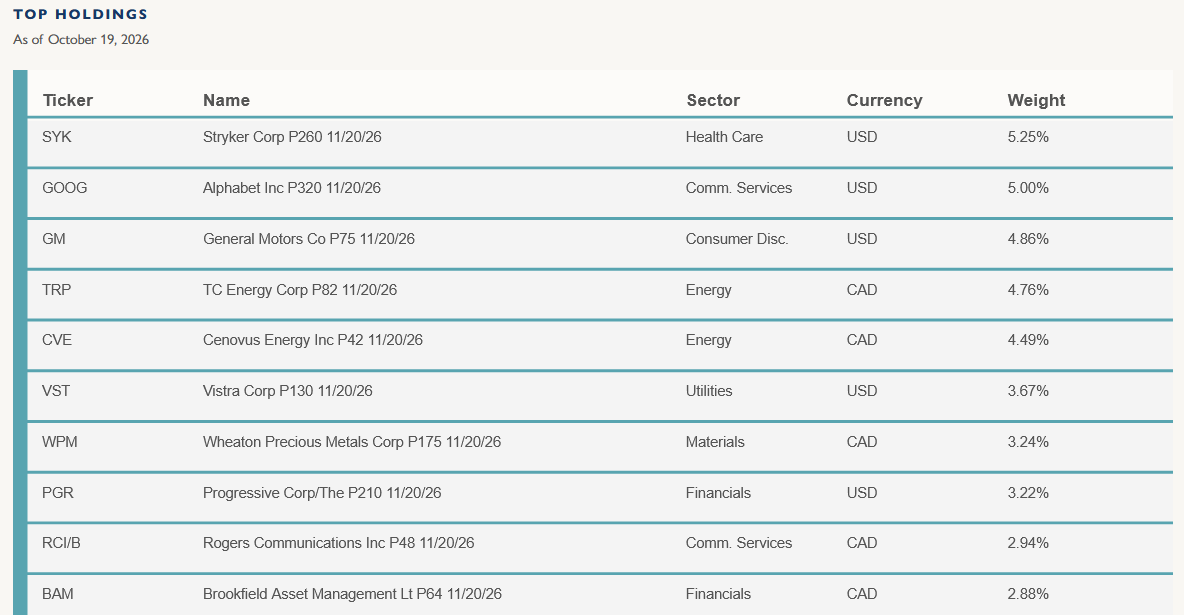
MOAT doesn't follow Morningstar's proprietary framework, but the underlying philosophy is similar. By concentrating on businesses with defensible competitive positions, the strategy targets companies that may be more attractive to own if their share prices decline and the options are assigned.
Source: LongPoint ETFs
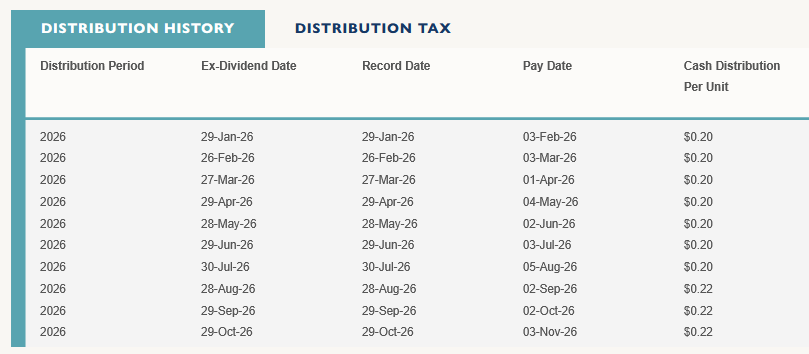
In terms of income, MOAT currently offers considerably more than ZPW, with an annualized distribution yield of 13.37% based on its latest monthly payout. The fund also increased its monthly distribution in August by 10%. That's an encouraging development for income-oriented investors, although I wouldn't extrapolate it indefinitely.
Option premiums depend on factors such as implied volatility, prevailing market conditions and the strikes selected by the portfolio manager. A favorable environment for put writing can support higher distributions, but those payouts can also decline when conditions change. As with ZPW, the distribution rate shouldn't be mistaken for total return.
Source: LongPoint ETFs
There are also some limitations to assessing MOAT at this stage. The ETF hasn't been operating for a full year, so I don't think there's enough performance history to draw meaningful conclusions about its returns, downside behavior or consistency across different market environments.
The same applies to its MER, which hasn't yet been established through a full audited fiscal year. What we do know is that MOAT charges a 0.75% annual management fee, already higher than ZPW's 0.65%. For a rough estimate, applying Ontario's 13% harmonized sales tax to that management fee produces an annual cost of approximately 0.85%. However, that's only an illustrative calculation.
For now, I think MOAT is an interesting alternative for investors who prefer a more selective, quality-oriented approach to put writing and are attracted to its higher monthly distribution rate. The trade-offs are its smaller asset base, limited operating history and potentially higher ongoing costs.