
Two Long/Short ETF Macro Trade Ideas for Active Investors
Last Updated:
I think using single-stock leveraged ETFs to trade around earnings announcements is a perfectly valid strategy, if a somewhat elementary application of these products. They offer a relatively straightforward way to express a bullish or bearish view on an individual company without having to navigate some of the complexities of options trading.
For one, you don't have to worry about correctly estimating implied volatility or accounting for time decay. Leveraged ETFs can also trade during premarket and after-hours sessions, subject to brokerage availability and liquidity. That's particularly useful during earnings season, when many companies report outside regular trading hours and listed equity options markets are generally closed.
Of course, leveraged ETFs introduce their own complications, particularly daily resets, compounding effects and potentially significant tracking differences over longer holding periods. But I think there's also an interesting case for active trading strategies using conventional, non-leveraged ETFs.
The most familiar approach involves ETFs with highly liquid options chains. Investors can buy or sell combinations of calls and puts to generate premium income, hedge downside exposure or speculate on directional movements. Depending on the strategy, these positions can be considerably more sophisticated than simply buying or shorting the underlying ETF.
One approach I see discussed less frequently, however, is the ETF long/short trade, particularly when used to express a macroeconomic thesis. Rather than taking an outright bullish or bearish position on the market, you simultaneously go long one ETF and short another, attempting to profit from the relative performance of the two. The trade can potentially generate a positive return even if both ETFs decline, provided the short position falls more than the long position, although the reverse can also happen.
I think thematic ETFs are particularly interesting instruments for this purpose. Their increasingly specialized exposures make it possible to construct trades around fairly narrow economic developments. With that in mind, I'm going to walk through two hypothetical ETF long/short trades that illustrate how these products can be used to express specific macroeconomic views.
For full transparency, I have not executed any of these trades, am not currently holding them and have no plans to initiate them. This article is purely an informational thought exercise, rather than an instructional trading guide or investment recommendation. The objective is to explore some less conventional applications of ETFs beyond their familiar role in buy-and-hold portfolio construction.
Long DTCR / Short DESK: Data Centers vs. Office REITs
Our first long/short trade involves two different commercial real estate segments: the Global X Data Center & Digital Infrastructure ETF (DTCR) and the VanEck Office & Commercial REIT ETF (DESK).
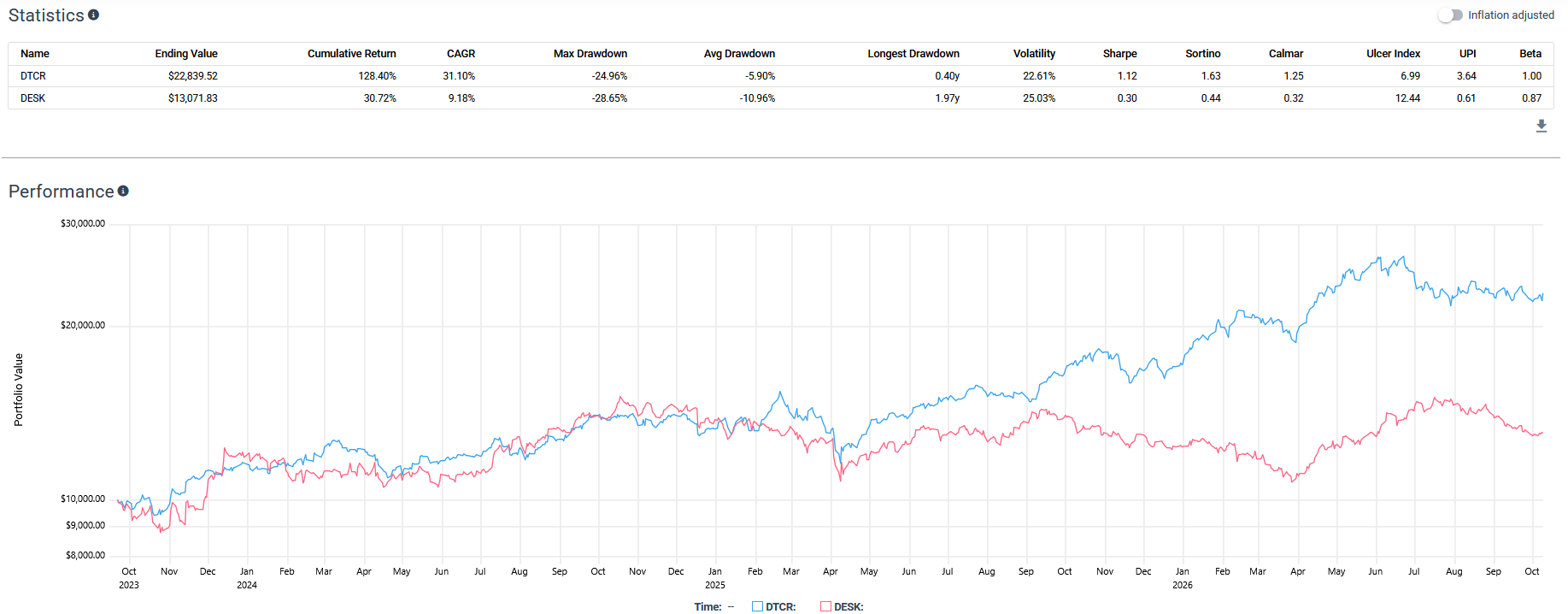
Source: Testfolio
DTCR charges a 0.50% expense ratio and tracks the Solactive Data Center REITs & Digital Infrastructure Index, which holds approximately 25 companies involved in the infrastructure supporting digital communications, cloud computing and data storage. Its holdings include American Tower, Digital Realty Trust, Equinix and Crown Castle.
Although many of these companies are structured as real estate investment trusts (REITs), their growth drivers are quite different from those of conventional commercial landlords. DTCR also pays less income than a typical real estate ETF, with a 30-day SEC yield of approximately 1.50%.
DESK, meanwhile, charges a slightly higher 0.51% expense ratio and tracks the MarketVector US Listed Office and Commercial REITs Index. Its portfolio includes traditional office landlords such as Cousins Properties, Kilroy Realty, Vornado Realty Trust and BXP, formerly Boston Properties. Its 30-day SEC yield is considerably higher at approximately 4.05%.
The proposed trade involves going long DTCR while shorting DESK, expressing the view that digital infrastructure landlords will outperform traditional office landlords. Both are exposed to interest rates and real estate valuations, but the demand drivers for their underlying properties are quite different.
The bullish case for DTCR starts with the continued expansion of AI and cloud computing. Hyperscalers need enormous amounts of computing capacity, and the facilities housing that equipment require specialized cooling, reliable electricity and high-speed connectivity. According to CBRE, North American primary-market data center vacancy fell to just 1.4% in the first half of 2026, even as available capacity increased 33.7% year over year.
That combination could support pricing power for established data center operators, particularly those with access to scarce electricity capacity. The Financial Times has highlighted how power availability and grid bottlenecks are becoming central constraints on further data center development. Existing facilities with secured power connections could therefore become increasingly valuable.
The bearish case for DESK rests on a different set of fundamentals. Hybrid working arrangements have reduced demand for traditional office space, while elevated borrowing costs have made refinancing and property transactions more difficult. The Wall Street Journal has reported on persistent office vacancies and, more recently, commercial real estate transactions being renegotiated as financing costs rise.
The relative-value thesis is that investors may continue assigning higher valuations to landlords benefiting from growing digital infrastructure demand while discounting office landlords facing weaker occupancy, costly tenant improvements and refinancing pressure.
There are several reasons the trade could fail, however. Bloomberg has highlighted emerging risks in data center financing, including dependence on a concentrated group of hyperscale tenants, changing computing requirements and constraints on power availability. AI infrastructure spending could also slow, leaving data center valuations vulnerable.
Meanwhile, the office market is showing signs of recovery. Newmark reported four consecutive quarters of positive U.S. office net absorption through the second quarter of 2026, with vacancy declining to 19.9%. A broader return-to-office movement, stronger leasing activity or lower financing costs could support a rebound in office REITs.
There's also the income differential. Shorting DESK means the trader generally owes payments equivalent to distributions on the borrowed shares, while receiving DTCR's lower distributions on the long position. Using the quoted SEC yields, that creates a 2.55% annual income disadvantage on equally sized positions before borrowing fees. Short-sale losses are also theoretically unlimited.
So, if you're a contrarian, the trade can easily be reversed. Going long DESK and short DTCR would express the view that office real estate is undervalued, its recovery has further to run, and investors have become overly optimistic about the economics of AI infrastructure.
Long CHAT / Short INDY: Generative AI vs. India's Economy
Our second hypothetical long/short trade involves the Roundhill Generative AI & Technology ETF (CHAT) facing off against the iShares India 50 ETF (INDY).
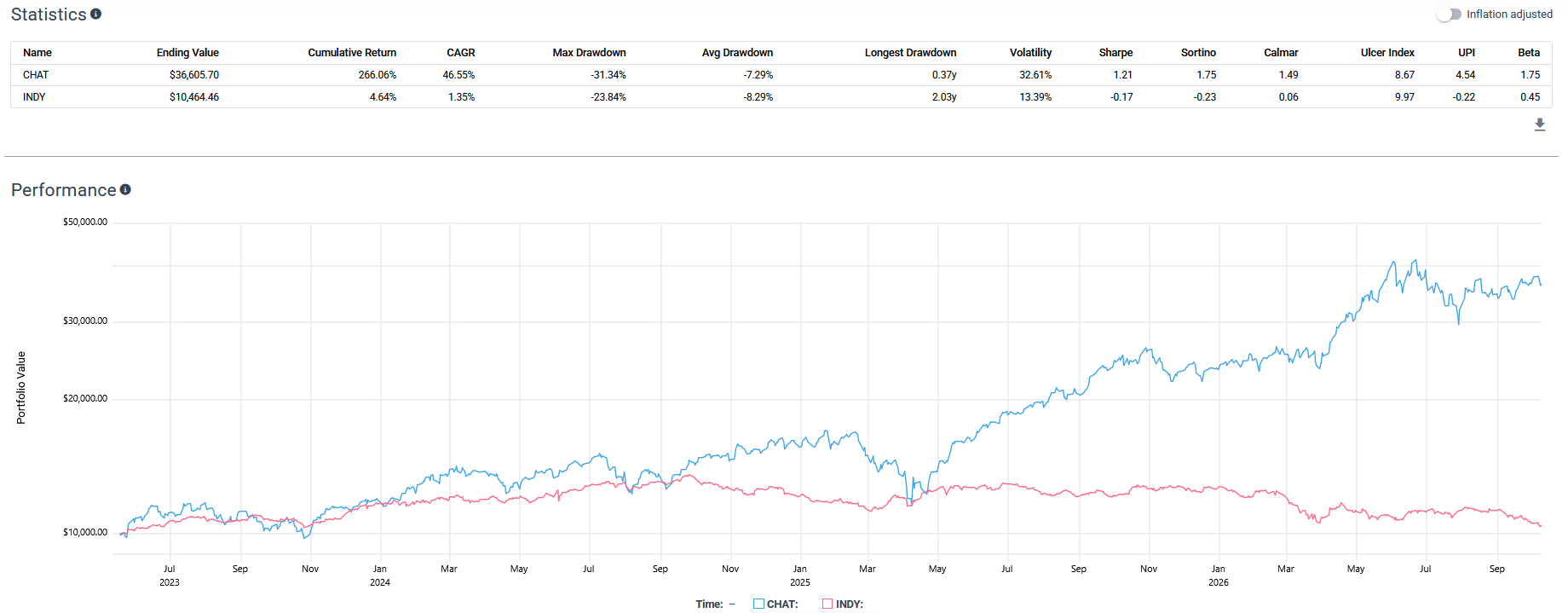
Source: Testfolio
CHAT is actively managed, charges a 0.75% expense ratio and holds 44 stocks selected through Roundhill's proprietary research methodology. Rather than simply screening for companies that mention artificial intelligence, the process incorporates transcript and sector scores to evaluate how relevant generative AI is to each business.
According to Roundhill CEO Dave Mazza, the methodology considers factors including revenue, profitability and research and development investment. The portfolio includes familiar AI leaders such as Nvidia, Alphabet, Microsoft and Amazon, alongside more specialized companies such as neocloud provider Nebius and memory manufacturer SK Hynix.
INDY, meanwhile, is one of iShares' many country-specific ETFs. It tracks the Nifty 50 Index, a market-capitalization-weighted benchmark of 50 large Indian companies. Financials account for approximately 37% of the portfolio, with major positions in HDFC Bank and ICICI Bank.
INDY provides broad exposure to India's largest listed companies, including banks, industrial businesses and consumer-oriented firms. Shorting it therefore expresses a considerably broader view about India's economy than simply betting against its technology services sector.
The underlying thesis is that generative AI could increasingly replace the offshore white-collar labour that has helped power India's economic development, benefiting companies developing the technology while creating headwinds for businesses and workers exposed to automation.
The macroeconomic backdrop begins with India's longstanding position as a global outsourcing destination. For decades, multinational corporations have relocated software development, customer support, accounting, back-office processing and other labour-intensive functions to India to take advantage of its large English-speaking workforce and comparatively low wages.
Generative AI potentially changes that calculation. If a U.S. corporation can automate a meaningful portion of its customer service, programming or administrative workload, the financial incentive to outsource those functions overseas could diminish. The International Monetary Fund has specifically identified India's IT-enabled services industry as vulnerable to automation, including customer service, transaction processing and technical support. It also warns that more AI-ready export markets could increasingly bring automated services back home.
The equity market has already begun wrestling with this possibility. Indian IT services companies such as Infosys and Tata Consultancy Services have faced pressure as investors reassess their growth prospects. Infosys shares, for example, were trading approximately 41% below their February 2026 high as of October 12. U.S.-listed businesses exposed to enterprise software and professional services have also experienced substantial volatility, including Intuit and Accenture, although the latter two have different business models and aren't direct substitutes for Indian outsourcing companies.
I wouldn't attribute all those declines to AI, and a precise year-to-date comparison would require a consistent price and currency basis. More importantly, the disruption narrative has already encountered resistance. Accenture surged 22% following its October 1 earnings announcement after forecasting stronger-than-expected revenue growth, suggesting that helping corporations implement AI can itself be a profitable business. Infosys and Wipro also rallied in sympathy.
Still, the potential long-term implications extend beyond listed IT services firms. India's white-collar outsourcing industry supports employment, household consumption and demand for financial services. If automation reduces hiring or wage growth, the consequences could eventually reach banks such as HDFC and ICICI through slower loan demand or weaker credit quality, particularly among affected borrowers. That is the broader transmission mechanism behind shorting INDY.
On the long side, CHAT offers exposure to companies supplying the computing infrastructure, models and software that could make this substitution possible. The IMF estimates that AI could lift global annual GDP growth by as much as 0.8 percentage points, although translating economy-wide productivity gains into shareholder returns is far from automatic.
The counterargument is that India remains one of the world's fastest-growing major economies. The World Bank recently raised its fiscal 2027 growth forecast to 7.1%, supported by domestic demand and exports. It also identified India's technical workforce and expanding AI investment as competitive advantages, with private AI investment rising from $1.2 billion in 2024 to $4.1 billion in 2025.
Indian outsourcing firms could therefore become beneficiaries of AI adoption by helping customers implement automation, while domestic companies use the technology to improve their own productivity. The IMF estimates that productivity improvements from AI could add between 0.3 and 3 percentage points to total factor productivity across emerging Asia over a decade.
There's also considerable valuation risk on the CHAT side. AI infrastructure stocks already reflect substantial expectations for future growth. A slowdown in capital expenditures, disappointing monetization or a broader rotation away from expensive technology shares could hurt CHAT even if the underlying technology continues advancing.
A contrarian could reverse the trade, going long INDY and short CHAT on the expectation that India's economic growth remains resilient while enthusiasm for AI stocks moderates. The question is whether generative AI ultimately creates more economic value for the companies developing it or for economies such as India that may become major adopters of the technology.